PIB Backgrounder
“White Gold: India’s Cotton Story”
“From Seed to Shirt”
Posted On:
20 JUL 2026 1:05PM by PIB Delhi
Cotton occupies a unique position in India’s agricultural and industrial economy. India is the only country cultivating all four recognised cotton species. It ranks first globally in acreage and second in production and consumption. Cotton production stood at 290.91 lakh bales in 2025-26 (provisional). Domestic consumption reached 328 lakh bales during the same period. The sector contributes nearly 19 percent of global fibre production. Recent interventions focus on productivity, quality, market access and value addition. MSP operations continue to provide price support during market downturns. The Mission for Cotton Productivity aims to raise output to 498 lakh bales by 2031. Technology demonstrations, digital procurement and traceability initiatives are strengthening competitiveness. These efforts are enhancing productivity, improving quality and reinforcing India’s position in the global cotton economy.
|
The Thread That Connects Millions
Imagine fields stretching across India where tiny white blossoms slowly turn into soft clouds of fibre under the sun. From these fields begins a journey that threads through spinning mills, handlooms, and finally reaches wardrobes across the world. Cotton is not merely a crop. It is a thread that binds agriculture, industry, and trade into one continuous story.
Cotton is one of the most important commercial crops cultivated in India. It accounts for around 23 percent of global fibre production. The crop supports the livelihoods of around 6 million cotton farmers. It also sustains employment for another 40-50 million people engaged in related activities such as cotton processing and trade. Beyond clothing, cotton plays a vital role in earning foreign exchange through exports of fibre, yarn, fabrics and garments. Due to its economic importance in India, it is also termed as “White-Gold”.
India’s cotton sector reflects both depth and dynamism. Its strength lies in biological diversity, extensive cultivation, and a robust textile ecosystem. Policy interventions, including MSP operations, the Mission for Cotton Productivity, and Kasturi Cotton Bharat, are reinforcing this foundation. Technology adoption, market reforms, and quality enhancement efforts are further shaping the sector’s future trajectory.
From Swadeshi to Atmanirbhar Bharat
India’s association with cotton stretches back thousands of years. The subcontinent was once a global centre for cotton textiles, trading its fabrics across Eastern and European markets. In ancient times, cotton cloth even functioned as a medium of exchange. This highlighted its economic value and widespread acceptance.
The modern cotton industry began taking shape in the 19th century with the establishment of textile mills in Kolkata, Mumbai, and Ahmedabad. The latter earned the title “Manchester of India”. Expansion gathered pace in the late 19th and early 20th centuries. The Swadeshi movement promoted the establishment of Swadeshi Mills to contest against British goods. Global demand during the World Wars further boosted the domestic industry. By the mid-20th century, the number of textile mills had risen steadily across the country. This resulted in a significant increase in cotton cloth production in the years leading up to Independence. This reflected the expanding scale and resilience of India’s cotton industry.
The Many Dimensions of India’s Cotton Sector
India is the only country that cultivates all four recognized cotton species. These include G. Arboreum and G. Herbaceum, commonly referred to as Asian cotton. The other species are G. Barbadense, known as Egyptian cotton, and G. Hirsutum, known as American upland cotton. Among these, G. Hirsutum accounts for nearly 90 percent of hybrid cotton production in India. All Bt cotton hybrids currently cultivated in the country belong to this species.
|
Bt refers to Bacillus thuringiensis, a naturally occurring soil bacterium. Bt cotton is a genetically modified cotton crop that incorporates genes from this bacterium. These genes provide resistance against bollworms, a major pest affecting cotton cultivation. Introduced commercially in India in 2002, Bt cotton significantly reduced bollworm infestation and lowered the need for insecticide sprays. The combined effect of higher yields and reduced pest control costs contributed to improved farm incomes following its adoption.
|
In addition to botanical diversity, cotton in India is also classified by staple length. This length determines fibre quality and end use. The country produces the full range of staple categories:
|
Staple Categories
|
Staple Length (in mm)
|
|
Short Staple
|
20 and below
|
|
Medium Staple
|
20.5 to 24.5
|
|
Medium Long Staple
|
25.0 to 27.0
|
|
Long Staple
|
27.5 to 32.0
|
|
Extra-Long Staple
|
32.5 and above
|
Geographical Spread of Cotton Cultivation
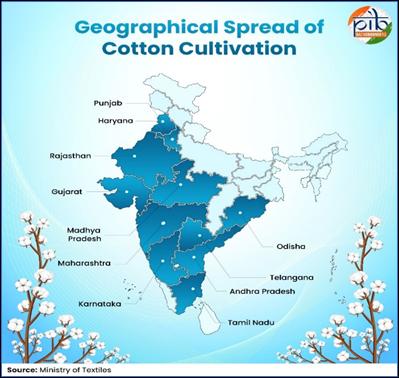
Cotton production in India is largely concentrated in 9 major states, grouped into 3 distinct agro-ecological zones:
• Northern Zone comprising Punjab, Haryana, and Rajasthan
• Central Zone comprising Gujarat, Maharashtra, and Madhya Pradesh
• Southern Zone comprising Telangana, Andhra Pradesh, and Karnataka
In addition to these states, cotton is also grown in Odisha and Tamil Nadu.
India’s Cotton Strength in Area, Production, and Consumption
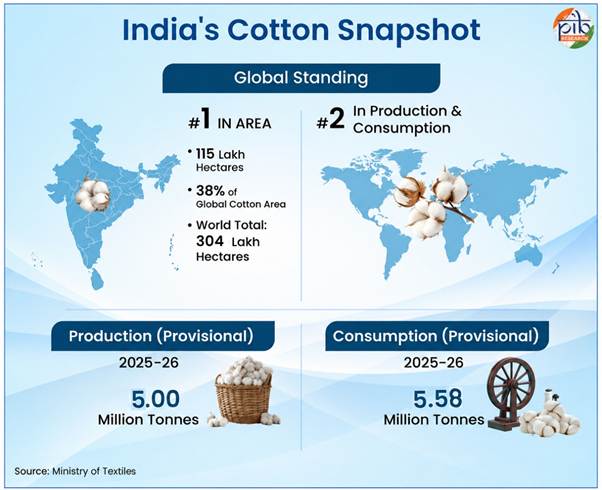
India ranks first in the world in cotton cultivation area (in hectares), with 114.84 lakh hectares devoted to the crop. This accounts for around 38 percent of the global cotton area of 304.08 lakh hectares. A large share of the country's cotton production depends on rainfall, with approximately 62 percent grown in rain-fed regions. The remaining 38 percent is cultivated under irrigated conditions.
India ranks second globally in both cotton production and consumption. This shows the scale of its cultivation base and the strength of its textile industry. Cotton production is commonly reported in bales; it is the standard unit used in the cotton trade. One bale is equivalent to 170 kg. During the 2024-25 cotton season, cotton production pegged at 297.24 lakh bales (5.06 million tonnes). This accounts for nearly 20 percent of global cotton output.
For 2025-26 (provisional), cotton production stood at 290.91 lakh bales (4.95 million tonnes). Domestic consumption, including Micro, Small, and Medium Enterprises (MSME), non-MSME, and non-textile segments, stood at 328 lakh bales (5.58 million tonnes). These reflect India’s prominent position in the global cotton economy.
Cotton Exports and India’s Trade Footprint
India continues to maintain a strong presence in the global cotton trade. In 2024-25, the country exported an estimated 18 lakh bales, equivalent to 0.31 million metric tonnes. This accounts for about 3.37 percent of total world exports, amounting to 541.69 lakh bales (9.21 million metric tonnes). This reflects India’s role as a significant exporter in the international cotton market.
Further, India exports cotton to several major global markets, reflecting strong and diversified international demand. In value terms, cotton exports reached US$ 11.49 billion in FY25. The United States of America emerged as the largest destination for Indian cotton fabrics and made-ups exports, accounting for 26.35 percent of cotton exports. This was followed by Bangladesh at 19.81 percent and Sri Lanka at 5.11 percent. Other important destinations included the United Kingdom, with a share of 2.38 percent, and the United Arab Emirates, at 2.32 percent.
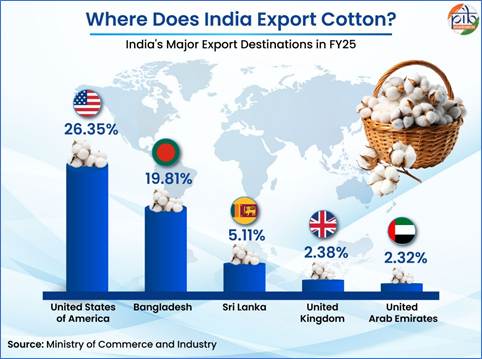
These export patterns highlight the diverse global demand for Indian cotton and reinforce its importance in the country’s agricultural and textile economy.
Building a Competitive Cotton Ecosystem
A multi-pronged strategy has driven the development of the cotton sector. Key priorities include price support, productivity enhancement, technology adoption, and market strengthening. To safeguard farmer incomes and improve the competitiveness of Indian cotton, several targeted initiatives have been undertaken, as outlined below.
Minimum Support Price Operation
Stable returns are essential for sustaining cotton cultivation. The Minimum Support Price (MSP) system serves as a key safeguard for cotton farmers. It ensures remunerative prices when market rates fall below the announced support level. Before each cotton year (Oct. to Sept.), MSP is recommended by the Commission for Agricultural Costs and Prices (CACP). It is announced for Medium Staple and Long Staple varieties of seed cotton (kapas). The objective is to ensure that farmers receive at least 50 percent of their returns on production costs.
Cotton MSP Operations and the Role of CCI
The government has designated the Cotton Corporation of India (CCI) to undertake MSP operations for cotton procurement. It intervenes when seed cotton prices fall below the MSP level. As the central nodal procurement agency, CCI has steadily expanded its operational network. The number of procurement centres increased from 508 in 2024-25 to 571 in 2025-26. These centres cover 152 districts across 11 cotton-growing states.
Strengthening Cotton Farmers through MSP
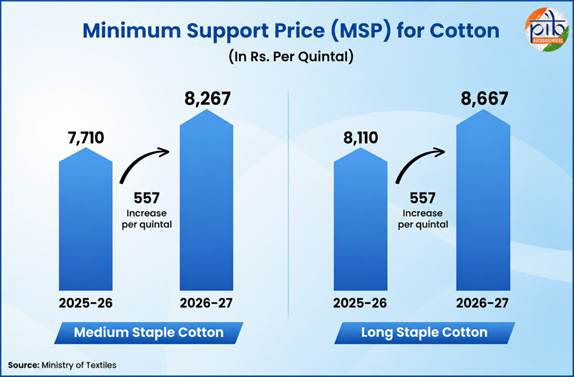
- For 2025-26, the MSP for cotton was fixed at Rs. 7,710 per quintal for medium-staple cotton and Rs. 8,110 per quintal for long-staple cotton. For 2026-27, it was increased to Rs. 8,267 per quintal for medium-staple cotton and Rs. 8,667 per quintal for long-staple cotton. This marked an increase of Rs. 557 per quintal for both varieties.
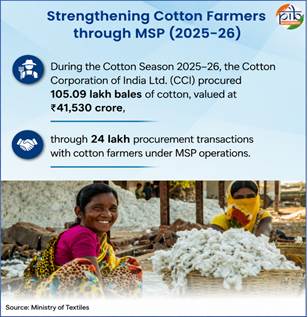
- During the Cotton Season 2025-26, the Cotton Corporation of India Ltd. (CCI) procured 105.09 lakh bales of cotton, valued at Rs.41,530 crore, through 24 lakh procurement transactions with cotton farmers under MSP operations.
Mission for Cotton Productivity
Sustained growth in the cotton sector depends not only on remunerative prices but also on higher productivity. To address this, a five-year Mission for Cotton Productivity was launched in 2025-26 to strengthen cotton production nationwide.
With the provision of Rs. 5,659.22 crore, the mission focuses on research, innovation, and field-level extension support. It aims to develop climate-resilient, pest-resistant, and high-yielding cotton varieties. Special emphasis has been placed on Extra Long Staple (ELS) cotton. These efforts will be supported by advanced breeding and biotechnology tools.
Aligned with the ‘5F’ vision of farm, fibre, factory, fashion and foreign, the initiative seeks to enhance farmer incomes and ensure a steady supply of quality cotton. The mission will cover nearly 24 lakh hectares across 140 districts in 14 cotton-producing states and is expected to benefit around 32 lakh farmers. The Mission also sets ambitious production targets for the coming years. Cotton production is targeted to increase from 297 lakh bales to 498 lakh bales by 2031. Higher productivity is expected to improve domestic cotton availability. It will also reduce dependence on imports and strengthen the textile sector.
Special Project on Cotton under National Food Security Mission
The field-level demonstrations play an important role in improving cotton productivity. Since 2023-24, a Special Project on Cotton has been implemented under the National Food Security Mission (NFSM). It focuses on large-scale demonstrations of technologies suited to different agro-ecological zones. It covers 8 major cotton-growing states across the country. The pilot interventions focus on three key technologies. These include the High-Density Planting System and the Closer Spacing Planting System. Production technology for Extra Long Staple (ELS) cotton is also being promoted. The objective is to improve productivity, fibre quality, and farmer incomes.
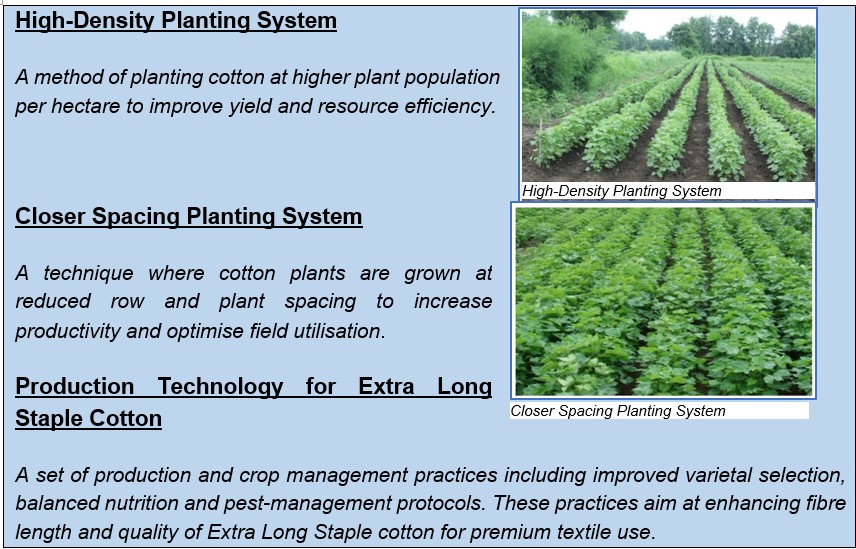
In 2023-24, an outlay of Rs. 41.87 crore covered 9,175 hectares. During 2024-25, Rs. 50.98 crore supported about 14,740 hectares. Field demonstrations recorded yield gains of about 40 percent under the High-Density Planting System (HDPS) and more than 32 percent under the closer spacing planting system. Encouraged by these results, the project was extended to 2025-26 with a total outlay of Rs. 60.32 crore, including committed liabilities. These encouraging field-level outcomes demonstrate the tangible impact of targeted technology interventions on cotton productivity and farmers’ incomes.
|
Success Stories of Special Project on Cotton
High-Density Planting Improves Cotton Yield in Rajkot
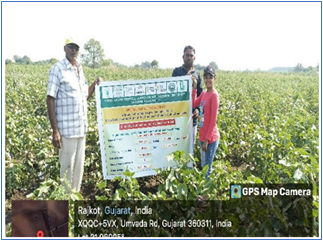
High-Density Planting System adopted by farmers in Rajkot, Gujarat
|
Shri Vinodbhai Virjibhai Vadodriya, a cotton grower from Gujarat’s Rajkot district, adopted the High-Density Planting System under the Special Project on Cotton. He planted cotton at a spacing of 90 cm x 15 cm between plants. This increased the number of plants per acre compared to his earlier method of 135 cm x 45 cm spacing. The intervention resulted in a cotton yield of 15 quintals per acre, with productivity increasing by about 30-35 percent over traditional planting. Early harvesting also helped him reduce losses from pink bollworm. The gains improved farm income and encouraged neighbouring farmers to adopt the technology.
Closer Spacing Transforms Cotton Productivity in Jalgaon
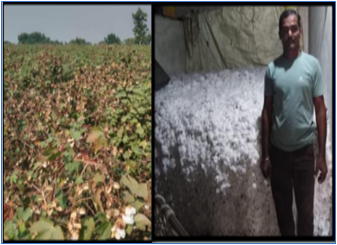
Closer Spacing in Cotton adopted in Jalgaon district of Maharashtra
|
Shri Bhaskar Tapiram Chaudhary, a cotton farmer from Jalgaon district, Maharashtra, adopted closer spacing at 90 cm x 30 cm under the Special Project on Cotton. Improved crop management, recommended fertiliser application and integrated pest and nutrient management were adopted. This intervention strengthened crop growth even under dry spell conditions. The demonstration recorded a yield of 11 quintals per acre compared to 8 quintals under farmer practice. It marked a 37.5 percent increase and improved overall profitability.
|
Kapas Kisan App
Technology is also being leveraged to make cotton procurement more transparent and efficient. The Kapas Kisan mobile application has been introduced to streamline procurement under the MSP system and place farmers at the centre of the process. The platform enables cotton growers to complete self-registration and book procurement slots on a four weeks rolling basis. This has significantly reduced waiting time and eliminated long queues at procurement centres.
With over 41 lakh farmers registered so far, the application has strengthened transparency and efficiency in MSP operations. It facilitates advance slot booking, Aadhaar-linked payments, and real-time SMS updates. These provisions are provided at every stage, from registration and procurement to final payment. By digitizing the process, the app has transformed cotton procurement into a paperless and farmer-friendly system.
Branding of Indian Cotton - Kasturi Cotton Bharat
Kasturi Cotton Bharat is a flagship initiative of the government. It seeks to enhance the value and global positioning of Indian cotton through traceability, certification, and branding. The programme is implemented in partnership with the Ministry of Textiles, the Cotton Corporation of India Limited, and the Cotton Textiles Export Promotion Council (TEXPROCIL). It has a total outlay of Rs.30 crore, with Rs.15 crore contributed by trade and industry bodies and an equal share from the Ministry of Textiles.
Key Highlights
- The Kasturi Cotton Bharat website (https://www.kasturicotton.com/) has been launched as a digital platform for information, updates, and ginner registration. It also highlights the unique processes that set Kasturi Cotton Bharat apart.
- 116 units, including 41 ginners and 75 supply chain members, have renewed registration.
- As of 30 June 2026, 3,29,550 bales have been certified, including 3,22,400 bales from CCI.
- Certification covers long-staple cotton with a staple length of 28 mm or more and extra-long staple (ELS) cotton with a staple length of 35 mm or more. National Accreditation Board tests these varieties for Testing and Calibration Laboratories (NABL) accredited agencies.
- QR-based certification and blockchain technology ensure end-to-end traceability.
Further initiatives, such as Kasturi Villages, awareness workshops, branding, traceability, and sustainability practices, strengthen the program. Thus, positioning Indian cotton as a global symbol of purity, quality, and sustainability.
Cotton Beyond the Loom: The Versatility of Cotton
Cotton is far more than a source of fibre for clothing. The crop also generates valuable by-products that contribute to food, feed, and rural energy needs. Raw cottonseed comprises roughly one-third lint and two-thirds seed. The seed contains about 18 percent edible oil, while the remaining meal is widely used as nutritious feed for cattle, poultry, and fish.
Cottonseed oil is often referred to as “heart oil”. It contains nearly 50 percent essential polyunsaturated fatty acids compared to about 30 percent in many traditional oils. This composition is associated with supporting heart health. After oil extraction, the residue is processed into Deoiled cake for animal feed. Other by-products include linters and hulls, while dried cotton stalks serve as biomass fuel in rural areas.
Cotton fibres also have medical applications. Short-staple fibres unsuitable for spinning are processed into absorbent or surgical cotton. These are therefore used in healthcare due to their high absorbency and purity.
These diverse uses highlight cotton’s role in supporting nutrition, livestock, industry, and healthcare. Its broad utility underscores the crop’s importance to the agricultural economy and everyday life.
Threads of Continuity and Change
India’s cotton story is one of continuity and change. Rooted in centuries of cultivation and trade, the sector continues to evolve through advances in science and technology and targeted policy support. Efforts to improve productivity, strengthen farmer incomes, modernize procurement, and enhance global competitiveness are shaping a more resilient cotton ecosystem. From the farm to the global marketplace, cotton remains deeply woven into India’s agricultural and industrial landscape. As new initiatives expand quality, sustainability, and value addition, the sector is well-positioned to support livelihoods, industry, and economic growth in the years ahead.
References
Ministry of Agriculture and Farmers Welfare
https://seednet.gov.in/cms/home/readyreckoner/Seed_4/19_Cotton_Seeds_Price_Control_Order_2015.PDF
https://www.pib.gov.in/PressReleasePage.aspx?PRID=2042234®=3&lang=2
https://ecotton.dac.gov.in/HomeController/about_project
https://ecotton.dac.gov.in/high-density-planting-system
https://ecotton.dac.gov.in/closer-spacing-planting-system
https://ecotton.dac.gov.in/extra-long-staple
https://cotton.dac.gov.in/circular.aspx
https://cotton.dac.gov.in/Mis/Docs/636990420200358183-d6fe6a24-6bfd-463f-b1e3-f3505913aa8822.1._Publication-Status_Paper_of_Indian_Cotton-compressed.pdf
https://www.pib.gov.in/PressReleasePage.aspx?PRID=2258187®=3&lang=1
Ministry of Textiles
https://www.texmin.gov.in/static/uploads/2025/07/db767d1d1501e27672906cd8c320c5f4.pdf
https://cotcorp.org.in/faq
https://www.pib.gov.in/PressReleasePage.aspx?PRID=2227424®=3&lang=2
https://www.pib.gov.in/PressReleasePage.aspx?PRID=2099411®=3&lang=2
https://www.pib.gov.in/PressReleasePage.aspx?PRID=2146756®=3&lang=2
https://www.pib.gov.in/PressReleseDetail.aspx?PRID=2217001®=1&lang=1
https://www.pib.gov.in/PressReleasePage.aspx?PRID=2241807®=3&lang=2#:~:text=In%20a%20significant%20step%20towards,of%20India%20(CCI)%20for%20the
https://www.texmin.gov.in/static/uploads/2026/05/5c48e80d2180ca3194b9e9b01340696d.pdf
Ministry of Culture
https://www.indianculture.gov.in/digital-district-repository/district-repository/establishment-swadeshi-mill-or-model-mill-1890
Ministry of Commerce and Industry
https://www.investindia.gov.in/team-india-blogs/cotton-textile-industry-india
https://www.ibef.org/exports/cotton-industry-india
Click here to see pdf
PIB Research
(Release ID: 2286497)
Visitor Counter : 9055