Posted On:
23 JUL 2026 4:16PM by PIB Delhi
A recent study that identified regional variations in the distribution of seven types of aerosols across various parts of the world and their associated radiative effects found that South Asia is largely affected by dust mixed with pollution which produces the highest Aerosol Radiative Forcing (ARF) and atmospheric heating rates.
The study offers a global, long-term perspective of aerosols that can help refine climate models and improve predictions.
Aerosols, tiny particles suspended in the atmosphere, play a crucial yet complex role in shaping our planet's climate. From desert dust storms to urban emissions and forest fires, these microscopic particles scatter, absorb, and interact with sunlight in different ways, altering the planet’s energy balance and affecting weather, clouds, and rainfall.
Researchers from the Indian Institute of Astrophysics (IIA), Bengaluru, India, and Aryabhatta Research Institute of Observational Sciences (ARIES), Nainital, both autonomous research institutes of the Department of Science and Technology (DST), Government of India, and other institutes from India and abroad studied the classification of global aerosol types and radiative effects.
This study, published in the Atmospheric Environment Journal, was based on Particle Linear Depolarization Ratio (PLDR) and Single Scattering Albedo (SSA) from the AERosol Robotic NETwork (AERONET). Seven main aerosol types were identified, and these are pure dust (PD), dust-dominated mixtures (DDM), pollution-dominated mixtures (PDM), very weakly absorbing (VWA), weakly absorbing (WA), moderately absorbing (MA), and strongly absorbing (SA). While pure dust (PD) aerosols dominate in northern Africa, a mixture of dust and pollution or dust-dominated mixtures (DDM) are common in South Asia. Urban and industrial regions in Europe and North America are characterized by less-absorbing aerosols, VWA, WA, and MA aerosols. Tropical regions, prone to biomass burning, are dominated by strongly absorbing (SA) aerosols. Among the aerosol types, SA contributes the highest atmospheric forcing (30.14 ± 8.04 Wm−2) and heating rate (0.85 K Day−1), while VWA has the lowest forcing (7.83 ± 4.12 Wm−2) and heating rate (0.22 K Day−1).
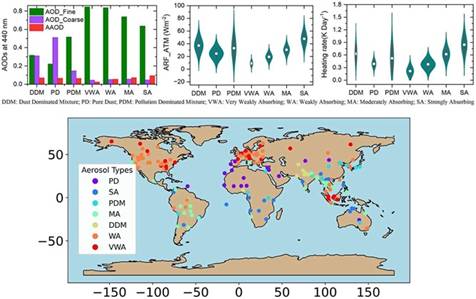
Fig 1: Global map of 171 AERONET sites shown with maximum frequency of occurrence (%) among the seven aerosol types, namely, PD, SA, PDM, MA, DDM, WA, and VWA in the current work.
Strongly absorbing (SA) aerosols produce the highest atmospheric forcing (30.14 ± 8.04 W m⁻²), whereas very weakly absorbing aerosols produce the lowest (7.83 ± 4.12 W m⁻²).
The study analyzed data from 171 ground-based monitoring stations, or AERONET sites, across six continents, spanning over 30 years. The researchers classified aerosols into seven specific types and studied their radiative forcing using advanced methods. The classification improved on earlier studies, which typically grouped aerosols into fewer, broader categories.
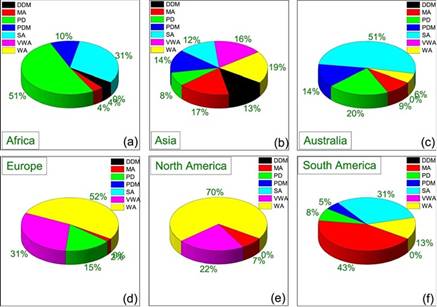
Fig 2: Global distribution of different types of aerosols on six continents. For the interpretation of color references, the readers are referred to the web version of this article.
These differences in aerosol composition have profound implications for the planet's energy budget and climate. The study reveals that strongly absorbing aerosols, such as those rich in black carbon, contribute significantly to atmospheric heating, with the potential to disrupt regional weather patterns and cloud formation. In contrast, very weakly absorbing aerosols have a relatively minor impact on the atmosphere, primarily reflecting sunlight back into space and cooling the surface.
"Aerosols are a key player in the complex climate system, but their diversity and regional variations make them challenging to represent accurately," explains the current study. “By shedding light on the global distribution of aerosols and their radiative effects, the comprehensive study offers valuable insights into climate science,” said the researchers.
The research was led by Swagata Mukhopadhyay (PhD Scholar, IIA, Bengaluru, India), Dr. Shantikumar Singh Ningombam (Scientist, IIA, Bengaluru, India), Dr. Umesh Chandra Dumka (Scientist, ARIES, Nainital, India), along with other collaborators from the Indian Space Research Organization (ISRO), and international collaborators Prof. Pradeep Khatri (Soka University, Tokyo, Japan), Prof. Thomas F. Eck, and Prof Pawan Gupta (Goddard Space Flight Center, NASA, USA). The findings also have important implications for satellite-based remote sensing and air quality monitoring.
Accurately identifying aerosol types is crucial for developing more reliable retrieval algorithms and assessing the impacts of air pollution on human health and ecosystems.
Publication link: https://doi.org/10.1016/j.atmosenv.2025.121530
****
NKR/FT/NM