PIB Backgrounder
India's Fight to Combat Hepatitis
Posted On:
27 JUL 2026 10:45AM by PIB Delhi
|
India is systematically breaking down healthcare barriers to achieve its 2030 goal of combating hepatitis. National Viral Hepatitis Control Program has adopted a health systems approach and integrated with various national programs to prevent infection and provide services including free drugs and diagnostics to the people affected with the disease.
|
What is Hepatitis?
Hepatitis is an inflammation of the liver, caused by hepatitis viruses or even other infections, toxic substances such as alcohol and drugs, and autoimmune diseases. There are five main hepatitis viruses, of which type B and type C are the most common and lead to chronic disease including cirrhosis and liver cancer.
Hepatitis has been recognised as a public health problem in India. In 2018, the Government launched the National Viral Hepatitis Program to combat this disease by providing screening and treatment services. This is in line with United Nation’s Sustainable Development Goal of combating various viral diseases.
Modes of Transmission, Prevention and Management
|
Hepatitis Virus
|
Causes / Transmission
|
Prevention & Treatment
|
|
Hepatitis A (HAV)
|
- Faecal-oral route via contaminated food/water
- Poor sanitation and lack of safe drinking water
|
- Prevention: Safe drinking water, hygiene and sanitation measures
- Treatment: Usually Self-limiting. Supportive care (hydration/nutrition). No specific antiviral
|
|
Hepatitis B (HBV)
|
- Most commonly: Mother-to-child at birth
- Contact with infected blood and blood products and body fluids etc
|
- Prevention: Vaccine preventable disease. Hepatitis B Vaccine under the Universal Immunization Program (birth dose at the earliest and certainly within 24 hours of birth, at 6,10 and 14 weeks of birth)
- Treatment: Chronic hepatitis B is managed with antiviral medication amongst those eligible as per the national guidelines
|
|
Hepatitis C (HCV)
|
- Exposure to blood from unsafe injections/ procedures
- Sharing needles/syringes
- Contact with infected blood and blood products and body fluids etc
|
- Prevention: Adopting harm reduction measures (needle exchange), safe injection practices. There is no vaccine to prevent hepatitis C infection
- Treatment: Cured in 12-24 weeks in nearly all patients using pan-genotypic regimen with Direct-Acting Antiviral (DAAs) drugs
|
|
Hepatitis D (HDV)
|
- Contact with infected blood and blood products and body fluids etc
- Infection only amongst some chronic HBV carriers
|
- Prevention: By preventing the underlying HBV infection, the Hepatitis B vaccine concurrently confers full protection against HDV infection
|
|
Hepatitis E (HEV)
|
- Faecal-oral route via contaminated food/water
- Poor sanitation and lack of safe drinking water
|
- Prevention: Safe drinking water, hygiene and sanitation measures
- Treatment: Usually Self-limiting. Supportive care (hydration/nutrition). No specific antiviral drugs
|
National Viral Hepatitis Control Program& Others
The key strategies adopted under the NVHCP include preventive, promotive and curative interventions with the focus on awareness generation, increasing access, providing diagnosis and treatment for viral hepatitis to all in need.
The NVHCP program deals with Hepatitis A, B, C, D and E viruses.
- Hepatitis A and E are usually acute, symptomatic and outbreak prone and monitored through Integrated Disease Surveillance Program.
- Free diagnostics and drugs are being made available to all in need, for management of hepatitis C and hepatitis B.
- The program uses paperless system of recording and reporting for patient management andmonitoring though NVHCP-MIS portal.
Seroprevalence is the share of people who test positive for a disease in a sample survey. In India's 2021 HIV Sentinel Surveillance data, about 0.85% of people tested positive for Hepatitis B and 0.29% for Hepatitis C — roughly 1 in 118 and 1 in 345 people, respectively.
The government runs various national health programs that also help in the prevention and treatment of the disease.
- Reproductive, Maternal, Newborn, Child, Adolescent Health and Nutrition program:
- Universal screening of pregnant women for Hepatitis B.
- Universal Immunisation Program
- To ensure 100% hepatitis B birth dose to all newborns and Hepatitis B immunoglobulin (HBIG) to newborns of positive pregnant women along with hepatitis B birth dose within 24 hours of birth
- National AIDS Control Program (NACP): Screening of high-risk groups for hepatitis B and C either through facility or outreach.
- Hepatitis B vaccination of healthcare workers and hepatitis B screened negative HRGs for infection prevention
- National Tuberculosis Elimination Program (NTEP): Use of existing machines under NTEP for molecular testing.
- Blood Transfusion services: Linkage of Hepatitis B/C positive donors for further management.
The program also has its toll-free number (1800-11-6666) shared with the NTEP which provides general information about the infection, its prevention, modes of transmission, management and the various service delivery sites strengthened under the program across the country.
Combating Hepatitis
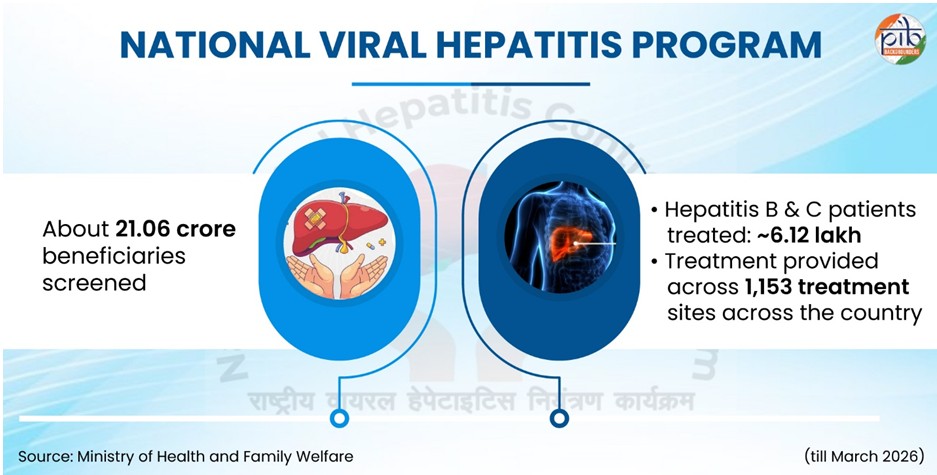
Since 2018, India's National Viral Hepatitis Control Programme has offered free screening and treatment for Hepatitis B and C nationwide. Smart use of local funding, cheaper generic drugs, and existing health programs has helped expand this care further. Services are now moving from district hospitals down to local health centers, bringing testing and treatment closer to everyone. This reflects the spirit of Sabka Saath, Sabka Vikas — collective effort for inclusive growth, reaching every citizen.
References
Ministry of Health and Family Welfare:
Others:
See in PDF
***
PIB Research Unit
(Release ID: 2289761)
Visitor Counter : 1443