PIB Backgrounder
India Leads the Wilderness in Tiger Conservation
“Protecting Tigers, Preserving Ecosystems”
Posted On:
28 JUL 2026 11:01AM by PIB Delhi
|
India has emerged as a global leader in tiger conservation through science based policies and strong institutional support. The country is now home to nearly 70% of the world's wild tigers. Technology driven monitoring, effective governance and community participation have strengthened conservation outcomes. India is also advancing global cooperation to secure the future of tigers and their habitats.
|
Thriving Tigers, Resilient Ecosystems
International Tiger Day, observed every year on 29 July, highlights the global importance of tiger conservation. For India, it reaffirms the Government's long-standing commitment to science-based conservation and sustainable development. The day also showcases India's remarkable conservation achievements. Today, India is home to the world's largest wild tiger population, accounting for nearly 70% of all wild tigers globally. This success reflects decades of sustained policy support, scientific management and community participation, positioning India as a global leader in tiger conservation.

This achievement is rooted in India's deep cultural and ecological connection with the tiger. For centuries, ancient coins, royal seals and temple carvings have portrayed the tiger as a symbol of strength and sovereignty. Recognising this enduring legacy, the Government declared the Royal Bengal Tiger as the National Animal in 1972. Today, the tiger continues to represent India's rich biodiversity, ecological wealth and shared natural heritage across diverse landscapes.
Beyond its cultural significance, the tiger plays a vital ecological role. As an apex predator and umbrella species, it helps maintain healthy forest ecosystems. Conserving tiger habitats protects forests, rivers and countless other species. These forests regulate water, conserve soil, support pollination and moderate local climates. They also reduce disaster risks and provide ecosystem services that sustain rural livelihoods and urban economies. By protecting tigers and their habitats, the Government is strengthening biodiversity conservation, enhancing ecological security and advancing the vision of Viksit Bharat through sustainable development.
|
Did You Know? International Tiger Day traces its origins to the Saint Petersburg Tiger Summit held in November 2010. Leaders from 13 tiger-range countries, including India, adopted the ambitious Tx2 goal to double the global wild tiger population by 2022. Today, it serves as a global platform to review conservation progress, strengthen international cooperation and raise awareness. In 2010, only about 3,200 wild tigers were estimated to remain globally. By 2022, improved conservation and scientific monitoring increased the estimate to around 4,500, with a plausible range of 3,700–5,600 tigers. According to recent global estimates, approximately 5,711 wild tigers remain worldwide, representing an increase of around 78% since 2010.
|
Rise in the Tiger Numbers: From Crisis to Recovery
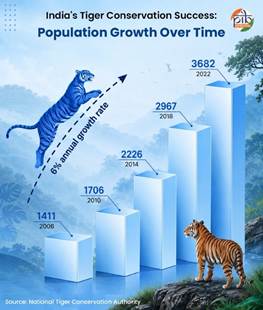
India's tiger conservation efforts have emerged as a global model of wildlife recovery. The country has more than doubled its scientifically assessed tiger population since 2006. The All India Tiger Estimation (2022) places India's tiger population at 3,682. The 2022 All India Tiger Estimation covered 20 States and surveyed over 6.41 lakh kilometres on foot. It is among the world's largest and most comprehensive wildlife assessments. This remarkable recovery reflects sustained policy support, science-based conservation and strong institutional governance. Long-term habitat protection, rigorous monitoring and coordinated implementation continue to strengthen tiger conservation across India.
Robust Governance Architecture for Tiger Conservation
India’s policy framework for tiger conservation combines long term vision with sustained institutional support at national and state levels. Project Tiger, the National Tiger Conservation Authority (NTCA) and Tiger Conservation Plans together provide a robust, science based governance architecture for tiger habitats.
Project Tiger
Project Tiger is a flagship Centrally Sponsored Scheme of the Government of India. It is implemented by the Ministry of Environment, Forest and Climate Change (MoEFCC). The scheme aims to secure viable tiger populations in their natural habitats. It provides financial and technical assistance to tiger range States for conservation efforts. The programme combines habitat protection, scientific management and regular field based monitoring. This approach has strengthened conservation measures over time.
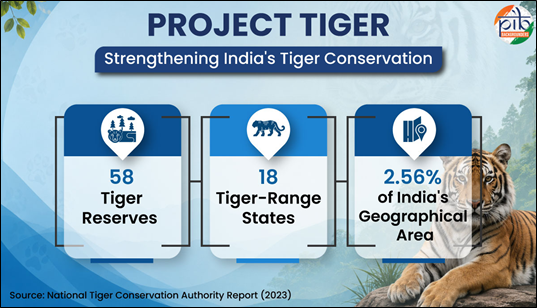
According to the National Tiger Conservation Authority (NTCA) Report (2023), Project Tiger has established a network of 58 tiger reserves across 18 tiger-range States. These reserves cover around 84,500 square kilometres, which is about 2.56% of India's geographical area. Today, Project Tiger remains a cornerstone of India's wildlife conservation efforts and reflects the Government's long term commitment to protecting tigers and their habitats.
|
Did You Know? Section 38 V (3) of the Wildlife Protection Act, (WPA), 1972 requires every State Government to prepare a Tiger Conservation Plan for each tiger reserve. Such plans must ensure protection of tiger reserves and provide habitat inputs to maintain viable populations of tigers, co predators and prey animals
|
National Tiger Conservation Authority (NTCA)

NTCA oversees the implementation of Project Tiger and related conservation initiatives. NTCA provides scientific, technical and financial guidance to tiger range States. It approves Tiger Conservation Plans and issues standard operating procedures for reserve management. The Authority also monitors the management of tiger reserves through periodic assessments. Its science based approach improve habitat protection, improves conservation outcomes and supports the long term survival of wild tigers across India.
|
Did You Know? NTCA is chaired by the Union Minister for Environment, Forest and Climate Change. It also includes Members of Parliament, senior government officials and experts. The Authority guides tiger conservation, oversees tiger reserves and ensures effective implementation of Project Tiger across the country.
|
The Government of India constituted the Tiger Task Force to re-examine conservation policies and recommend reforms. The Tiger Task Force reviewed India's tiger conservation framework and recommended key policy reforms. It brought together administrative experts, ecologists and community representatives. The Task Force emphasised transparency, community participation and stronger institutional support for Project Tiger. Its recommendations shaped a more robust conservation framework. They led to significant amendments to the Wildlife (Protection) Act in 2006. The amendments established the National Tiger Conservation Authority (NTCA) and the Wildlife Crime Control Bureau (WCCB) as statutory bodies.
India's tiger conservation framework reflects a strong governance model built on institutions and cooperative federalism. This integrated approach is helping secure the future of tigers while advancing India's biodiversity.
|
Did You Know? India's tiger reserves follow a landscape-based conservation approach. Each reserve includes a Core Area (also known as Critical Tiger Habitat) and a Buffer Area. Core Areas receive the highest level of protection. Buffer Areas balance conservation with sustainable livelihoods. Also, Wildlife corridors connect tiger reserves, enabling safe movement and maintaining healthy tiger populations across landscapes.
|
Monitoring and Evaluation of Tigers in India
India has developed a robust, science-based system to monitor and evaluate its tiger population. The approach combines field surveys, camera traps, digital technologies and scientific analysis. It generates reliable data on tiger populations, prey species and habitat quality. This information guides evidence-based conservation planning and adaptive management. Continuous monitoring strengthens habitat protection and enables informed management decisions across tiger landscapes.
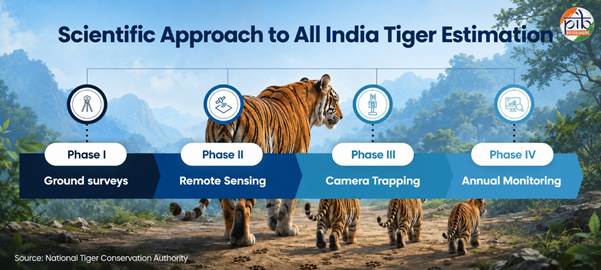
All India Tiger Estimation (AITE): The World's Largest Biodiversity Survey
AITE is the world's largest biodiversity survey. Conducted every four years, it is led by the NTCA in collaboration with the Wildlife Institute of India (WII). It estimates tiger populations, co-predators, prey species and habitat quality across all tiger bearing States. The 2022 assessment also included India's first nationwide survey of ungulates. The exercise highlighted the importance of healthy prey populations for sustaining viable tiger populations.
|
Did You Know? The All India Tiger Estimation is recognised as the world's largest biodiversity survey. The NTCA's camera trap survey also holds a Guinness World Record as the world's largest camera trap wildlife survey. Together, advanced technologies and scientific monitoring make India's tiger estimation among the most rigorous in the world.
|
Technology Driven Monitoring
India has integrated advanced digital technologies into every stage of tiger monitoring. The Monitoring System for Tigers – Intensive Protection and Ecological Status (M-STrIPES) uses GPS, GPRS and remote sensing technologies for field monitoring. GPS tagged photographs improve data accuracy and reduce human error. The platform integrates field observations into a central database for scientific analysis and informed decision making. Artificial intelligence further strengthens monitoring. The Camera Trap Data Repository and Analysis Tool (CaTRAT) automatically classify camera trap images by species. ExtractCompare identifies individual tigers using their unique stripe patterns. Collectively, these tools improve the accuracy and reliability of tiger population estimates.
Management Effectiveness Evaluation (MEE)
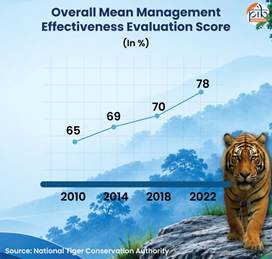
The MEE assesses how well tiger reserves are managed. The framework evaluates planning, protection, management processes and conservation outcomes. It helps identify management gaps and reinforce accountability. By 2022, 51 tiger reserves had been evaluated under the framework. Twelve reserves received "Excellent" ratings, while the average management score reached 78%. The findings guide policy decisions, strengthen reserve management and support long-term conservation planning.
India's Global Leadership in Tiger Conservation
India is actively collaborating with countries across the world to strengthen tiger and wildlife conservation. Key partnerships include transboundary biodiversity conservation with Nepal and Bhutan. Collaboration with Myanmar focuses on combating timber trafficking and conserving tigers and other wildlife. India also cooperates with Russia on camera trap data management and through the Indo-Russia Working Sub-Group on Tiger and Leopard Conservation. Partnerships with Botswana, South Africa, Guatemala, Cambodia, Kenya and Namibia strengthen wildlife conservation, management and sustainable biodiversity use. India has also established bilateral cooperation with China on tiger conservation. These partnerships reinforce India's commitment to global wildlife conservation through science, cooperation and shared action.
International Big Cat Alliance (IBCA)

IBCA is a global coalition of 95 big cat range and partner countries, scientific organisations and conservation partners. The Alliance promotes cooperation for conserving seven big cats—tiger, lion, leopard, snow leopard, cheetah, jaguar and puma. The Union Cabinet approved its establishment on 12 March 2024, with its Secretariat headquartered in India. Building on India's globally recognised tiger conservation experience, the IBCA strengthens international collaboration to protect big cats and their habitats.

GTF is the world's only intergovernmental organisation dedicated exclusively to tiger conservation. Headquartered in New Delhi, it brings together 13 tiger range countries-Bangladesh, Bhutan, Cambodia, China, India, Indonesia, Lao PDR, Malaysia, Myanmar, Nepal, Russia, Thailand and Vietnam. The Forum promotes a common approach to conserving tigers, their prey and habitats. It supports landscape-scale conservation, regional capacity building and technological innovation to strengthen tiger conservation across member countries. Through knowledge sharing and international cooperation, the GTF reinforces India's leadership in global tiger conservation.
Integrated Tiger Habitat Conservation Programme (ITHCP)
ITHCP is the International Union for Conservation of Nature's (IUCN) flagship tiger conservation initiative. It is funded by the German Government through KfW Development Bank. The programme supports science-based conservation projects across priority tiger landscapes in Asia. It promotes habitat protection, landscape level conservation and international collaboration. India actively participates in ITHCP programmes, strengthening regional efforts to conserve tigers and their habitats.
|
Did You Know? Conservation Assured Tiger Standards CA|TS is a global certification system that ensures effective management specifically of tiger conservation areas. Launched at the 1st Asian Parks Congress in Japan in 2013. It sets benchmarks for protection, habitat management, community involvement, and wildlife monitoring. CA|TS supports efforts to create safe, sustainable environments for tigers and preserve global biodiversity. CA|TS has accredited 23 Indian tiger reserves ensuring global best practices in conservation.
|
India's international partnerships are strengthening collective action for tiger conservation across borders. By sharing knowledge, technology and best practices, India continues to advance global efforts to protect tigers and their habitats.
Towards a Secure Future for Tigers
Tiger conservation remains a dynamic and evolving priority for the India. Looking ahead, India’s vision is to secure connected, climate resilient tiger landscapes that support both wildlife and people. Continued investment in data driven monitoring, technology- enabled protection and capacity building of frontline staff will support this vision. Cooperation with other tiger range countries and global partners will also help share knowledge and reinforce collective conservation gains. International Tiger Day offers a recurring opportunity to engage citizens, particularly youth, in this forward looking agenda. By combining strong policy direction with sustained implementation, India aims to keep its tiger conservation journey on a path of global leadership.
References
Ministry of Environment, Forest and Climate Change
National Tiger Conservation Authority
Click here to see pdf
PIB Research
(Release ID: 2290233)
Visitor Counter : 5238