Ministry of Education
IIT Bhilai Converts Plastic Waste into High-Value Reprocessable Material with 3D Printing Potential
Indigenous breakthrough transforms discarded Polyethylene Terephthalate (PET) bottles into durable, repairable and recyclable engineering material
Green catalyst developed from eucalyptus leaves advances circular economy, sustainable manufacturing and waste-to-wealth innovation
Posted On:
03 AUG 2026 6:47PM by PIB Raipur
Researchers at the Indian Institute of Technology (IIT) Bhilai have developed an innovative technology to transform discarded Polyethylene Terephthalate (PET) plastic bottles into a high-value engineering material that can be reshaped, repaired and recycled repeatedly. The breakthrough is expected to provide a sustainable solution to plastic waste management while strengthening circular economy practices and supporting next-generation manufacturing technologies, including three-dimensional (3D) printing.
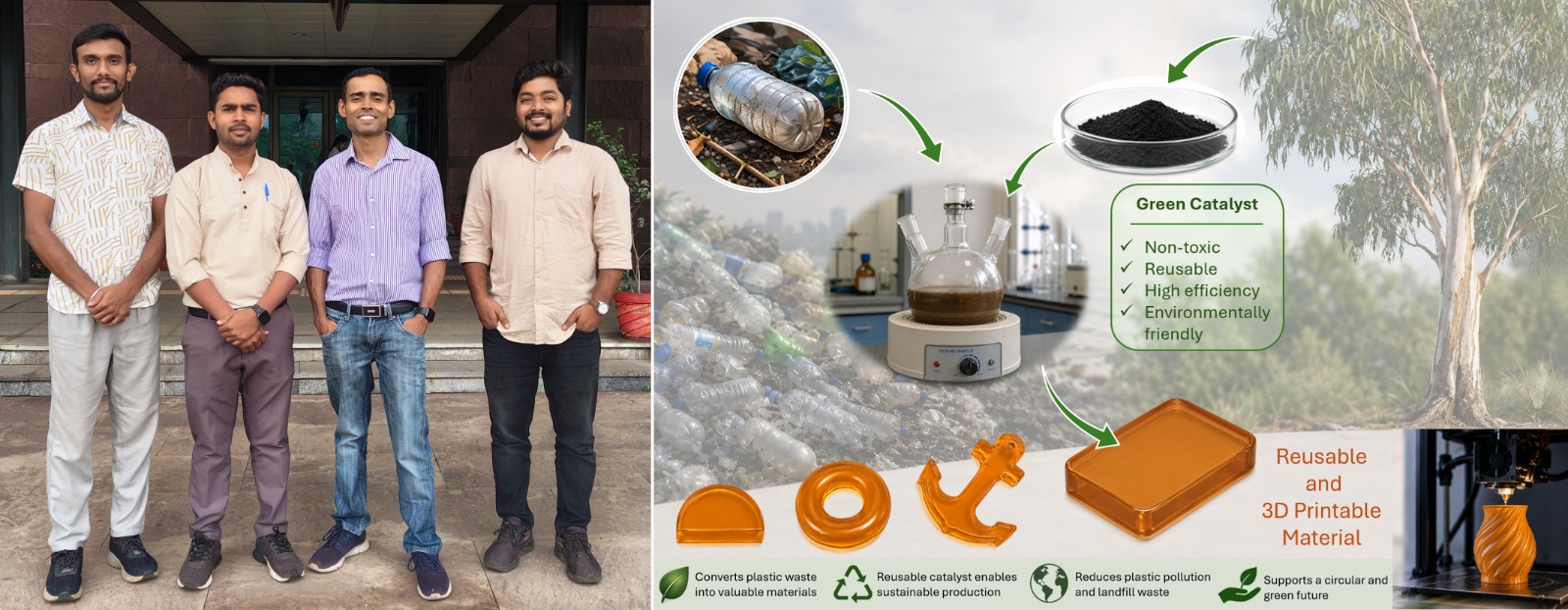
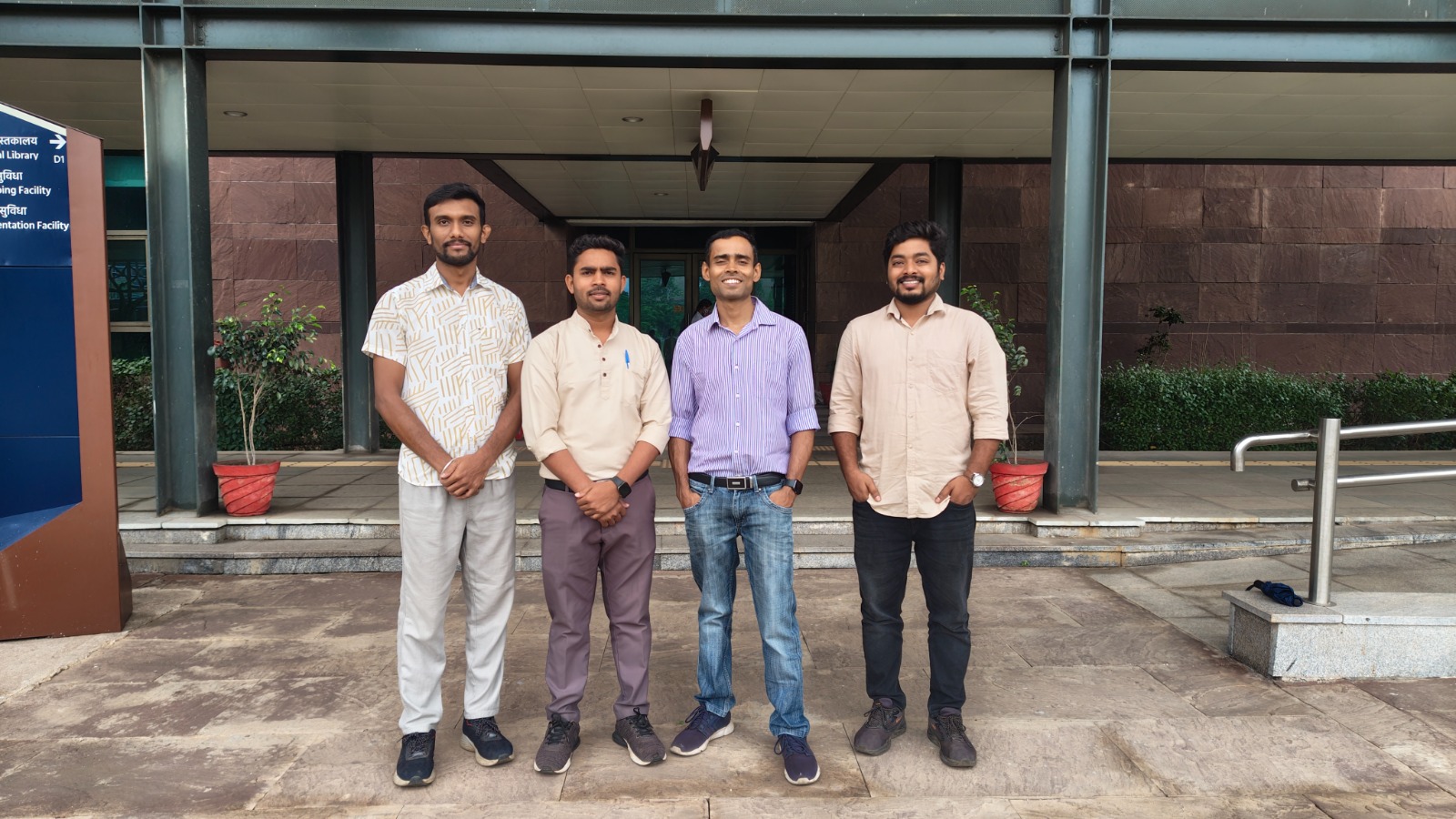
The research was led by Dr. Sanjib Banerjee of the Department of Chemistry, Indian Institute of Technology Bhilai, with researchers Priyank Sinha, Bharatbhushan Meshram and Onkarnath Verma. The findings have been published in the internationally reputed journal Materials Today Catalysis, underscoring the institute's growing contribution to sustainable materials research. The team has also filed an Indian patent application for the technology.
Polyethylene Terephthalate (PET) is one of the world's most widely used plastics, particularly in beverage bottles and food packaging, generating millions of tonnes of waste annually. Although PET is recyclable, conventional recycling processes gradually degrade the quality of the material, limiting its long-term reuse and value.
To overcome this challenge, the researchers developed a green, magnetically recoverable catalyst using waste eucalyptus leaves. The catalyst efficiently converts discarded Polyethylene Terephthalate (PET) bottles into a valuable chemical building block and can be easily separated using a magnet for repeated reuse. This makes the depolymerisation process cleaner, more sustainable and cost-effective. The recovered building block is subsequently converted into a high-performance dynamic polymer that combines mechanical strength with reprocessability and offers significant potential for future three-dimensional (3D) printing applications.
The technology effectively transforms discarded plastic bottles from an environmental liability into high-value engineering materials, demonstrating a practical "waste-to-wealth" approach. By reducing plastic waste, lowering dependence on virgin petroleum-based raw materials and enabling repeated reuse instead of disposal, the innovation has the potential to significantly reduce the environmental and carbon footprint associated with plastic products. It also reinforces the transition towards sustainable manufacturing and a circular economy.
A key feature of the newly developed material is its ability to soften when heated, be reshaped into a desired form and permanently retain the new shape upon cooling. Researchers successfully demonstrated repeated reshaping into different objects without any significant loss in performance. Unlike conventional thermoset plastics, which cannot be reshaped or recycled after curing, the new material can be repaired and remoulded multiple times, substantially extending its service life and reducing waste generation.
Explaining the significance of the innovation, Dr. Sanjib Banerjee said that while conventional thermoset plastics offer excellent strength and durability, their inability to be reshaped or recycled after manufacture results in substantial waste accumulation. The newly developed material overcomes this limitation by combining durability with reprocessability, demonstrating that discarded Polyethylene Terephthalate (PET) bottles can be converted into high-value engineering materials for advanced manufacturing applications.
The technology holds considerable promise for producing customised plastic components, reusable consumer products, educational models and engineering prototypes where repeated reshaping and repair are advantageous. Its thermal responsiveness and ability to regain strength after cooling also make it a promising candidate for future three-dimensional (3D) printing and additive manufacturing technologies, enabling more sustainable production with reduced material waste.
The innovation aligns with the Government of India's vision under flagship initiatives such as Swachh Bharat Mission, Atmanirbhar Bharat, Make in India, and the National Resource Efficiency Policy. By converting plastic waste into value-added, reusable engineering materials through indigenous research, the technology has the potential to reduce dependence on virgin plastics, promote resource efficiency and contribute to a cleaner, more sustainable manufacturing ecosystem.
If this is intended for official Press Information Bureau (PIB) release, it can be further refined to match the Bureau's editorial house style, including a stronger government-news lead, sharper attribution, and a 650–750-word format commonly used for national media dissemination.
******
(Release ID: 2293973)
Visitor Counter : 65