PIB Backgrounder
GI Tags: Scaling Traditional Wealth into Global Brands
Posted On:
04 AUG 2026 9:45AM by PIB Delhi
Geographical Indication (GI) tags have emerged as a powerful tool for protecting India's cultural heritage, while creating economic opportunities for local communities. By linking products to their place of origin, GI tags preserve traditional knowledge, prevent misuse, and enhance consumer trust. They help artisans, weavers, farmers, and producer groups secure better market recognition and gain access to premium markets. India's GI ecosystem has expanded significantly over the years, supported by a robust legal framework and growing public awareness. Government initiatives are further strengthening this ecosystem through financial assistance, export promotion, tourism integration, and dedicated marketing platforms. Together, these efforts are transforming GI products into drivers of rural development, cultural preservation, and export-led growth.
|
GI Tag- Safeguarding India's Unique Products
A weaver in Banaras spends weeks crafting a single Banarasi saree. Every thread of intricate zari work is woven with exceptional precision and skill. These techniques are not learned overnight. They are passed down through generations, preserving a centuries-old tradition.
Yet, despite the effort and craftsmanship involved, many authentic Banarasi sarees are often sold at prices far below their true value. Buyers may not always be able to distinguish a genuine handwoven saree from other imitations. This is where two words make all the difference- GI Tag (Geographical Indication).
A GI tag certifies that the saree is genuinely made in Banaras using traditional methods. It assures buyers of its authenticity, quality, and cultural heritage. As a result, the authentic Banarasi saree can command a significantly higher price in domestic and international markets. This ensures that the weaver receives greater recognition and better economic returns for their craftsmanship.
Significance of GI goods in Indian tradition, economy, sustainability
A GI tag serves as a seal of authenticity for artisanal crafts, safeguarding them against imitation, misuse, and unauthorized commercialization. Its significance, however, extends far beyond legal protection. For instance, the Channapatna toys received GI recognition in 2006. This recognition applies only to wooden toys made in Karnataka's Channapatna region. The toys must be produced using the region's distinctive lacquerware art. Although it may appear to be a simple certification, the tag can deliver far-reaching benefits.
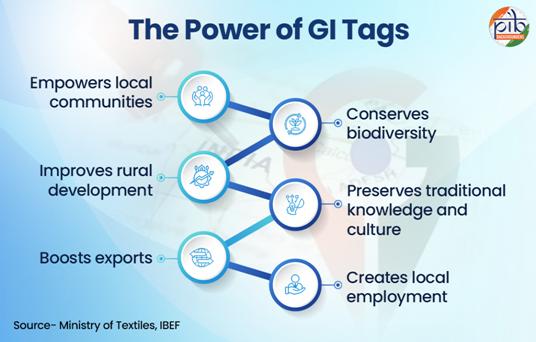
A GI tag is more than a label. As per the Ministry of Textiles, it can raise rural artisans' incomes by 20–30%!
|
By certifying a product’s origin and unique heritage, GI tags instil confidence among buyers and enhance the product’s market appeal.
- As consumers increasingly seek authenticity, tradition, and craftsmanship, GI recognition serves as a powerful symbol of quality and cultural distinctiveness.
- Growing demand for GI-tagged products enables artisans to gain greater visibility, access premium markets, strengthen their bargaining power, and capture a larger share of the value generated by their work.
- The recognition creates sustainable livelihood opportunities. They also play a vital role in preserving and promoting India’s rich cultural heritage and indigenous craftsmanship for future generations.
Success Story of Muzaffarnagar Jaggery: From Local Specialty to Global Markets
The GI tag for Muzaffarnagar Jaggery has helped strengthen its identity as a premium product with distinct quality and origin. Leveraging this recognition, Brijnandan Agro Farmer Producer Company successfully exported 30 metric tons of jaggery to Bangladesh in 2025. The GI certification enhanced buyer confidence and improved the product's marketability in international markets.
As a result, the farmer-led company gained access to export opportunities. It increased income prospects for its 545 members, and created greater value for locally produced jaggery.
|
DID YOU KNOW?

India is home to over 800 registered GI products and 607 GIs have been granted since 2014.
|
Darjeeling Tea from West Bengal was the first product in India to receive a GI tag, with protection extended to both the product and its logo. Other early registrations included Aranmula Kannadi, a traditional handicraft from Kerala, and Pochampalli Ikat, a renowned textile craft from Telangana.
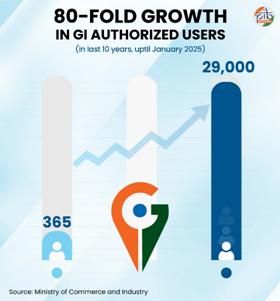
In the last 10 years, authorized users for GI tags increased from 365 to 29,000 (as of January 2025)..
Leading export destinations for Indian GI products include the UK, Italy, UAE, Bahrain, Qatar, the USA, South Korea.
|
As a form of intellectual property, GIs are recognised internationally under the Paris Convention for the Protection of Industrial Property and the World Trade Organization’s (WTO) Agreement on Trade-Related Aspects of Intellectual Property Rights (TRIPS). In India, their registration and protection are overseen by the Geographical Indications Registry under the 1999 Act.
Through the 2025 amendment, the fee for filing GI applications and related processes has been reduced by 80%. The renewal fee for the tag has also been cut from ₹3,000 down to just ₹500!
|
India established a legal framework for protecting products linked to specific regions through the Geographical Indications of Goods (Registration and Protection) Act, 1999 and the accompanying Rules notified in 2002. The framework became operational in 2003, and GI registrations commenced in 2004–05. The Geographical Indications of Goods (Registration and Protection) Rules, 2002, were amended in 2025.
Key Sectors & States with GI Tagged products
India is home to GI-tagged products across categories such as handicraft products, agricultural products, manufactured goods, food products and natural products.
- Handicraft products- 445 handicraft products and 27 product logos have been registered under the Act (as of December 2025). Examples include Pashmina from Jammu & Kashmir, Baluchari Saree from West Bengal and Banaras Gulabi Meenakari Craft from Uttar Pradesh.
- Agricultural products- 251 products have been registered, spanning a diverse range of crops, including cereals, fruits, vegetables, spices, and non-basmati rice.
- Manufacturing products- 64 manufactured products have been registered, such as Nashik Valley Wine and Kannauj Perfume.
- Food products- 66 food products, encompassing prepared, cooked, or processed delicacies are GI tagged. For eg. West Bengal's Bardhaman Mihidana and Sitabhog, Odisha's Kendrapara Rasabali, and Andhra Pradesh's famous Tirupathi Laddu.
- Natural products- 5 natural products- Makrana Marble (Rajasthan), Chunar Balua Patthar (Uttar Pradesh), Lac of Purulia (West Bengal), Panna Diamond (Madhya Pradesh) and Ambaji White Marble (Gujarat) are GI-tagged in India. While these are strictly "Natural" products, hundreds of other natural-origin goods fall under the Agricultural Products category.
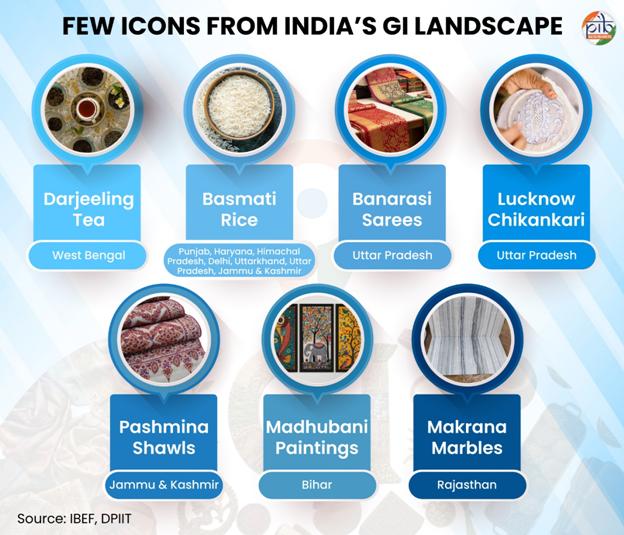
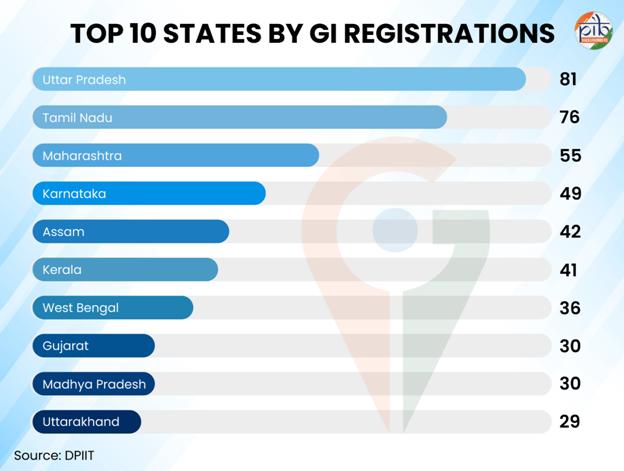
Several Indian states are driving India’s GI legacy. As of December 2025, Uttar Pradesh is the leading state with 81 GI-tagged products. It is followed by Tamil Nadu (76 GI-tagged products) and Maharashtra (55 GI-tagged products).
Behind the GI Tag: Registration, Protection and Renewal
Before a product can receive the certification, it must meet specific legal and procedural requirements. India's GI registration system defines who can apply, how long protection lasts, and the circumstances under which a GI may be revoked.
GI Registration Framework
Any association of producers, organisation, or authority established under law can apply for GI registration. The applicant must be a legal entity and represent the interests of the producers of the concerned product. If the applicant is not a producers' association, it must prove that it represents the producers' interests. Similarly, an authority applying for registration must also demonstrate that it represents the producers of the product.
Application or any other document may be filed directly in the GI Registry. It may also be sent by post, registered post, speed post or courier services. The GI Registry is located at Geographical Indications Registry, Chennai, which has all-India Jurisdiction.
GI Exclusions: What Cannot Be Registered
- Generic product names no longer protected in their country of origin.
- Indications that mislead consumers or falsely suggest a different geographical origin.
- Indications that offend religious sentiments or contain scandalous, offensive, or obscene matter.
- Indications not eligible for legal protection or that violate any law in force.
|
The registration of a GI is valid for ten years, but may be renewed from time to time.
The revocation, cancellation, or variation of a GI registration is governed by Section 27 of the Act. Any aggrieved person may apply to the Registrar or the competent authority for cancellation or variation of a registered GI. The Registrar or the Appellate Board may also initiate such action on their own if necessary.
A GI registration may be revoked or cancelled if:
- It was obtained through fraud or misrepresentation.
- It is no longer protected in its country of origin or has fallen into disuse.
- Its use is likely to deceive consumers, violates any law, or contains scandalous or obscene matter.
Schemes & Policies Bolstering GI Tag
The Government is promoting GI products through initiatives aimed at improving awareness, market access, exports, and legal protection. Aligned with the vision of Aatmanirbhar Bharat and Vocal for Local, these efforts are empowering artisans, farmers, and producer communities. They are also enhancing the domestic and global recognition of India’s unique regional products.
Dedicated Retail & Infrastructure Spaces
Certain platforms have been introduced to enhance product visibility, strengthen access to buyers, and create new opportunities for traditional producers.
- PM Ekta Mall (Unity Mall): PM Ekta Malls promote and sell One District One Product (ODOP) items, GI-tagged products, and other handicrafts. An allocation of ₹5,000 crore was made for establishing these malls across all States (FY 2023-24).
- One Station One Product (OSOP): Railway GI booths under the OSOP initiative provide dedicated stalls for showcasing and selling GI-tagged products. They enhance the outreach of regional crafts, textiles, handlooms and food products. OSOPs offer direct market access to artisans, weavers, farmers and producer groups.
GI clusters are being integrated into mainstream tourism itineraries. Much like wine tours in France, India is experimenting with GI Trails (like a Pochampally Ikkat weaving village tour or a Darjeeling tea estate trail). This blends experiential tourism with direct-to-consumer rural retail.
In June 2026, Muga Silk Trail was announced in Assam, along with a Silk Tourism Park and Muga Utsav festivals. This positions Assam as a premier destination for silk heritage tourism.
Support is provided under the Intellectual Property Rights (IPR) component of the MSME Innovative Scheme for IP protection and commercialization, including GIs. Under the scheme, eligible applicants can receive reimbursement of the actual cost incurred for GI registration. The reimbursement covers up to 100% of the cost, subject to a maximum limit of ₹2 lakh per registered GI.
The Office of the Development Commissioner (Handicrafts), under the Ministry of Textiles, provides financial support for GI protection. Eligible applicants can receive up to ₹1.5 lakh for enforcing GI rights and covering legal expenses related to protection of GIs. Besides, the Government promotes products under the National Handloom Development Programme (NHDP) & National Handicrafts Development Programme (NHDP). Financial assistance is offered for meeting the expenses in registering the designs/products, training personnel of implementing agencies and effective enforcement of GI registration.
104 GI-registered handloom products and 53 registrations are supported under Handloom Marketing Assistance, a component of NHDP (June 2026).
The Agricultural and Processed Food Products Export Development Authority (APEDA) is strengthening the global presence of India’s GI-tagged agricultural products. It supports farmers and exporters through quality improvement, capacity building, infrastructure support, and market promotion.
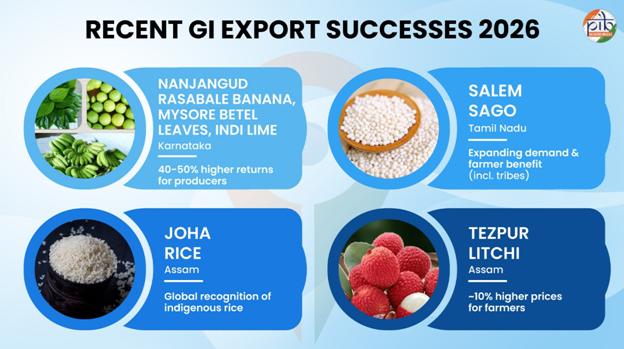
In 2026, APEDA accelerated exports of GI-tagged products by opening new international markets for farmers and producer groups. From fresh fruits to traditional rice and processed foods, these first-time shipments strengthened the global presence of India's regional specialties while improving returns for producers.
|
Market
|
GI Product
|
Key Impact
|
|
Maldives
|
Karnataka GI fruits
|
40–50% higher returns for farmers
|
|
Canada
|
Salem Sago
|
Expanded demand, better incomes
|
|
UK & Italy
|
Joha Rice
|
New export markets
& better price realization
|
|
Dubai
|
Tezpur Litchi
|
~10% higher prices for growers
|
The EU-India FTA Connection
Free Trade Agreements (FTAs) enhance the value of GIs by expanding market access for distinctive regional products. GI tags certify authenticity and origin, while FTAs reduce trade barriers and improve export opportunities. Reflecting their growing importance, GIs have become a key issue in India's trade negotiations-
- After the India–Oman CEPA was signed, 3 metric tonnes of Indi Lime from Karnataka were exported to Oman in December 2025. The export of GI-tagged Indi Lime to Oman demonstrates the value addition offered by GI certification.
- New Zealand has also committed to enabling the registration of Indian GI products, a privilege currently accorded only to the European Union. The move will secure formal GI protection for Indian products such as Darjeeling Tea, Basmati Rice, and region-specific handicrafts in the New Zealand market.
- In the India–EU FTA talks, both sides continue negotiations on a dedicated GI agreement.
Exhibitions, awareness programmes, and international trade events are organised to showcase GI-tagged products, widen markets, and support the livelihoods of artisans and weavers.
- Exhibitions include craft fairs, Dilli Haat events, and dedicated GI promotion programmes. Summits, seminars, and workshops are also organised for weavers and artisans.
- Events such as GI & Beyond: Virasat se Vikas Tak showcase the heritage, authenticity, and craftsmanship of GI handloom products. They also help increase awareness among domestic and international audiences.
- Recently, GI products were promoted at World Food India, 2025, Tribal Business Conclave, 2025 and India AI Impact Summit, 2026. They are also encouraged through screens, display boards, conveyor belts etc. at Varanasi, Delhi, Mumbai Airport and even Delhi Metro.
- Besides domestic events, live demonstrations and exhibitions of India’s GI products are organized overseas as well. Examples include the Autumn Fair International 2024 in Birmingham, UK and the Bazaar Berlin 2024, Germany.
The Road Ahead: Scaling India’s GI Success Story
India's GI ecosystem is evolving into a bridge between tradition and opportunity. Protecting heritage and empowering local producers, GI tags create lasting economic value. They also expand access to domestic and global markets. These efforts ensure India's unique regional products continue to thrive for generations. With a target of 10,000 GI registrations by 2030, India is well positioned to strengthen its heritage economy and enhance the global presence of its unique regional products.
References
Ministry of Electronics & Information Technology
https://varanasi.nic.in/district-produce/banarasi-saree/
https://ariyalur.nic.in/geographical-indications/
Ministry of Law & Justice
https://www.indiacode.nic.in/bitstream/123456789/1981/5/A1999-48.pdf
https://ipindia.gov.in/frontend/pdf/mannual/GAZETTE_NOTIFICATION_AMENDED_GI_RULES_2025.pdf
https://www.indiacode.nic.in/handle/123456789/1981
https://www.indiacode.nic.in/bitstream/123456789/1981/1/a199948.pdf
Ministry of Tourism
https://www.incredibleindia.gov.in/en/karnataka/channapatna-toys-and-dolls
https://www.indiator.com/package/a-day-excursion-to-textile-village-pochampally-from-hyderabad
https://www.incredibleindia.gov.in/en/west-bengal/darjeeling/happy-valley-tea-estate
Ministry of Textiles
https://www.indiahandmade.com/blog/why-do-gi-tags-make-indian-handicrafts-global-and-boost-artisan-livelihoods?srsltid=AfmBOorwnYG19-Hd5LVKdyTeYtIIrcMJ_TZX-vUeJ6V61Du9bZ7Wrb4b
https://www.pib.gov.in/PressReleasePage.aspx?PRID=2152551®=48&lang=2
https://x.com/TexMinIndia/status/2066117182086603038
https://www.pib.gov.in/Pressreleaseshare.aspx?PRID=1579529®=48&lang=2
https://www.pib.gov.in/PressReleaseIframePage.aspx?PRID=2113550®=48&lang=2
Ministry of Commerce & Industry
https://www.pib.gov.in/PressReleasePage.aspx?PRID=2113966®=48&lang=2
https://sansad.in/getFile/loksabhaquestions/annex/187/AU2947_WBLKzd.pdf?source=pqals
https://ipindia.gov.in/frontend/pdf/gi/registered/State_wise_Registered_GI_of_India.pdf
https://www.pib.gov.in/PressReleaseDetail.aspx?PRID=2239598®=6&lang=1
https://www.pib.gov.in/PressReleasePage.aspx?PRID=2270578®=3&lang=1
https://www.commerce.gov.in/files/2026-04/final_1.pdf
https://www.dpiit.gov.in/static/uploads/2026/03/863a5fef349d79a1bba316c4b51eaacb.pdf
https://www.pib.gov.in/PressReleaseIframePage.aspx?PRID=2206803®=48&lang=2
https://www.pib.gov.in/PressReleasePage.aspx?PRID=2149738®=48&lang=2
Ministry of Micro, Small & Medium Enterprises
https://www.pib.gov.in/PressReleasePage.aspx?PRID=2271522®=3&lang=1
https://innovative.msme.gov.in/Home/AboutIpr
https://ciprpf.com/msme-innovative-scheme
https://www.pib.gov.in/PressReleasePage.aspx?PRID=2038537®=48&lang=2
Ministry of Development of North-East Region
https://www.pib.gov.in/PressReleasePage.aspx?PRID=2268097®=48&lang=2
Ministry of Railways
https://www.pib.gov.in/PressReleaseIframePage.aspx?PRID=1942801®=48&lang=2
European Parliament
https://www.europarl.europa.eu/legislative-train/theme-a-global-europe-leveraging-our-power-and-partnerships/file-eu-india-fta-bit-and-gi-agreement?sid=10301
South Asian Journal of Management Research
https://siberindia.edu.in/journals/SAJMR/Oct-2021/Paper-5.pdf
Office of the Controller General of Patents, Designs and Trademarks & Registrar of GIs
https://ipindia.gov.in/frontend/pdf/mannual/1_31_1_manual-of-geographical-indications-practice-and-procedure.pdf
Chanakya National Law University
https://www.cnlu.ac.in/wp-content/uploads/2025/04/15-Yashna-Walia-and-Shreya-Kumar-1.pdf
IBEF
https://www.ibef.org/giofindia
https://www.ibef.org/blogs/promotion-of-geographical-indications-gis-in-india
See in PDF
***
PIB Research
(Release ID: 2294126)
Visitor Counter : 8379