Ministry of Science & Technology
Light-activated nano-robots can help targeted breast cancer therapy
Posted On:
05 AUG 2026 7:08PM by PIB Delhi
Researchers have developed an advanced light-driven multifunctional nanobot that can help targeted breast cancer therapy.
Breast cancer remains one of the leading causes of cancer-related mortality among women worldwide. Conventional chemotherapy often causes severe side effects, drug resistance, and damage to healthy tissues due to non-specific drug distribution, poor tumor penetration, and lack of active control after administration.
Current nanomedicines primarily rely on passive tumor accumulation, resulting in limited tissue penetration and poor spatial control, while most light-powered micro/nanorobots require ultraviolet or visible light with restricted tissue penetration and potential damage to healthy tissues. In contrast, stimulus-responsive nanorobots, controlled by external (e.g., near-infrared light or magnetic fields) or internal (e.g., pH or enzymes) cues, offer precise, targeted therapy with minimal systemic toxicity, making them a promising future platform for precision medicine.
Scientists from the Institute of Nano Science and Technology (INST), Mohali, an autonomous institute of the Department of Science and Technology (DST), envisioned combining nanorobotics with phototherapy to develop an intelligent therapeutic platform capable of actively navigating due to externally applied light while simultaneously performing targeted cancer treatment.
Under the leadership of Dr. Jiban Jyoti Panda (INST, Mohali), in collaboration with Dr. Santosh K. Gupta (BARC, Mumbai), Swapnil Srivastava, as the first author, together with Annu Balhara, Pankaj Kharra, and Jyoti Yadav, developed upconversion nanoparticle (UCNP)-based nanobots capable of efficiently converting near-infrared (NIR) light into heat and showed directional movement in presence of NIR.
The team functionalized the nanobots with a photosensitizer, enabling the generation of reactive oxygen species (ROS) upon NIR irradiation. The nanobots also exhibited light-guided directional movement (phototaxis) upon NIR irradiation, facilitating localized therapeutic action. Furthermore, surface functionalization with folic acid enabled selective recognition and targeting of breast cancer cells overexpressing folate receptors, thereby enhancing tumor-specific phototherapeutic efficacy. This work highlights the pioneering contribution of Swapnil Srivastava and the scientific leadership of the corresponding authors, Dr. Jiban Jyoti Panda and Dr. Santosh K. Gupta, in advancing UCNP-based nanobot-mediated cancer phototherapy.
When exposed to a 980 nm NIR laser, polydopamine generates localized heating, creating a temperature gradient. The temperature gradient induces thermally driven motion, causing the nanobots to actively move toward the laser source through phototaxis. Simultaneously, photothermal heating and photodynamic ROS generation destroy cancer cells. The combined effects produce enhanced tumor inhibition compared to individual treatment modalities.
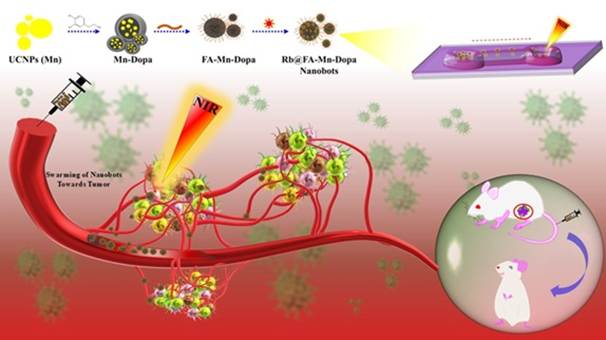
Fig: Schematic illustration of the therapeutic mechanism of NIR-responsive UCNP nanobot-mediated phototherapy for breast tumour treatment. The illustration depicts the directional movement (phototaxis) of UCNP nanobots under NIR laser irradiation, enabling localized photothermal and photodynamic therapy.
The team has demonstrated therapeutic efficacy in both cellular models and breast tumor-bearing mice.
The research published in the journal ACS Applied Materials & Interfaces introduces a fuel-free, NIR-responsive nanobot that integrates active light-guided movement (phototaxis) under biologically compatible NIR irradiation, bringing about targeted delivery through folic acid-mediated cancer cell recognition regulated by laser intensity, pH, and glutathione concentration in biological media.
This unique combination would allow precise, externally controlled, and minimally invasive treatment of breast tumors through localized therapeutic action.
Publication link: DOI: 10.1021/acsami.5c20372
******
NKR/FT/NM
(Release ID: 2295121)
Visitor Counter : 1874