PIB Backgrounder
From Queues to Clicks: Four Decades of Passenger Reservation in Indian Railways
Posted On:
06 AUG 2026 2:18PM by PIB Delhi
|
From queues to clicks, Indian Railways has transformed passenger reservations. Today, technology powers one of the world's largest public reservation systems. Continuous modernisation has made bookings faster and more reliable. The modernised Passenger Reservation System is creating a smarter and more seamless travel experience.
|
The Backbone of Railway Reservations
Every day, Indian Railways (IR) connects millions of travellers across one of the world's largest rail networks. Whether travelling for work, education, healthcare, business or family, passengers depend on a reliable reservation ecosystem to plan their journeys. Behind every reserved ticket is the Passenger Reservation System (PRS), the technology-enabled backbone of railway bookings for nearly four decades. Introduced in 1986, PRS has evolved from replacing manual reservation counters to supporting online and mobile ticket booking.
As user volumes and online adoption have grown, so have expectations for faster, more reliable and seamless booking facilities. Peak booking periods, particularly during tatkal reservations, witness massive demand, increasing pressure on infrastructure originally designed for a different era. To meet these changing needs, Indian Railways is undertaking a comprehensive modernisation of the PRS. The new PRS will enhance booking capacity, introduce passenger-centric features and create a resilient online Infrastructure.
Four Decades of Passenger Reservation System
The PRS is the computerised platform that manages reserved ticketing across the Indian Railways network. It enables commuters to book, modify and cancel reserved tickets. It also manages seat allocation, waitlists, Reservation Against Cancellation (RAC), reservation charts and passenger enquiries. By connecting reservation centres and online booking channels, the PRS has made railway reservations more efficient, transparent and accessible.
PRS replaced manual reservation registers and counter-based booking with an electronic setup. As the railway network expanded, the PRS evolved into a nationwide reservation platform. It enabled commuters to book tickets for trains across the country from a single location. The PRS now supports reservations through counters, websites and mobile applications. For online reservations, passengers access PRS through the Indian Railway Catering and Tourism Corporation’s (IRCTC) website and mobile application. This enables passengers to book reserved tickets from anywhere through a seamless digital platform.
PRS replaced manual reservation registers and counter-based booking with an electronic system. As the railway network expanded, PRS evolved into a nationwide reservation platform through the Country-wide Network for Computerised Enhanced Reservation and Ticketing (CONCERT). This enabled passengers to book tickets for trains across the country from any connected reservation centre, irrespective of the train's origin or destination. Over time, booking channels expanded beyond reservation counters to websites and mobile applications. Today, passengers access PRS online through the Indian Railway Catering and Tourism Corporation's (IRCTC) website and mobile application, enabling reserved ticket booking from anywhere.
|
Key Milestones in the Evolution of PRS
|
|
Year
|
Milestone
|
|
1986
|
PRS introduced, marking the beginning of computerised railway reservations in India.
|
|
1990s
|
PRS network expanded across railway zones, enabling reservations through an interconnected nationwide network.
|
|
2002
|
Internet-based ticket booking introduced, extending reservation services beyond physical counters.
|
|
2014
|
Next Generation e-Ticketing (NGeT) system launched to improve online booking capacity and passenger experience.
|
|
2025
|
RailOne app launched. Government announces the development of a next-generation PRS with significantly enhanced booking and enquiry capacity.
|
|
Aug 2026
|
Phased migration of trains to the upgraded PRS, marking a new phase in the digital transformation of railway reservations.
|
These initiatives improved transparency and operational efficiency.
PRS: A Digital Platform at Scale
During June 2025 and June 2026, passengers booked 65.08 crore reserved tickets through PRS. Of these, 57.90 crore tickets (89%) were booked online. This reflects the rapid adoption of digital services by rail travellers.
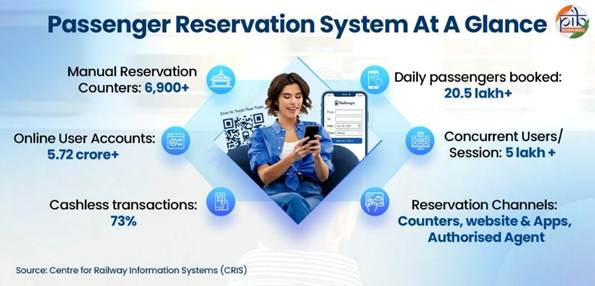
At present, the PRS is one of the world's largest online railways booking platforms. It was developed and is maintained by the Centre for Railway Information Systems (CRIS). It serves over 20.5 lakh passengers every day through multiple booking channels. Around 73% of PRS transactions are cashless. PRS has evolved into one of India's largest public-facing online platforms.
Meeting the Needs of Digital India
To meet growing demand, Indian Railways requires a booking system capable of handling higher transaction volumes while delivering faster, more reliable, and more secure services.
To strengthen the reservation ecosystem, Indian Railways introduced several passenger-centric reforms:
- Advance Reservation Period (ARP) reduced from 120 days to 60 days to better align with passenger booking patterns.
- Aadhaar-authenticated Tatkal booking introduced in July 2025 to improve fairness and transparency.
- OTP-based verification added later to curb misuse by automated bots and unauthorised agents. The existing PRS, deployed in 2010 on Itanium servers and the OpenVMS platform, was designed for a different scale of digital demand. It is now being upgraded to a cloud-enabled, next-generation reservation system.
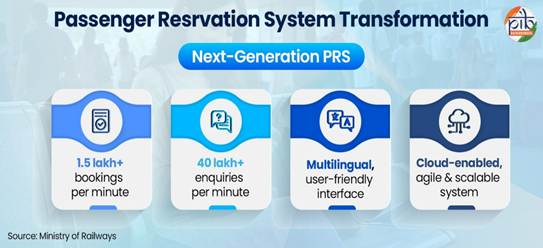
The upgraded PRS will deliver:
- Over 1.5 lakh ticket bookings per minute, compared to 32,000 under the existing setup.
- Over 40 lakh enquiries per minute, up from 4 lakh currently.
- A multilingual, user-friendly interface for booking and enquiries.
- Greater scalability, flexibility and reliability to support future passenger demand.
|
Passenger facilities are also being strengthened through a redesigned IRCTC website. The beta version, launched in July 2026, features a simplified interface, fewer booking steps and seat availability across all classes. The new portal will be integrated with the next-generation PRS, creating a smoother booking experience.
Beyond railway ticketing, IRCTC also offers travel-related services through its tourism platform, including hotel bookings, retiring rooms, lounge bookings, tour packages, flight tickets and bus tickets.
|
CRIS: Institution Driving Railway Technology
Established in 1986, Centre for Railway Information Systems (CRIS) designs, develops and maintains the IT infrastructure for Indian Railways. Over nearly four decades, CRIS has expanded from computerising railway bookings to developing integrated digital platforms. Currently, its solutions support millions of passengers and railway personnel every day.
Passenger-Centric Digital Services
CRIS has developed several platforms, including PRS, that have transformed how passengers interact with Indian Railways.
- Unreserved Ticketing System (UTS): Supports paperless and mobile ticketing for unreserved travel.
- National Train Enquiry System (NTES): Provides real-time train running status, schedules and arrival or departure information.
- RailConnect: Introduced in 2017, the RailConnect mobile application brought PRS services to smartphones. It enabled online ticket booking, ticket cancellation and PNR enquiries.
- RailOne: Launched in July 2025, RailOne is an integrated mobile application. RailOne combines multiple functions into a unified interface, simplifying access to railway services. The application has recorded over 4.55 crore downloads across Android and iOS devices (till 22nd July). It is currently facilitating around 9.65 lakh ticket bookings every day. One of its latest features is AI-based waitlist confirmation prediction. It estimates the likelihood of a waitlisted ticket being confirmed before the journey, even at the time of booking tickets. The prediction accuracy has improved from 53% to 94%, helping passengers make more informed travel decisions.
- RailMadad: Provides an integrated platform for passenger grievances, feedback and service requests. Passengers can seek assistance through the RailMadad website, mobile application, SMS and Railway Helpline 139. The platform uses automated complaint assignment and auto-escalation for timely grievance redressal. Details of grievances resolved during last three years:
|
Year
|
Percentages of Grievances Resolved
|
|
2023-2024
|
99.98%
|
|
2024-2025
|
99.99%
|
|
2025-2026
|
99.98%
|
- CoachMitra: Helps passengers request onboard facilities such as housekeeping and assistance during their journey.
- Rail Sugam: Provides information on railway services, freight and passenger-related facilities.
- Rail Rajbhasha: Supports the use of Hindi in railway administration through digital tools.
Technology Supporting Railway Operations
Beyond passenger services, CRIS has developed digital systems that improve railway efficiency.
- Freight Operations Information System (FOIS): Digitises freight movement, wagon management and logistics planning.
- Crew Management System (CMS): Streamlines crew scheduling, deployment and monitoring.
- eDrishti: Provides dashboards for monitoring railway performance and operational indicators.
- Aapoorti: Digitises procurement and tender management processes.
- Chalak Dal and Hand-Held Terminals: Support field operations, inspections and real-time monitoring.
Adopting Emerging Technologies
CRIS continues to modernise railway technology through advanced digital solutions. It is adopting Artificial Intelligence (AI), Machine Learning (ML), Big Data Analytics and Cloud Computing. It is also adopting Blockchain, the Internet of Things (IoT) and Augmented/Virtual Reality (AR/VR) across railway applications. These technologies are being used to:
- Predict train delays and waitlist confirmation.
- Optimise train routes and timetables.
- Forecast energy consumption.
- Enable predictive maintenance of railway assets.
- Improve planning and operational decision-making.
The next-generation PRS builds on this technological foundation. It combines cloud-enabled infrastructure with advanced digital technologies to create a faster, smarter and more scalable reservation platform.
A Future Ready Reservation Ecosystem
The Passenger Reservation System reflects the digital transformation of Indian Railways over nearly four decades. Today, it is a trusted reservation platform used by millions of travellers across the country. The next-generation PRS builds on this strong foundation. Together, these will deliver faster, more reliable and more seamless railway offerings. As passenger needs continue to evolve, Indian Railways is building a future-ready reservation ecosystem.
Centre for Railway Information Systems:
https://cris.org.in/loadpage?page=indexNew#home
Ministry of Railways
https://indianrail.gov.in/enquiry/PNR/PnrEnquiry.jsp
https://sr.indianrailways.gov.in/view_detail.jsp?lang=0&id=0,4,268&dcd=19160&did=17678519509983E5D5568AFF4D66322B878236BFF8C69
https://www.pib.gov.in/Pressreleaseshare.aspx?PRID=1685036®=48&lang=2
https://www.pib.gov.in/Pressreleaseshare.aspx?PRID=1566211&lang=2®=48
https://indianrailways.gov.in/railwayboard/uploads/directorate/eff_res/work_Study/2019-20/208_SR_2019-20.pdf
https://www.pmf.irctc.co.in/cn/TermsAndConditions.html
https://www.pib.gov.in/PressReleaseIframePage.aspx?PRID=2141145®=48&lang=2
https://indianrailways.gov.in/railwayboard/uploads/directorate/eff_res/work_Study/2019-20/81_NR_2019-20.pdf
https://www.pib.gov.in/PressReleasePage.aspx?PRID=2258800®=3&lang=1
https://www.pib.gov.in/PressReleasePage.aspx?PRID=2154363®=48&lang=2
https://www.pib.gov.in/PressReleaseIframePage.aspx?PRID=2140614®=48&lang=2
https://www.pib.gov.in/PressReleasePage.aspx?PRID=2285066®=48&lang=1
https://www.pib.gov.in/PressReleaseIframePage.aspx?PRID=2065879®=48&lang=2
https://www.pib.gov.in/PressReleasePage.aspx?PRID=2135694®=48&lang=2
https://www.pib.gov.in/PressReleasePage.aspx?PRID=1486017®=48&lang=2
https://www.pib.gov.in/PressReleasePage.aspx?PRID=2140614®=48&lang=2
https://www.pib.gov.in/PressReleasePage.aspx?PRID=2287719®=48&lang=1
https://www.pib.gov.in/PressReleasePage.aspx?PRID=1514686®=48&lang=2
Click to see PDF
***
PIB Research
(Release ID: 2295409)
Visitor Counter : 1476