Ministry of Social Justice & Empowerment
Government Strengthens Rehabilitation Framework for Persons Engaged in Begging under SMILE-Beggary Scheme
₹45.59 Crore Released under SMILE-Beggary Scheme Since Inception; 10,446 Persons Including 2,824 Children Rehabilitated
Posted On:
11 AUG 2026 6:50PM by PIB Delhi
The Central Government has taken comprehensive measures to strengthen the care, rehabilitation and social reintegration of persons engaged in begging through the Support for Marginalized Individuals for Livelihood and Enterprise (SMILE) – Comprehensive Rehabilitation of Persons Engaged in the Act of Begging (SMILE-Beggary) Scheme.
This information was provided by the Minister of Social Justice and Empowerment, Shri B.L. Verma, in a written reply to Dr. M P Abdussamad Samdani in the Lok Sabha.
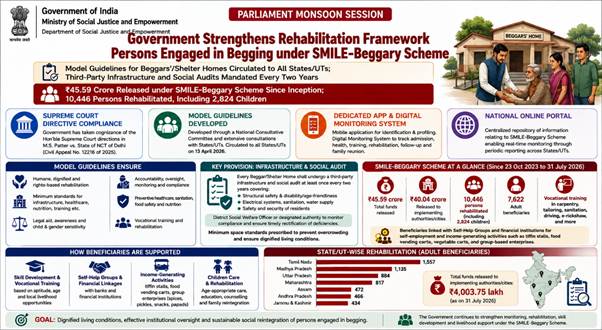
The reply said that since inception of the SMILE-Beggary Scheme on 23 October 2023 and up to 31 July 2026, a total of ₹45.59 crore has been released under the Scheme. This includes ₹40.04 crore released to implementing authorities/cities, with the balance utilised towards administrative and other scheme-related expenditure.
As on 31 July 2026, a total of 10,446 persons including 2,824 children, have been rehabilitated under the SMILE-Beggary Scheme. Of these, 7,622 are adult beneficiaries, the reply further said.
Children rescued under the Scheme are provided age-appropriate care, education, counselling and family reintegration and are therefore not covered under vocational training interventions.
The Scheme provides vocational training to eligible beneficiaries based on their aptitude, age, physical and mental condition, and local livelihood opportunities. Training includes trades and livelihood activities such as carpentry, tailoring, housekeeping, management of community toilets, sanitation services, hair cutting, security services, cooking, gardening, driving/operation of e-rickshaws and other locally relevant trades.
Beneficiaries are also facilitated in forming community/group-based Self-Help Groups and are linked with banks and other financial institutions for financial assistance to undertake self-employment and income-generating activities. These include tiffin stalls/food vending carts, vegetable vending carts and group-based enterprises such as preparation of spices, pickles, snacks and papads.
The written reply said as per the State/UT-wise details provided in the Lok Sabha reply, Tamil Nadu recorded the highest number of adult beneficiaries rehabilitated at 1,557, followed by Madhya Pradesh (1,135), Uttar Pradesh (884), Maharashtra (817), Assam (472), Andhra Pradesh (466), Jammu & Kashmir (434) and Kerala (418).
The Government's measures under the SMILE-Beggary Scheme aim to strengthen institutional mechanisms for care, rehabilitation, skill development, livelihood support and social reintegration, while ensuring dignified living conditions and effective monitoring of Beggars’/Shelter Homes.
In compliance with the directions of the Hon’ble Supreme Court in M.S. Patter vs. State of NCT of Delhi (Civil Appeal No. 12216 of 2025), the Ministry of Social Justice and Empowerment has developed Model Guidelines for Beggars’/Shelter Homes through a National Consultative Committee and extensive consultations with States and Union Territories. The Guidelines were circulated to all States/UTs on 13 April 2026 for necessary compliance and effective implementation.
The National Consultative Committee included representatives from the Ministries of Law & Justice, Health & Family Welfare, Housing and Urban Affairs, Women and Child Development, Skill Development and Entrepreneurship, the National Human Rights Commission, State/UT Governments and non-governmental organisations working in the sector.
The Model Guidelines establish a comprehensive framework for humane, dignified and rights-based rehabilitation of persons engaged in begging. They prescribe minimum standards for infrastructure and capacity, preventive healthcare and sanitation, nutrition and food safety, vocational training and rehabilitation, legal aid and awareness, child and gender sensitivity, accountability, oversight, monitoring, implementation and compliance.
To facilitate identification, profiling and rehabilitation, the Ministry has developed a dedicated mobile application, with login credentials shared with implementing cities. The application facilitates a comprehensive survey of persons engaged in begging for their rehabilitation under the SMILE-Beggary Scheme.
The Model Guidelines further provide for establishment of a Digital Monitoring System by States/UTs to capture standardised information relating to admission of rescued persons/residents, health status, skill development and training, rehabilitation, release, follow-up and family reunion. The National Online Portal of the Ministry serves as a central repository of information relating to the SMILE-Beggary Scheme and facilitates real-time monitoring of implementation across States and Union Territories through periodic reporting and maintenance of scheme-related information.
Two-Yearly Infrastructure and Social Audits
The Model Guidelines mandate that every Beggar/Shelter Home undergo a third-party infrastructure and social audit at least once every two years. The audit covers structural safety, disability and age-friendliness, electrical systems, sanitation, water supply, and the safety and security of residents. The District Social Welfare Officer or designated authority is responsible for monitoring compliance and ensuring timely rectification of deficiencies identified during the audit. The Guidelines also prescribe minimum space standards for Beggars’/Shelter Homes to prevent overcrowding and ensure dignified living conditions.
****
PR-66-TAR-KV-GA
(Release ID: 2297830)
Visitor Counter : 873