PIB Backgrounder
World Elephant Day
Celebrating Elephants, Ecosystems and Coexistence
Posted On:
12 AUG 2026 11:27AM by PIB Delhi
|
World Elephant Day highlights the ecological and cultural importance of elephants. India hosts nearly 60% of the world’s wild Asian elephant population and has strengthened conservation through Project Elephant, Elephant Reserves and protected corridors. Scientific monitoring, technology-driven conservation and community participation further support coexistence between people and elephants. These sustained efforts reflect the Government of India’s commitment to safeguarding elephants, ecosystems and India’s natural heritage.
|
The Gentle Giant of India's Forests
India is home to nearly 60% of the world’s wild Asian elephants, highlighting its vital role in global elephant conservation. Elephants hold deep cultural significance and play a vital role in healthy ecosystems. As a keystone species, they sustain forests, support biodiversity and maintain ecological balance. The Synchronous All India Population Estimation of Elephants (SAIEE) 2021–25 estimates India’s wild elephant population at 22,446. These elephants are protected across 33 Elephant Reserves and 150 identified corridors.
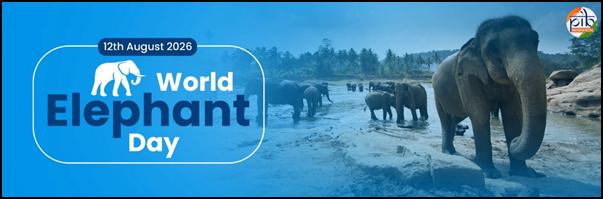
This rich elephant heritage also brings a responsibility to address growing conservation challenges. World Elephant Day, observed annually on 12 August, highlights the need for sustained global action. India’s conservation efforts address habitat loss, fragmentation, poaching, illegal wildlife trade and human-elephant conflict. The country combines legal protection, habitat conservation, scientific monitoring and community participation as part of its conservation efforts. Technology-driven measures further strengthen these efforts and support the long-term survival of elephants in the wild.
The Enduring Significance of Elephants in India
Elephants are integral to India’s natural and cultural heritage. Their significance spans ecosystem health, cultural traditions and community identities.
Ecological Importance
Elephants are foundational species that shape forest structure and ecosystem functioning. They are migratory in nature, with home ranges spanning 100–3,000 km². As they move long distances, they create pathways and water holes that benefit other wildlife. Their feeding habits support nutrient cycling, and bring about seed dispersal that aids forest regeneration. This helps in connecting fragmented forests and creating favourable conditions for thriving genetic diversity. Protecting elephants therefore strengthens ecological connectivity, forest health and wider biodiversity.
Cultural and Social Importance

Elephants have shaped India’s religious traditions, cultural practices and community identities for centuries. Lord Ganesha represents wisdom and the removal of obstacles in North Indian traditions. Elephants historically symbolised authority and prestige as royal emblems. Temple elephants remain part of religious rituals and festivals in South India. Communities across the Northeast worship Lord Ganesha as a manifestation of their deities and regard elephants with deep respect. Some communities traditionally view elephants as elders and symbols of wisdom. These traditions highlight the enduring place of elephants in India’s cultural heritage and community life.

Counting the Giants: Where India's Elephants Stand Today
India's elephant conservation story is best told through numbers. From reserve networks to corridor restoration, each figure reflects decades of sustained institutional effort.
Project Elephant: A Comprehensive Conservation Framework
Project Elephant is the Government of India's flagship initiative for elephant conservation. Implemented by the Ministry of Environment, Forest and Climate Change (MoEFCC), the programme provides financial and technical support to States for protecting elephant habitats, conserving captive elephants and mitigating human-elephant conflict. It also promotes science-driven conservation through AI-enabled monitoring, radio-collaring, genetic databases and early warning systems.
|
DNA-based Sampling
Scientific monitoring under Project Elephant has strengthened elephant population assessment. SAIEE 2021–25 used India’s first DNA-based synchronised elephant census. Scientists analysed dung samples to identify individual elephants through unique genetic fingerprints. This helped detect repeat samples across landscapes and improve population estimates. SAIEE combined DNA profiling, block counts and line-transect surveys, strengthening the scientific rigour of elephant population assessment.
|
Securing India's Elephant Corridors
Elephant corridors play an important role in elephant conservation in India. They connect erstwhile natural habitats that have got fragmented due to human development or other reasons. The elephant corridors are habitats that have been developed to connect fragmented habitats. They are essential for maintaining healthy and genetically diverse elephant populations by enabling safe movement between fragmented habitats and helping reduce human-elephant conflict. They also support long-term population viability by maintaining ecological connectivity. Under Project Elephant, the Government has identified and validated elephant corridors across 14 elephant-range states.
According to Elephant Corridors of India, 2023, prepared with technical support from the Wildlife Institute of India, these corridors span across four regions. The East-Central region has 52 corridors, followed by the North-East (48), Southern (32) and Northern (18) regions. West Bengal has the highest number, with 26 corridors. This accounts for more than 17% of the national total. The network includes 19 inter-state corridors and six transboundary corridors connecting India and Nepal. Monitoring shows increased elephant use in 59 corridors (40%), stable use in 29 (19%), declining use in 29 (19%), and impaired conditions in 15 corridors.
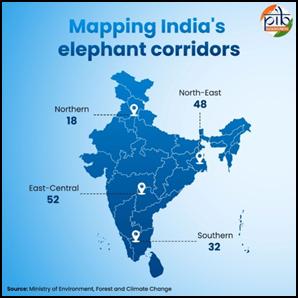
Protecting these corridors strengthens habitat connectivity, reduces conflict and supports the long-term conservation of India’s elephant populations.
|
Sustained Corridor Conservation
The Government continues to strengthen these ecological lifelines through scientific monitoring, boundary delineation and integration into State working and management plans. Currently, 150 corridors support elephant movement. These sustained efforts are strengthening habitat connectivity and securing safer movement for elephants across India's forest landscapes.
|
Growing the Reserve Network
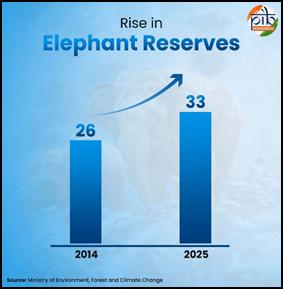
Elephant Reserves have expanded steadily since 2014, now covering 80,777 km across 14 major elephant-range states. The expansion has brought an additional 8,610 km² under protection, securing critical habitats and strengthening ecological connectivity. It has also improved scientific management and created a stronger foundation for the long-term survival of India's wild elephant population.
Collectively, Project Elephant, scientific population estimation, protected reserves and connected corridors have transformed elephant conservation into an integrated landscape-level programme. These initiatives demonstrate the Government's commitment to combining traditional conservation values with modern science to secure the future of the Asian elephant.
Beyond the Count: Protecting Every Elephant
Estimating elephant populations is only one part of conservation. Long-term success depends on safer habitats, stronger legal safeguards and peaceful coexistence with communities. The Government of India has adopted a comprehensive conservation approach that combines science, technology, infrastructure and public welfare. These initiatives protect elephants both inside forests and across shared landscapes.
India has sought to improve how elephant landscapes are managed. The Management Effectiveness Evaluation framework for Elephant Reserves was launched in 2023 and tested in four representative reserves—Shivalik, Kaziranga–Karbi Anglong, Mayurbhanj and Nilgiri. Building on the pilot experience, the Government is taking this framework to Elephant Reserves across the country, supported through CAMPA funding. This institutionalises transparent assessment and adaptive management based on measurable conservation outcomes.
More recently, the Ministry has taken this landscape-based approach a step further by developing Regional Action Plans for all elephant-bearing regions of the country. These plans recognise that elephants range across State boundaries and that challenges relating to habitat connectivity, human-elephant conflict and landscape management require coordinated action across jurisdictions. The Regional Action Plans provide a common framework for States to undertake priority conservation and conflict-mitigation interventions at the landscape scale.
Making Railways Safer for Elephants
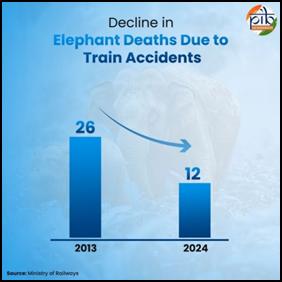
The Government has taken decisive steps to reduce elephant deaths along railway corridors. Joint surveys covered 127 sensitive railway stretches spanning 3,452.4 km. Further, Seventy-seven stretches across 14 States, covering 1,965.2 km, have been recommended for mitigation measures involving 705 structures, including underpasses, overpasses, ramps, level crossings and bridge modifications. These structural interventions are being complemented by technologies such as optical-fibre-based intrusion detection, seismic sensors and thermal cameras.
Also, AI-enabled Distributed Acoustic Sensing systems now provide real-time alerts to loco pilots, station masters and control rooms. Every train collision involving elephants is jointly investigated with the concerned State Forest Department. These sustained interventions reduced train-hit elephant deaths from 26 in 2013 to 12 in 2024, a decline of more than 50 percent.
Guarding Captive Elephants Through Genetics
The Government has strengthened safeguards against the illegal trade and movement of captive elephants through science-based monitoring. Under the Wildlife (Protection) Act, 1972, cases related to sale, transport and procurement are referred to State Chief Wildlife Wardens for action. The Gajah Suchana mobile application has created a national genetic database containing DNA profiles, morphological characteristics and ownership details of every registered captive elephant. The database verifies identity before movement and provides reliable forensic evidence during legal proceedings.
|
Captive Elephant (Transfer or Transport) Rules, 2024
To regulate the movement of captive elephants, the Government notified the Captive Elephant (Transfer or Transport) Rules, 2024. A High-Powered Committee examines interstate transfers of captive elephants. It was constituted under the Supreme Court's order dated March 3, 2023. Together, the application, the rules and the committee strengthen transparency and curb illegal transfer of captive elephants.
|
Supporting Communities for Peaceful Coexistence
Conservation succeeds when communities become equal partners in protecting wildlife. The Government provides ex-gratia assistance under the Centrally Sponsored Schemes Project Tiger and Elephant and Development of Wildlife Habitats. Assistance includes ₹10 lakh for death or permanent incapacitation, ₹2 lakh for grievous injury, treatment costs up to ₹25,000 for minor injuries, and compensation for crop and property losses as per State and UT norms.
The Government has further strengthened conflict management through the Human-Wildlife Conflict Advisory. It recommends hotspot mapping, rapid response teams, State and district-level review committees and faster compensation. Elephant-specific conflict mitigation guidelines, issued in 2023, further improve coordination among stakeholders. Together, these measures protect both elephants and people, strengthening safe and sustainable coexistence across India's elephant landscapes.
Reverence to Responsibility
India’s relationship with elephants reflects a unique harmony between civilisational values and modern conservation. Revered for centuries, elephants continue to inspire India’s commitment to protecting nature and maintaining ecological balance. This legacy is now strengthened through scientific research, technology, strong institutions and community participation.
The Government of India has developed a comprehensive framework for elephant conservation. Efforts include securing habitats, expanding Elephant Reserves, protecting corridors, improving railway safety and regulating captive elephant movement. Support for communities affected by human-elephant conflict further strengthens coexistence between people and wildlife.
As India observes World Elephant Day 2026, its commitment to elephant conservation remains steadfast. Every protected habitat, restored corridor and community partnership strengthens the future of the Asian elephant. Under Viksit Bharat, India continues to protect both its natural heritage and civilisational legacy for future generations.
References
MINISTRY OF ENVIRONMENT, FOREST AND CLIMATE CHANGE
World Elephant Day
*****
PIB Research
(Release ID: 2298058)
Visitor Counter : 3129