PIB Backgrounder
Reforming India’s Tribunal System
Tribunal Reforms Bill, 2026
Posted On:
12 AUG 2026 2:29PM by PIB Delhi
|
The Tribunals Reforms Bill, 2026 seeks to create a more independent, transparent and professionally administered tribunal system. The Bill provides for setting up of a judiciary-led National Tribunals Commission that will make selections to the tribunals and exercise oversight on their functioning. The aim is to reduce executive discretion while strengthening accountability. By creating a common institutional framework for tribunal administration, the Bill seeks to address longstanding concerns over appointments, tenure and functioning, while giving effect to the principles laid down by the Supreme Court in its Madras Bar Association judgments.
|
Strengthening India’s Tribunal System
The Tribunal Reforms Bill, 2026 passed by the Parliament in August 2026, aims to reform the tribunal system to make it more efficient, independent of the executive, transparent and uniform.
The Bill follows various Supreme Court judgements on the independence of tribunals. In Madras Bar Association v. Union of India [(2026) 2 SCC 1], the Supreme Court struck down provisions of the Tribunals Reforms Act, 2021. The Court also directed the establishment of an independent National Tribunals Commission.
The 2026 Bill proposes to repeal the Tribunal Reforms Act, 2021. It introduces a new structure to ensure that the system is independent yet accountable to the people it serves.
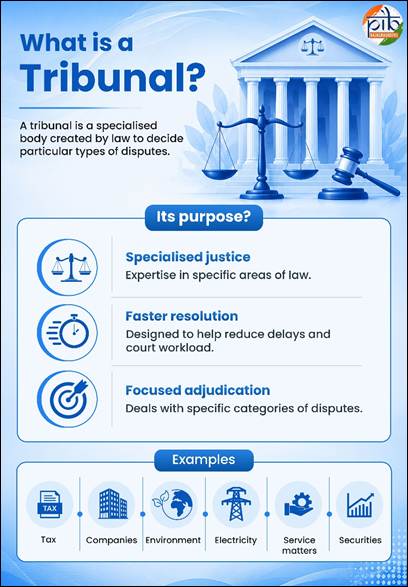
Covered Tribunals & Governing Acts
The Bill lists all the Tribunals, Appellate Tribunals, and Authorities governed by the bill, alongside their corresponding Enactments. The changes proposed by the Bill shall apply to these tribunals.
|
Sl. No.
|
Tribunal / Appellate Tribunal / Authority
|
Enactments
|
|
1.
|
Customs, Excise and Service Tax Appellate Tribunal
|
The Customs Act, 1962 (52 of 1962)
|
|
2.
|
Appellate Tribunal
|
The Smugglers and Foreign Exchange Manipulators (Forfeiture of Property) Act, 1976 (13 of 1976)
|
|
3.
|
Central Administrative Tribunal
|
The Administrative Tribunals Act, 1985 (13 of 1985)
|
|
4.
|
State Administrative Tribunals
|
The Administrative Tribunals Act, 1985 (13 of 1985)
|
|
5.
|
Railway Claims Tribunal
|
The Railway Claims Tribunal Act, 1987 (54 of 1987)
|
|
6.
|
Securities Appellate Tribunal
|
The Securities and Exchange Board of India Act, 1992 (15 of 1992)
|
|
7.
|
Debts Recovery Tribunal
|
The Recovery of Debts and Bankruptcy Act, 1993 (51 of 1993)
|
|
8.
|
Debts Recovery Appellate Tribunal
|
The Recovery of Debts and Bankruptcy Act, 1993 (51 of 1993)
|
|
9.
|
Telecom Disputes Settlement and Appellate Tribunal
|
The Telecom Regulatory Authority of India Act, 1997 (24 of 1997)
|
|
10.
|
Appellate Tribunal for Electricity
|
The Electricity Act, 2003 (36 of 2003)
|
|
11.
|
Armed Forces Tribunal
|
The Armed Forces Tribunal Act, 2007 (55 of 2007)
|
|
12.
|
National Green Tribunal
|
The National Green Tribunal Act, 2010 (19 of 2010)
|
|
13.
|
National Company Law Appellate Tribunal
|
The Companies Act, 2013 (18 of 2013)
|
|
14.
|
National Consumer Disputes Redressal Commission
|
The Consumer Protection Act, 2019 (35 of 2019)
|
|
15.
|
Industrial Tribunal constituted by the Central Government
|
The Industrial Relations Code, 2020 (35 of 2020)
|
|
16.
|
Income-tax Appellate Tribunal
|
The Income-tax Act, 2025 (30 of 2025)
|
A New National Tribunals Commission
The 2026 Bill aims at protecting the independence of the tribunals system through the establishment of a new National Tribunals Commission (NTC). This commission, which will be dominated by the high-ranking members of the judiciary, replaces the Central Government, which was given the charge of making key appointments and services conditions according to the Tribunal Reforms Act, 2021.
Composition of the Commission
The Commission would consist of:
- A Chairperson who has been a Judge of the Supreme Court or a Chief Justice of a High Court, and
- Four Members:
- Two shall be Judicial Members who have been Chief Justice or Judge of a High Court
- Two shall be Technical Members with at least 25 years of experience in the fields of public administration, finance, law, accountancy, banking, management, or technology.
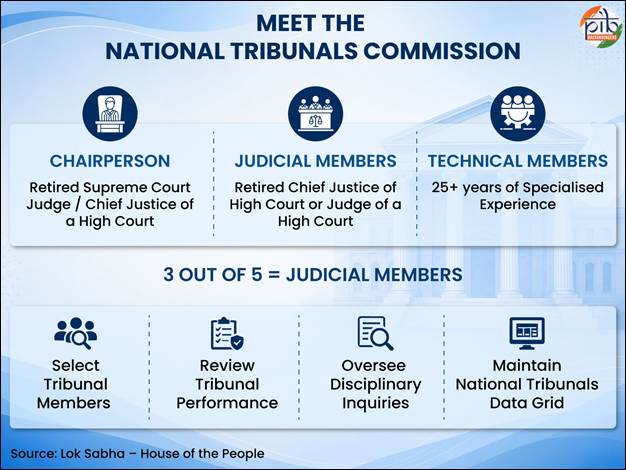
The Central Government will formally appoint the Chairperson and the Judicial Members of the Commission. However, it must consult the Chief Justice of India before appointing the Chairperson and Judicial Members.
Functions of the Commission
Under the Tribunals Reforms Bill, 2026, the National Tribunals Commission (NTC) has several important roles:
- Conduct selections: Conduct the selection process for filling up the vacancies of Chairpersons and Members of the Tribunals through Search-cum-Selection Committees.
- Review performance: Monitor tribunal performance and prepares annual reports to be submitted to the Central Government.
- Oversee inquiries: Supervise inquiries into complaints against tribunal members.
- Maintain data: Develops and maintains the National Tribunals Data Grid, which is a portal containing the repository of all case-related information pertaining to the 16 tribunals.
Term of Service
- The Chairperson of the Commission or a Member of the Commission shall hold office for a term of five years or till he attains the age of seventy years, whichever is earlier
- A Member of a Tribunal shall hold office for a term of five years or till he attains the age of sixty-seven years, whichever is earlier.
The framework also allows reappointment, with previous service and performance considered during the selection process.
New Secretariat
The Secretariat serves as the administrative support system for the National Tribunals Commission. The Secretariat will be headed by a Secretary to the Government of India. Its other officers and employees, including their number and service conditions, will be prescribed by rules. It will function under the general and administrative oversight of the Commission’s Chairperson. It:
- Empanels experts: Identifies and empanels experts from relevant fields to assess candidates.
- Communicates recommendations: Sends the Search-cum-Selection Committee’s recommendations to the Central Government within three days.
- Provides administrative support: Supports the Commission and carries out functions prescribed.
- Prepares annual reports: Prepares an annual report yearly giving full and true account of the activities of the Commission and forward the report to the Central government.
-
Search-cum-Selection Committees
The selection of Chairpersons and Members to various tribunals will be done through Search-cum-Selection Committees. These committees will be responsible for evaluating candidates and recommending appointments to tribunal posts.
Under Section 13 of the Tribunals Reforms Bill, 2026, the Search-cum-Selection Committee comprises:
For selecting a Tribunal Chairperson
- Chairperson of the National Tribunals Commission
- Technical Member of the Commission
- Retired Chief Justice of a High Court, nominated by the Commission Chairperson
- Secretary to the Government of India, nominated by the Central Government. In case of appointment to the post of Chairperson of the State Administrative Tribunals, the Chief Secretary to the State Government concerned shall be the Member
- Two empanelled experts who assessed the candidates
- Secretary of the Commission — Member Secretary
For selecting a Tribunal Member:
- Judicial Member of the National Tribunals Commission — Committee Chair
- Technical Member of the Commission
- Retired High Court Judge, nominated by the Commission Chairperson
- Secretary to the Government of India, nominated by the Central Government. In case of appointment to the post of Member of the State Administrative Tribunals, the Chief Secretary to the State Government concerned shall be the Member
- Two empanelled experts who assessed the candidates
- Secretary of the Commission — Member Secretary
The Committee Chair has the casting vote, while the Member Secretary and expert Members do not have voting rights. The Committee:
- Selects candidates: Conducts the selection process for Chairpersons and Members.
- Recommends candidates: The Committee recommends one suitable candidate for each vacancy and one additional candidate for the waiting list.
- Considers past performance: For candidates seeking reappointment, the Committee considers their previous service and performance.
- Facilitates timely appointments: Recommendations are sent to the Central Government through the Secretariat, which must communicate them within three days. The Government must process the recommendation and make the appointment within three months.
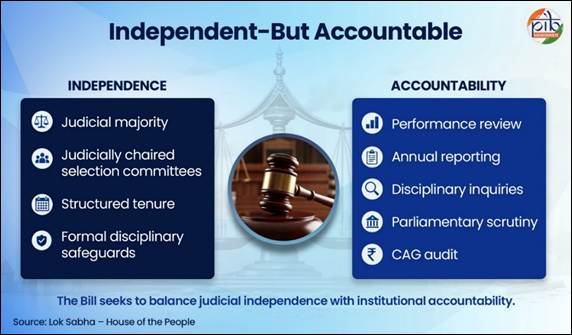
The proposed National Tribunals Commission has a judicial majority. Its Search-cum-Selection Committees are also judicially chaired. The judicial Chairperson has the casting vote. The Committee recommends a single candidate rather than a panel of names. This strengthens judicial influence over the selection process while limiting executive discretion.
Financial and Administrative Independence
The Bill seeks to give tribunals greater financial and administrative autonomy. Under this framework, individual tribunals will identify their requirements for funds, staff, and premises. The Commission's Secretariat will consolidate these projections, and the Commission will evaluate them using an objective framework to determine overall allocation needs.
The Central Government will continue to allocate the necessary grants following parliamentary appropriation.To ensure financial accountability and transparency, the Comptroller and Auditor-General of India (CAG) will audit the accounts of the Commission and forward the audit report to the Central Government, which will then lay it before both Houses of Parliament.
Towards a More Independent Tribunal System
The Tribunals Reforms Bill, 2026 seeks to establish judicial independence and transparency in the tribunals system. While the Bill reinforces judicial independence, it balances this by keeping the system accountable to the public through parliamentary oversight.
The proposed National Tribunals Commission creates a permanent institutional mechanism for appointments, performance review and disciplinary oversight. Judicially led selection committees strengthen the judicial element in appointments. Expert assessment places greater emphasis on professional competence. Five-year tenure provides greater stability.
The Bill marks a shift from fragmented, executive-driven tribunal rules to a structured institutional framework. Its core goal is to establish a more independent, transparent, and professionally managed system that aligns with the Supreme Court's Madras Bar Association jurisprudence.
References:
https://sansad.in/ls
https://prsindia.org/billtrack/prs-products/the-tribunal-system-in-india
https://www.indiacode.nic.in/handle/123456789/16901?view_type=browse
Reforming India’s Tribunal System
******
PIB Research
(Release ID: 2298157)
Visitor Counter : 5412