Ministry of Science & Technology
AI uncovers hidden cancer stem cells responsible for tumour recurrence paving way to precision medicine
प्रविष्टि तिथि:
12 AUG 2026 3:42PM by PIB Delhi
A new artificial intelligence (AI) framework that identifies three distinct developmental states of cancer stem-like cells can help identify hidden cancer stem cells from thousands of patient samples and bring precision medicine one step closer to reality specially in areas with limited health facilities.
Cancer remains one of humanity's greatest medical challenges. Although modern treatments can destroy millions of cancer cells, a small population of cells often survives, allowing tumours to return, spread to distant organs and develop resistance to therapy.
Scientists have long believed that these rare cancer stem-like cells that help tumours survive and return and are responsible for tumour recurrence, metastasis and treatment failure. However, because these cells are extremely rare and constantly change their identity, accurately detecting them has remained one of the biggest challenges in cancer research.
Researchers from S. N. Bose National Centre for Basic Sciences (SNBNCBS), an autonomous institute of the Department of Science and Technology (DST), Government of India, in collaboration with Ashoka University, have now developed an artificial intelligence (AI) framework that reveals hidden cancer stem-like cell states from tumour gene-expression data.
This work led by Dr. Shubhasis Haldar builds upon the team's earlier AI platform, OncoMark, which accurately decoded the biological hallmarks that drive cancer progression across millions of cells with over 99% predictive accuracy.
By enabling researchers to measure the fundamental processes that fuel tumour growth, metastasis and drug resistance, OncoMark demonstrated how artificial intelligence can uncover complex biological information hidden within massive genomic datasets. Building on that success, the team has now turned its attention to one of cancer biology's most difficult problems—identifying the elusive stem-like cells that drive tumour evolution.
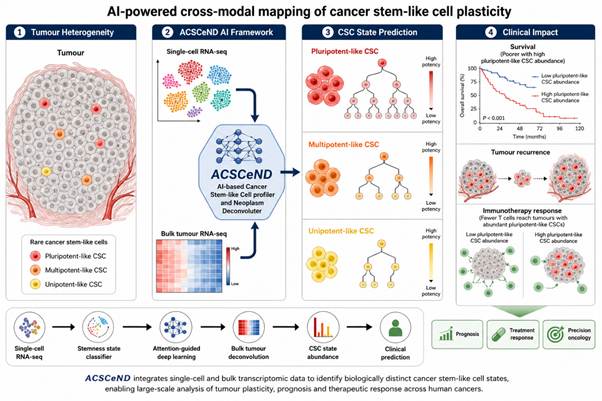
Their new framework, called ACSCeND (AI-based Cancer Stem-like Cell Profiler and Neoplasm Deconvoluter), goes beyond conventional methods that assign tumours a single "stemness" score. Instead, it identifies three distinct developmental states of cancer stem-like cells—pluripotent-like, multipotent-like and unipotent-like—providing an unprecedented view of tumour heterogeneity. The system combines knowledge learned from high-resolution single-cell sequencing with deep learning to analyse conventional bulk tumour RNA sequencing, allowing these hidden cell populations to be studied in thousands of patient samples where single-cell experiments are unavailable.
The researchers rigorously validated ACSCeND against existing computational approaches and showed that it consistently outperformed current methods across independent datasets and sequencing platforms. They then applied the framework to analyse more than 25,000 tumour samples from major international cancer databases, including TCGA and PRECOG. The analyses revealed that tumours enriched with highly potent, pluripotent-like cancer stem cells were associated with poorer patient survival, a greater likelihood of tumour recurrence and reduced response to modern immunotherapies.
Beyond identifying these dangerous cells, ACSCeND also uncovered the molecular programs that enable them to survive, adapt and evade the immune system. Such insights could help scientists discover new drug targets, identify patients who are more likely to relapse and design more effective precision cancer therapies.
Artificial intelligence is rapidly becoming an indispensable partner in modern biomedical research. AI enables researchers to detect hidden biological patterns across enormous genomic datasets that would be impossible to analyse manually.
Studies such as OncoMark and ACSCeND illustrate how AI can accelerate discoveries that ultimately improve cancer diagnosis, predict treatment response and guide the development of more effective therapies.
Publication link: https://doi.org/10.1093/narcan/zcag015
****
NKR/FT
(रिलीज़ आईडी: 2298235)
आगंतुक पटल : 186
इस विज्ञप्ति को इन भाषाओं में पढ़ें:
हिन्दी