PIB Backgrounder
Empowering Governance through Digital Infrastructure
Posted On:
12 AUG 2026 6:20PM by PIB Delhi
Building a Connected and Citizen-Centric India
India's governance has undergone a fundamental transformation through Digital Public Infrastructure (DPI). Public services that once depended on extensive paperwork and physical offices are now available through integrated digital platforms. Over the past 12 years, DPI has connected citizens, governments and institutions on an unprecedented scale. It has made governance faster, transparent and more responsive to citizens' needs.
Digital infrastructure has also emerged as a cornerstone of India's economic growth. Digital Economy now contributes about 12–14% of India's Gross Domestic Product (GDP) and is projected to account for 20% over the next decade. India is now the world’s fifth-largest digitalised economy and the fourth-highest ranked G20 economy, according to the State of India’s Digital Economy Report 2026. As India marks its 80th Independence Day, the continued expansion of digital governance is strengthening service delivery, enabling economic opportunities and advancing the vision of Viksit Bharat.
Key Milestones in India’s Digital Self-Reliance Landscape
Electronics Manufacturing: Driving India's Self-Reliance
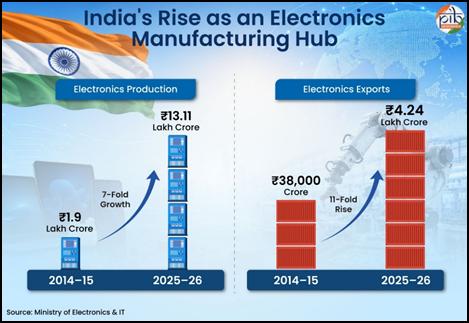
Guided by the vision of Make in India, India has emerged as a global hub for electronics manufacturing. Flagship initiatives, including the Production Linked Incentive (PLI) Scheme, Electronics Components Manufacturing Scheme (ECMS), India Semiconductor Mission (ISM), Modified Electronics Manufacturing Clusters (EMC 2.0), have strengthened domestic manufacturing in India.
- 7-Fold Growth in Electronics Production: Electronics production increased from ₹1.9 lakh crore in 2014–15 to ₹13.11 lakh crore in 2025–26.
- 11-Fold Rise in Electronics Exports: Electronics exports grew from ₹38,000 crore to ₹4.24 lakh crore during the same period.
- Third-largest Export Sector: Electronic goods have now become India's third-largest export category, with exports reaching USD 47.96 billion in FY 2025-26.
- Employment and Women Participation: Electronic manufacturing ecosystem supports nearly 25 lakh jobs, with women accounting for nearly 30% of the workforce.
Building India's Semiconductor Ecosystem
The Union Cabinet approved Semicon 2.0 with an outlay of ₹1.27 lakh crore to strengthen India's semiconductor ecosystem. Under ISM 1.0, 12 semiconductor units worth ₹1.64 lakh crore have been approved. Three facilities have already started commercial production, with another unit expected to commence operations this year.
Mobile Phones: A Major Driver of Growth
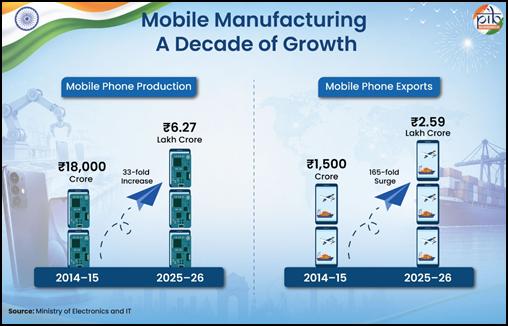
- Global Mobile Manufacturing Hub: India is now the world's 2nd largest mobile phone manufacturer, with mobile phones rising from the 153rd largest export item in FY 2014-15 to become India's largest export product in FY 2025-26.
- 33-fold increase in mobile phone production: Production rose from ₹18,000 crore in 2014–15 to ₹6.27 lakh crore in 2025–26.
- 165-fold surge in mobile phone exports: Exports increased from ₹1,500 crore to ₹2.59 lakh crore over the same period.
- Employment and Women Participation: Out of 12 lakh jobs in mobile manufacturing segment, women constitute nearly 70% of the workforce.
Enhanced Telecommunications Infrastructure
- Telephone Connectivity: Telephone connections increased from 93.3 crore in 2014 to 134.8+ crore at the end of June 2026.
- Higher Tele-density: Tele-density grew from 75.23% in 2014 to 94.31% at the end of June 2026.
- Wireless Mobile Subscribers: The number of active wireless mobile subscribers reached 1201.06 million in June 2026.
Internet and Digital Connectivity
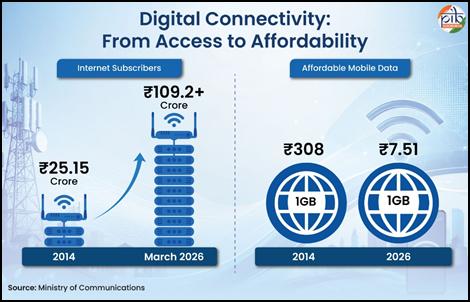
- Internet Users Quadrupled: Internet subscribers increased from 25.15 crore in 2014 to 109.2+ crore at the end of March 2026.
- Affordable Mobile Data: Wireless data cost dropped drastically from ₹308/GB in 2014 to ₹7.51/GB in 2026, making digital services more affordable.
- Mobile broadband speed: Average mobile broadband download speed has increased from 13.67 Mbps in March 2022 to 132.00 Mbps in December 2025 as per Ookla’s global speedtest index.
- Nationwide 5G Rollout: 5G services are now available in 99.9% of districts across all States and Union Territories. The number of 5G Base Transceiver Stations (BTSs) has now reached 5.63 lakh in June 2026.
- Expanding Rural Mobile Connectivity: A total of 6.31 lakh villages have been now covered with 4G services by BSNL and other operators.
- Connectivity under BharatNet Initiative: As of June 2026, 2.21 lakh Gram Panchayats are service-ready, supported by over 8.5 lakh route km of optical fibre cable.
- PM-WANI: PM-WANI provides affordable public Wi-Fi through a distributed network of public data offices and other ecosystem partners. Over 4 lakh hotspots have been deployed nationwide, as of 28 February 2026. New reforms introduced in May 2026 enable QR-based authentication, 15, 30 and 60-minute Wi-Fi plans, and standardised hotspot names.
India is Preparing for the 6G Era
The Bharat 6G Vision aims to position India among the global leaders in 6G technology by 2030, with a focus on indigenous research, intellectual property, standards development and next-generation telecom innovation.
UPI: Powering Seamless Digital Payments
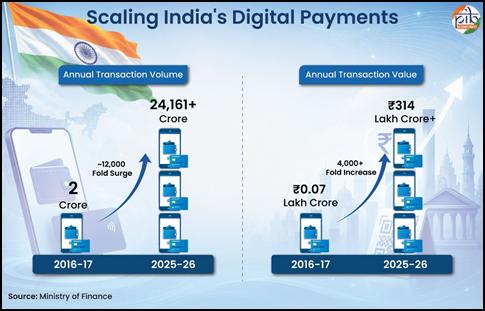
UPI accounts for nearly 50% of global real-time payment transaction volume, making it the world's largest real-time payment system by volume.
- Volume of Transactions: UPI processed 24,161.69 crore transactions worth ₹314.23 lakh crore in FY 2025–26.
- India’s Largest Digital Payments Network: UPI serves more than 55.49 crore individuals, 6.5 crore merchants, and connects 731 banks on one platform, making it the world’s largest digital payment system.
- Share of UPI in India's Digital Payments: UPI accounted for 85% of India's digital payment transactions by volume in FY 2025–26.
- Monthly Transactions Soar: UPI transactions increased from 0.01 crore in a month in 2016 to 2,000+ crore transactions in a month by 2025, reflecting its rapid adoption across India.
- UPI Goes Global: UPI is now accepted in 11 foreign countries like Cambodia, Singapore, UAE, France, Mauritius etc.
- Open Network for Digital Commerce (ONDC): ONDC is building an open digital commerce ecosystem connecting buyers and sellers across platforms.
- By June 2026, it had over 20 crore buyers, 5 lakh sellers, presence in 1,000 cities and nearly 90 lakh monthly transactions.
- Its integration with eSaras and Indiahandmade has expanded market access for SHGs, weavers and artisans across 11+ buyer apps, while the Sahayak WhatsApp Bot supports small businesses in 5 languages.
- Government e-Marketplace (GeM): GeM has transformed public procurement by making it transparent, efficient and paperless.
- By June 2026, it recorded over ₹18.4 lakh crore in cumulative Gross Merchandise Value (GMV), including ₹5 lakh crore in FY 2025–26, and enabled over 11 lakh MSMEs to access government markets.
- SWAYATT (Startup Runway for Women and Youth-led Enterprises) initiative, promotes inclusive public procurement through the GeM by enabling startups, women and youth-led enterprises to directly access government buyers.
- By FY 2025–26, women-led businesses recorded ₹83,323 crore and startups ₹54,005.8 crore in cumulative order value, demonstrating the initiative’s growing reach.
E-Governance Initiatives Revolutionising G2C Services
- DigiLocker: DigiLocker is replacing physical documents with a secure digital wallet. As of 31 July 2026, the platform has registered over 72 crore users and issued more than 934+ Cr documents.
- UMANG: UMANG has become a single digital gateway for government services, expanding from 166 services in 2017 to 2585 services as of 23 July 2026. Transactions have grown from 4.6 crore to over 798 crore as of 23 July 2026, reflecting widespread digital adoption.
- Aadhaar: Aadhaar created a trusted biometric identity platform for secure and instant digital authentication. Aadhaar generation increased from 0.42 crore in 2010-11 to over 145 crore by July 2026.
- Common Service Centres: CSCs provide physical access points for Government-to-Citizen (G2C) e-services, reducing the need to visit government offices. As of June 2026, more than 5.16 lakh CSCs were functional across India.
- Direct Benefit Transfer (DBT): Aadhaar-linked DBT enables direct transfer of welfare benefits from 318 schemes across 56 Ministries into beneficiaries’ bank accounts. More than ₹52 lakh crore has been transferred through DBT across the country. Read More: The Digital India
Digital Platforms Driving Educational Access
- DIKSHA: DIKSHA provides curriculum-linked content, QR-coded textbooks, teacher training and accessible learning resources. It has 2.35 crore registered users and 3.58 lakh daily active users, as on 10 August 2026.
- SWAYAM: SWAYAM offers free courses from Class IX to postgraduate level. The platform hosts over 20,000 courses across disciplines with 6.5 crore+ total enrollments, as of 10 August 2026.
- SWAYAM Prabha: It uses 40 DTH channels to broadcast high-quality educational programmes 24×7 through the GSAT-15 satellite, enabling students to access learning without internet connectivity.
- PM e-Vidya: PM e-Vidya integrates DIKSHA, SWAYAM, SWAYAM Prabha, community radio and educational television to support uninterrupted and inclusive learning.
- Automated Permanent Academic Account Registry (APAAR): APAAR provides students with a unique digital academic identity for storing and verifying academic records. More than 33.74 crore APAAR IDs had been generated by June 2026.
A Stronger Framework Against Exam Fraud
The Public Examinations (Prevention of Unfair Means) Amendment Bill, 2026, introduced in the Lok Sabha on 31 July 2026, proposes tougher penalties and a time-bound justice mechanism. Under the Bill, individual offenders face 5–10 years’ imprisonment and a fine up to ₹50 lakh, service providers face fines up to ₹5 crore and an 8-year ban, while organised exam-fraud syndicates face 7–10 years’ imprisonment and a minimum fine of ₹10 crore. Investigations must be completed within 2 months, trials within 3 months of filing the chargesheet, and appeals before the High Court are to be disposed of within 3 months of admission.
Powering India’s Digital Workforce
- FutureSkills PRIME: It equips learners with cutting-edge skills essential in today's rapidly evolving digital landscape. The platform has 34 lakh+ registered users for digital skills, as of 10 August 2026.
- Skill India Digital Hub (SIDH): SIDH brings skilling, digital learning and employment opportunities onto a single platform. As of 2 August 2026, it has 20.10 million registrations, offers 3,643 self-paced courses, and has generated 1 million+ opportunities.
- National Institute of Electronics and Information Technology (NIELIT): NIELIT delivers digital literacy and skill development programmes, including Awareness in Computer Concepts (ACC) and Course on Computer Concepts (CCC), through 56 centres and over 9,000 partner institutes across India. More than 31.92 lakh candidates have been trained over the last three financial years.
- IndiaAI Mission: The IndiaAI Mission is strengthening AI education, infrastructure and responsible AI adoption. It is promoting AI skilling across schools, higher education institutions and professional training programmes through initiatives such as IndiaAI Kosh. Read More: Transforming India with AI
India’s Growing Digital Rise
India’s digital rise is transforming the way citizens, businesses and institutions interact with the government and economy. A rapidly expanding digital ecosystem is enabling faster services, greater transparency and wider access. Digital Public Infrastructure is creating a strong foundation for innovation, entrepreneurship and inclusive growth. The growing adoption of emerging technologies is opening new opportunities across sectors and strengthening India’s global digital presence. Digital capabilities are also making governance more responsive, efficient and citizen-centric. This transformation is positioning technology as a key enabler of economic opportunity and social development. Together, these advances are strengthening the foundations of a digitally empowered and Viksit Bharat.
References
Ministry of Communications
Ministry of Electronics & IT
Ministry of Finance
PIB Backgrounder
Ministry of Commerce & Industry
Digital India Initiatives
State of India’s Digital Economy 2026
Empowering Governance through Digital Infrastructure
******
PIB Research
(Release ID: 2298492)
Visitor Counter : 3439