Ministry of Science & Technology
A smart cancer drug activating primarily in cancer cells, could replace chemotherapy
Posted On:
19 AUG 2026 7:18PM by PIB Delhi
A new "smart" cancer drug designed to switch on and work only inside cancer cells can replace traditional chemotherapy, which in many cases also harms healthy cells.
Cancer treatment often damages healthy cells along with cancer cells, causing significant associated adverse effects and side effects. This has created a need for targeted therapies that remain inactive in normal tissues while it travels through the body and become activated specifically at tumor sites.
Scientists have taken an important step toward making this idea a reality. Collaborative research led by Dr. Asis Bala from the Institute of Advanced Study in Science and Technology (IASST), an Autonomous Institute under the Department of Science & Technology (Govt. of India), and Dr. K.P. Bhabak from the Indian Institute of Technology-Guwahati has developed a new "smart" cancer drug called RK-251. RK-251 is designed to activate primarily in cancer cells and does not harm healthy cells.
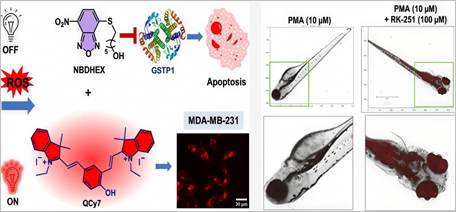
Fig: Schematic representation of the new "smart" cancer drug designed to switch on and work only inside cancer cells.
Cancer cells often produce high levels of reactive oxygen species (ROS), which are harmful molecules. When RK-251 enters a cancer cell, the high ROS levels trigger the drug's activation, releasing a powerful anticancer compound called “NBDHEX”. This compound blocks target proteins that many cancer cells use to survive and resist treatment.
In preclinical studies, RK-251 showed strong activity against aggressive triple-negative breast cancer cells, with much less effect on healthy cells.
The behavioral study of the developed candidate drug in zebrafish embryos (Danio rerio) also showed no obvious signs of toxicity and exhibited the desired fluorescence in the presence of reactive oxygen species (ROS), suggesting the drug may be safe for further research and validation. More studies are needed before this technology can be tested in patients. The work is published in ACS- Journal of Medicinal Chemistry:
Link to publication: https://doi.org/10.1021/acs.jmedchem.6c01286
*****
NKR/FT
(Release ID: 2301318)
Visitor Counter : 6101