Ministry of Housing & Urban Affairs
Delhi Master Plan 2047: A Roadmap for Viksit Delhi; Viksit Bharat 2047
Union Minister Shri Manohar Lal unveils the Delhi Master Plan 2047 (MPD-2047)
Master Plan envisages the development of around 40 lakh new affordable housing units, with a focus on meeting the future housing requirements of the city : Shri Manohar Lal
Posted On:
20 AUG 2026 7:24PM by PIB Delhi
Union Minister of Housing and Urban Affairs and Power, Shri Manohar Lal unveiled the Delhi Master Plan 2047 (MPD-2047) today in the presence of; Lieutenant Governor of Delhi, Shri Taranjit Singh Sandhu; and Chief Minister of Delhi, Smt. Rekha Gupta.
Secretary, Department of Capital Development, Ministry of Housing and Urban Affairs, Ms. D. Thara; Chief Secretary, Government of NCT of Delhi, Shri Rajeev Verma; Vice Chairman, Delhi Development Authority (DDA), Shri N. Saravana Kumar; and other senior officials were also present on the occasion.
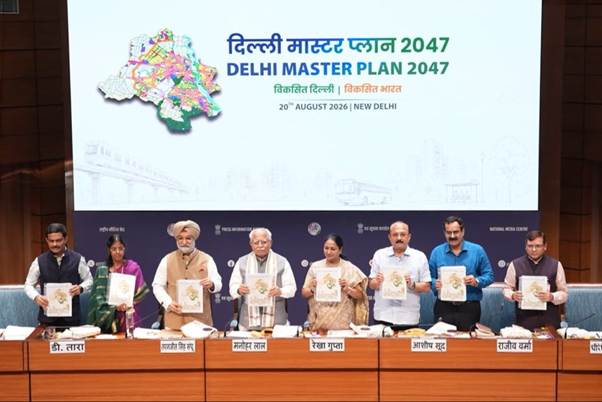
Speaking on the occasion, Union Minister of Housing and Urban Affairs and Power, Shri Manohar Lal said that, keeping in view Delhi’s growing population and the need for its holistic development, the Delhi Master Plan 2047 will prove to be a milestone in shaping the future of the national capital. He said that the Master Plan envisages the development of around 40 lakh new affordable housing units, with a focus on meeting the future housing requirements of the city.
The Minister further stated that a Transit-Oriented Development (TOD) policy has been incorporated to strengthen public transport corridors and promote better-connected urban development. He added that, with a view to making colonies more habitable, Resident Welfare Associations (RWAs) would be encouraged to register and adopt a redevelopment framework on the lines of the in-situ redevelopment policy, facilitating planned redevelopment and improvement of existing residential areas.
Lieutenant Governor of Delhi, Shri Taranjit Singh Sandhu, said that, aligned with the Hon’ble Prime Minister’s vision of ‘Sapt-Dhara’, the Delhi Master Plan 2047 lays down a robust roadmap for vertical growth, transit-oriented development and quality housing, while promoting the development of knowledge, education and medical hubs and preserving Delhi’s rich cultural heritage.
He emphasised the need to translate the planning framework into visible outcomes on the ground to enhance Ease of Living and build a more sustainable, vibrant and future-ready Delhi.
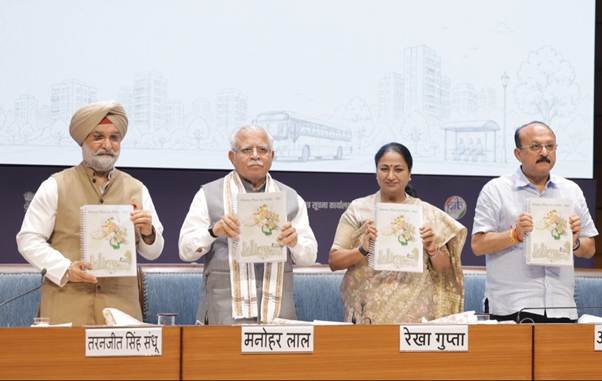
Chief Minister of Delhi, Smt. Rekha Gupta, said that the Delhi Master Plan 2047 provides a comprehensive roadmap for a Viksit Delhi, aimed at creating a more planned, accessible and future-ready national capital for coming generations. She said that the Plan addresses the diverse needs of Delhi—from villages and unauthorised colonies to old residential colonies and market areas—while responding to the challenges posed by a growing population, transportation needs and pollution.
The Chief Minister highlighted that provisions for higher FAR would open new avenues for redevelopment, while simplified norms would facilitate expansion of urban amenities. She added that the Plan would also strengthen the vision of ‘Jahan Jhuggi, Wahan Makaan’, giving further impetus to the aspiration of poor families for permanent housing.
Aligned with the vision of the Hon'ble Prime Minister for Viksit Bharat 2047, the Delhi Master Plan 2047 provides a roadmap to transform Delhi into an inclusive, sustainable, resilient and globally competitive capital city.
MPD-2047 adopts two distinct planning approaches—area-based redevelopment for existing brownfield areas and ROW-based planning for greenfield areas. Brownfield development will focus on TOD, mixed-use development and infrastructure augmentation, while greenfield areas will use connected road networks extending through Land Pooling and Low-Density Areas. Together, these approaches enable efficient land use, stronger intra- and inter-city connectivity, and coordinated sustainable growth.
Over 40 Lakh Homes: Building Viksit Delhi 2047
- Redevelopment of Existing Areas (Group Housing/ DDA Housing/Govt Housing): minimum area requirement of 40,000 sqm reduced to 3000 sqm. (around 7 lakh additional dwelling units)
- Better Living in Unauthorised Colonies
- Affordable Housing along Metro Corridor (around 18 lakh affordable housesin TOD Zones)
- Dignified Homes for Jhuggi jhopri Clusters (to benefit more than 17 lakh JJ dwellers)
- Additional 15% FAR for Workers' Housing on Industrial plots of 5000sqm and above.
- Additionally affordable housing also to be developed along High Density Corridors (HDC)
- Affordable Rental Housing: 50% FAR incentive to encourage rental housing for students, working professionals, migrant workers and low-income groups.
Commissioning of Land Pooling Policy:
- Nearly 200 sq. km. of planned urban expansion to create around 12 lakh new homes. 600 km road network also envisaged.
- Government-led, infrastructure-first development — with DDA developing 30-metre and wider roads upfront to enable planned growth and better connectivity.
- Different implementation models being adopted, including Town Planning Schemes.
- Faster rollout through planning schemes of a minimum 20 hectares, where land is being developed through assembly of land.
- Introduction of High-Density Corridor development in Land pooling area with FAR upto 400- 250 m wide corridor along UER-II
- Sector 8B, Zone P-II in Village Gadi Khasro and Ibrahimpur, the first notified sector- ready for implementation.
Revitalising Economic Spaces
- Redevelopment of Commercial centres allowed in a minimum plot area of 1000 sqm through incentivised FAR, encouraging investment and transforming them into modern business destinations.
- Mixed-use development along 30.0 m RoW and above, permitting commercial activities on the ground floor and first lower floor (in buildings with stilt).
Promotion of Industry
- Modern industrial parks with flexible zoning,
- Big-box retail, e-commerce, Warehousing permitted in Industrial areas.
- Co-working spaces, data centres permitted to support innovation, start-ups.
Preserving Delhi's Heritage
- Conservation of around 1,500 heritage assets for which Cultural Resource Management Plans shall be prepared. Adaptive reuse of heritage buildings facilitated- hotels, museums, offices, libraries and cultural activities while preserving their historic character.
- Heritage Incentive -50 TDR -first time introduced
Promoting Green-Blue Delhi
- Protection, conservation, and ecological restoration of nearly 1,700 hectares of the River Yamuna floodplains through 13 major restoration projects
- 52 km cycle track shall be developed along Yamuna floodplain.
Narela as Education Hub
- Transforming Narela into a world-class education-138 Ha land reserved for development of Universities (both public and Private).
Dwarka New Investment Hub
- Developing Dwarka as Delhi's International Gateway with world-class infrastructure, future-ready industries like IT, start-ups, data centre, industrial parks.
Strengthening Mobility
- Unified Metropolitan Transport Authority – Single Authority for planning/ development of an Integrated system, implementation and enforcement of Policies.
- Multi-modal transit hubs will be developed to provide seamless connectivity between the Metro, RRTS, buses, intermediate public transport, walking, and cycling, making travel easier and more convenient. Development of UER-I, UER-II and UER-III to strengthen intra-city and inter-state connectivity. UER-II already providing faster connectivity
- Unified Parking Planning Framework for integrated planning, management and regulation of parking.
Ease of Doing Business
- Online approvals and streamlined processes to improve Ease of Doing Business and Ease of Living.
- Regulatory simplification by reducing 133 use premises to 45
- Negative list approach for Residential, commercial and Industrial use zones incorporated, allowing greater flexibility.
Redevelopment Strategy
- Plot based redevelopment encouraged waiving of area level requirement of 4 Ha land.
- Commercial redevelopment will also be promoted through higher FAR incentives, reduced minimum plot sizes (minimum plot size reduced to 1,000 sq. m)
Regularisation of Unauthorised Colonies
- Regularisation of residential buildings in 1,511 unauthorised colonies on an "as is where is" basis. No requirement of layout plans, simplifying the regularisation process.
- Greater property ownership security for around 45 lakh residents.
A City for All: Vibrant, Inclusive & Age-Friendly Delhi
- Promoting a safe and vibrant 24 x 7 city with planned cultural circuits.
Infrastructure: Building Tomorrow's Delhi
- Expansion of Sewage Treatment Plants (STPs) and sewerage infrastructure to improve water quality and support a cleaner Yamuna.
- Net Zero development will be promoted through energy-efficient buildings and low-carbon urban planning.
- Encouraging rooftop solar, rainwater harvesting, water recycling, waste-to-resource initiatives and green mobility.
Technology-Driven Governance
- GIS-based planning and digital platforms for transparent, efficient and data-driven urban planning.
Park Connectors: Greener Delhi, Healthier Delhi
- Green Connect Network to improve access to recreational spaces and strengthen ecological connectivity. Expansion of green cover through urban forests, biodiversity parks, ecological corridors and indigenous plantations.
Core Capital Development
- Strengthening the Capital’s administrative and ceremonial core. Redevelopment of Kartavya Path to create a world-class public and cultural space.
- Development of the Yuge Yugeen National Museum (approximately 1.25 lakh sq. m.) as a landmark cultural institution.
Low-Density Areas: Planned Growth, Protected Ecology
- A planned and regulated framework for nearly 150 sq km of Low-Density Areas (LDA), covering areas along the NCT’s peripheral villages and 23 notified LDRA villages,
- Planned development in the LDA with the continuity of arterial roads from Land Pooling areas.
- Uniform planning framework allowing residential, recreational, PSP and commercial activities in the area.
****
SK
(Release ID: 2301684)
Visitor Counter : 7614