Posted On:
21 AUG 2026 10:43AM by PIB Delhi
Pradhan Mantri Annadata Aay Sanrakshan Abhiyan (PM-AASHA) is the Government’s flagship price-support framework for remunerative prices for farmers. It includes various schemes to strengthen the implementation of the Minimum Support Price (MSP) and reduce distress sales. Procurement of pulses, oilseeds, and copra is undertaken by the Central and State Governments through agencies such as NAFED and NCCF. With a ₹7,200 crore Budget allocation for 2026–27, PM-AASHA strengthens effective price-support interventions. Digital reforms, including Aadhaar-enabled authentication, e-NAM, e-Samriddhi, and e-Samyukti, have improved transparency and procurement efficiency. Support from the Agriculture Infrastructure Fund and expanded procurement coverage have further strengthened the scheme.
|
Ensuring Remunerative Prices to Farmers
The government has taken several initiatives to ensure that the benefits of the Minimum Support Price (MSP) reach all farmers, including small and marginal farmers. One major initiative is the Pradhan Mantri Annadata Aay Sanrakshan Abhiyan (PM AASHA). The Government launched the scheme in September 2018. It was designed to ensure remunerative prices for farmers while maintaining price stability for consumers.
PM AASHA brings together multiple price support mechanisms under a unified framework. Each mechanism is implemented according to the crop and market conditions. The scheme strengthens MSP implementation and reduces distress sales among farmers. It also stabilises farm incomes while ensuring food price stability for consumers.
Under PM AASHA, procurement arrangements begin before each marketing season. Central nodal agencies and state governments prepare procurement infrastructure before crops reach the markets. This coordinated approach ensures timely procurement operations and strengthens effective MSP implementation across the country.
Policy design and institutional framework
PM AASHA broadly consists of four key components: Price Support Scheme (PSS), Price Stabilization Funds (PSF), Price Deficiency Payment Scheme (PDPS), and Market Intervention Scheme (MIS).
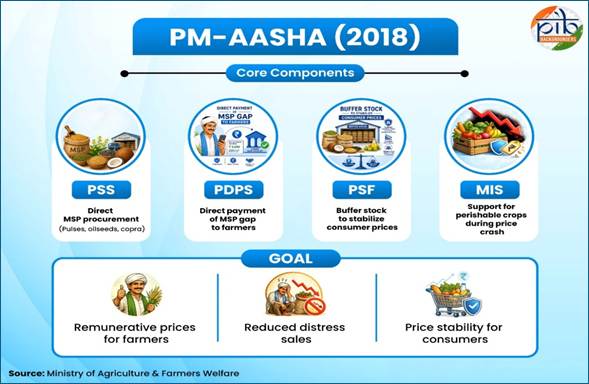
1. Price Support Scheme (PSS)
This scheme ensures procurement of crop at MSP when market prices fall below MSP during harvest. It mainly covers pulses, oilseeds, and copra. Procurement is carried out through agencies such as the National Agricultural Cooperative Marketing Federation of India (NAFED) and the National Cooperative Consumers' Federation of India Limited (NCCF) at the request of state governments. Only registered farmers with valid land records are eligible, which ensures direct benefit without intermediaries. This helps prevent distress selling and ensures income stability for farmers during price crashes.
From the 2024–25 procurement year, under the Price Support Scheme (PSS), procurement of pulses, oilseeds, and copra is initially allowed up to 25% of a State/UT’s production. Additional procurement beyond this limit may be approved by the Committee of Secretaries up to 25% of national production. However, to boost domestic pulse output and reduce imports, procurement of Tur, Urad, and Masur is permitted up to 100% of State production.
2. Price Stabilization Fund (PSF)
The Price Stabilization Fund (PSF) protects consumers from price volatility by maintaining buffer stocks of essential commodities like pulses, onions, and potatoes. It was set up to stabilize the prices of key agri-horticultural products. Commodities are procured during harvest and released in lean seasons to control price spikes and ensure affordability. PSF is now merged with PM-AASHA but continues to be managed by the Department of Consumer Affairs.
3. Price Deficiency Payment Scheme (PDPS)
Under PDPS, farmers’ produce is not physically procured. Instead, they are paid the price difference between the MSP and the actual market price in the notified market, up to 15% of the MSP value, directly into their bank accounts. This scheme is mainly used for oilseeds and reduces the need for large procurement infrastructure. It promotes market-based selling while still ensuring MSP protection to farmers.
4. Market Intervention Scheme (MIS)
The Market Intervention Scheme (MIS) is designed to procure a range of perishable agricultural and horticultural commodities. It targets products such as tomatoes, onions, and potatoes for which a Minimum Support Price does not apply. The scheme activates when market prices drop by at least 10% over the previous normal season's rates. It operates through cost-sharing between the Centre and State governments for the operations undertaken by Central Nodal Agencies like NAFED and NCCF. This scheme is especially useful during glut situations when supply exceeds demand.
Enhanced Financial Support Under PM-AASHA
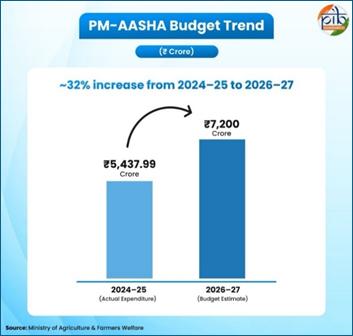
Under the Pradhan Mantri Annadata Aay Sanrakshan Yojana (PM-AASHA), the budget allocation has steadily increased over the years. In 2024–25, the actual expenditure under the scheme was ₹5437.99 crore. The budget increased to ₹6,941.36 crore in 2025–26 and was further raised to ₹7,200.00 crore in 2026-27. This reflects the government's focus on ensuring income support for farmers and strengthening price assurance mechanisms.
From Cost to Confidence: Strengthening Farmer Remunerative Returns
Higher Minimum Support Prices over production costs strengthen farmers’ income security while encouraging sustained cultivation of key crops, supported by schemes under PM-AASHA. In 2026–27, paddy (common) cost ₹1,627 per quintal, while its MSP was ₹2,441 per quintal, yielding a margin of ₹814. Soybean (yellow) cost ₹3,805 per quintal, while its MSP was ₹5,708 per quintal, yielding a margin of ₹1,903.
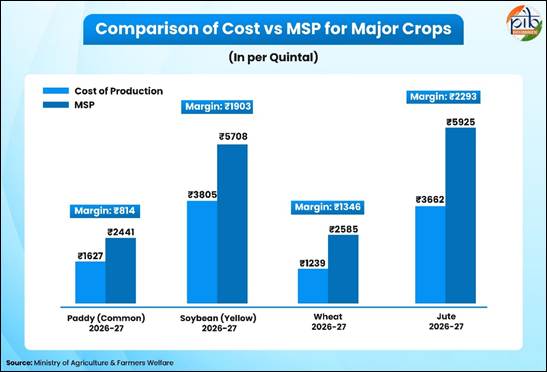
In 2026–27, wheat has a production cost of ₹1,239 per quintal and an MSP of ₹2,585 per quintal, ensuring a ₹1,346 margin. Meanwhile, jute has a production cost of ₹3,662 per quintal and an MSP of ₹5,925 per quintal, providing the highest margin of ₹2,293. These remunerative MSP margins reinforce the objectives of PM-AASHA by strengthening price assurance and improving farmers’ confidence in agricultural markets.
Overall, MSP consistently exceeds the cost of production across crops and years, and PM-AASHA further strengthens this system by ensuring better price realization for farmers. This highlights a supportive framework that promotes stable income and growth in the agricultural sector.
Strengthening Farm-to-Market Connectivity
The Government has undertaken several initiatives to strengthen agricultural marketing and post-harvest infrastructure, such as AIF and e-NAM. The Agriculture Infrastructure Fund (AIF) has sanctioned loans worth ₹96,426 crore for 2,14,437 projects, mobilizing investments exceeding ₹1,66,179 lakh crore. The e-NAM platform has integrated 1,656 mandis across 23 States and 4 Union Territories, facilitating trade worth ₹4,94,847 crore. It has registered 4,776 FPOs on e-NAM and onboarded 7,334 FPOs onto Open Network for Digital Commerce (ONDC). The government has also sanctioned 50,249 warehouses with 992.6 lakh metric tonnes storage capacity alongside 25,081 agricultural marketing infrastructure projects.
Recent PM-AASHA reforms introduced biometric farmer authentication, direct procurement from pre-registered farmers, transportation support for Tomato, Onion, and Potato (TOP) crops, and price differential payments under the Market Intervention Scheme.
Bihar and Chhattisgarh: Advancing PM-AASHA Implementation
In Bihar, organized procurement of masoor (lentil) has been initiated for the first time through the National Cooperative Consumers' Federation of India (NCCF). This marks a significant step towards strengthening pulse procurement under PM-AASHA through 48 Primary Agricultural Credit Societies (PACS) and Farmer Producer Organizations (FPOs). As of 10th August, 2026, NCCF has procured 1042.65 MT of masoor, registering 358 farmers and benefiting 285. During the same period, NAFED has also procured 1,814.13 MT of masoor, registering 495 farmers and benefiting 455 farmers.
In Chhattisgarh, procurement operations under PM-AASHA have been strengthened through a network of 200 operational PACS and 12 FPOs. As on 10th August, 2026, NCCF has procured 18392.228 MT of chana, 22.231 MT of masoor, and 1035.0205 MT of Mustard. It registered 21,721 farmers and benefited 13,790 farmers. During the same period, NAFED has procured 17,020.65 MT of chana and 355.05 MT of masoor. It registered 46,146 farmers and benefited 13,673 farmers. These initiatives have strengthened MSP procurement, improved market access, and supported region-specific pulse self-sufficiency goals.
Securing Farmer Incomes, Strengthening Markets
PM-AASHA has emerged as a strong and structured mechanism to support farmers through assured procurement, price stabilization, and effective market interventions. This enables the timely procurement of key crops like pulses, oilseeds, and copra through agencies such as NAFED and NCCF. The establishment of additional procurement centres has further strengthened market access and collective empowerment of farmers.
Digital reforms and infrastructure support have improved transparency, efficiency, and reach of procurement operations across states. Collectively, these efforts ensure better price realization for farmers, reduce distress sales, and promote a stable and resilient agricultural economy in the country.
References
Ministry of Agriculture and Farmers Welfare
https://www.pib.gov.in/PressReleasePage.aspx?PRID=2155528®=3&lang=2
https://www.pib.gov.in/PressReleasePage.aspx?PRID=2112407®=3&lang=2
https://www.pib.gov.in/PressReleasePage.aspx?PRID=2246181®=3&lang=2
https://www.pib.gov.in/PressReleasePage.aspx?PRID=2241414®=3&lang=2
https://agriwelfare.gov.in/Documents/AR_Eng_2024_25.pdf
https://www.pib.gov.in/PressNoteDetails.aspx?NoteId=154999&ModuleId=3®=3&lang=2
https://sansad.in/getFile/annex/268/AU2274_YtUhNS.pdf?source=pqars
Cabinet
https://www.pib.gov.in/PressReleasePage.aspx?PRID=2055990®=3&lang=2
Ministry of Finance
www.indiabudget.gov.in/doc/eb/sbe1.pdf
Click here to see pdf.
PIB Research