Ministry of Defence
Raksha Mantri and West Bengal Chief Minister carry out Bhumi Pujan for five expansion projects of GRSE & YIL virtually from Kolkata
Worth approx. Rs 3,500 crore, the projects to bolster the nation’s shipbuilding, ship repair, metallurgical and production capabilities, giving a major push towards ‘Aatmanirbhar Bharat’ & ‘Make in India’, Make for the World’
The projects to generate jobs and provide greater opportunities for ancillary industries, including MSMEs
Self-reliance is not merely a policy; it is a force multiplier for battlefield capability: Shri Rajnath Singh
“Emerging ‘Capacity Paradox’ presents a golden opportunity for India to emerge as a global shipbuilding hub”
Posted On:
23 AUG 2026 3:59PM by PIB Delhi
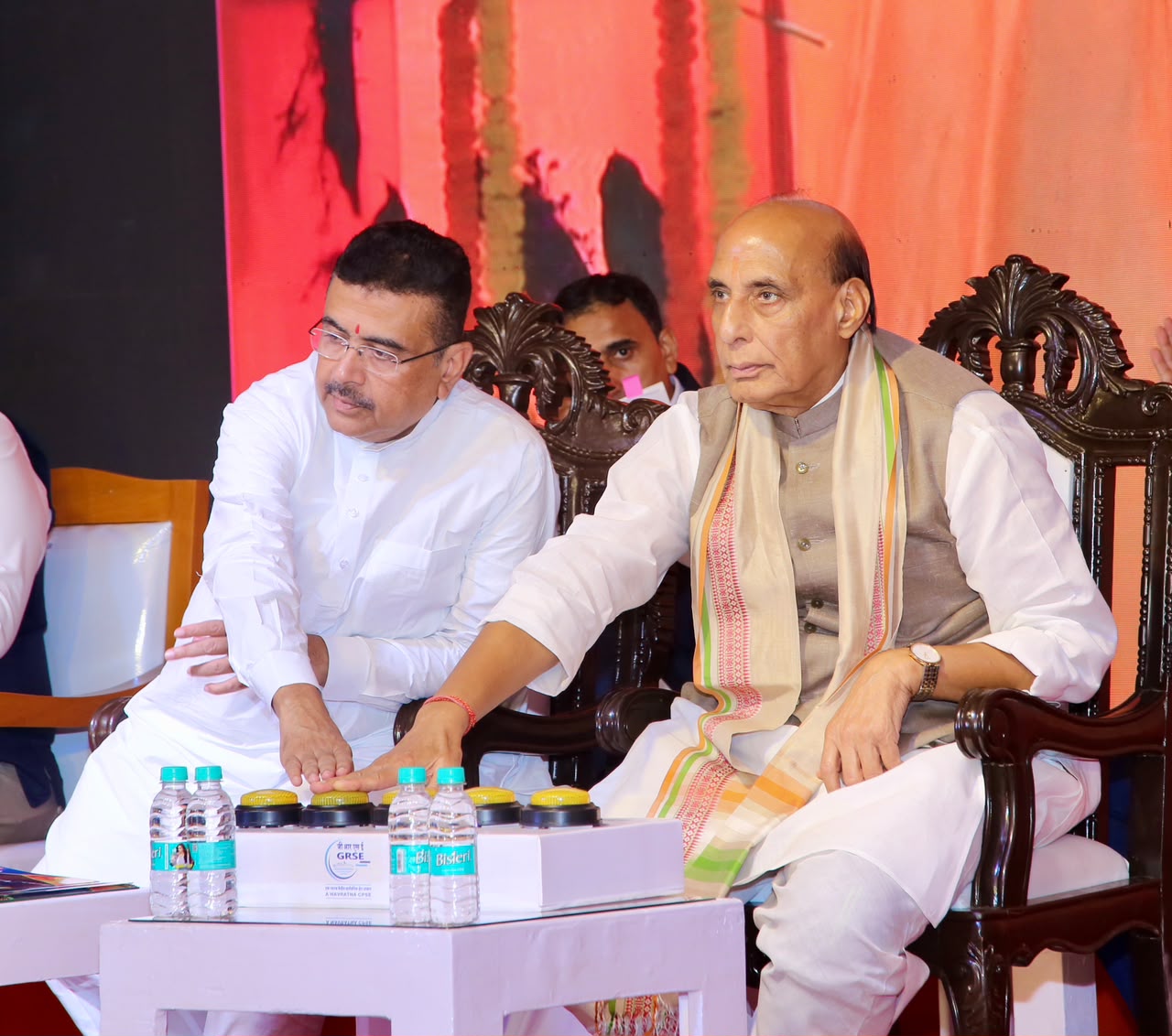
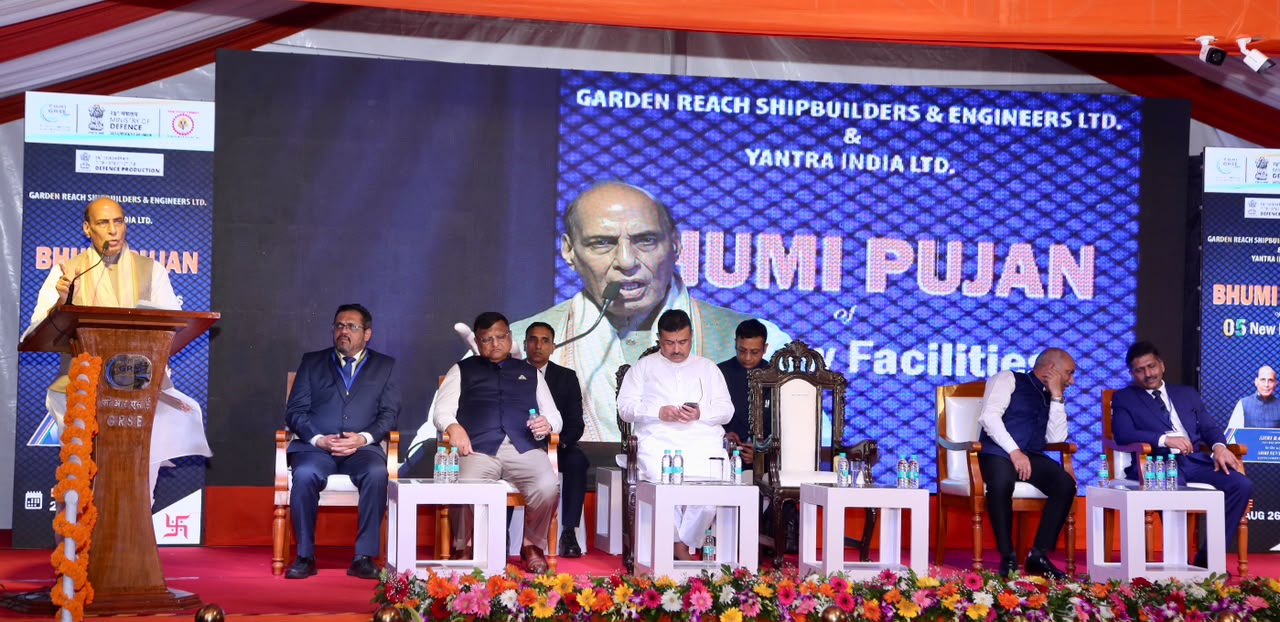
Raksha Mantri Shri Rajnath Singh, along with West Bengal Chief Minister Shri Suvendu Adhikari, presided over the Bhumi Pujan ceremony for three expansion projects of Garden Reach Shipbuilders & Engineers Limited (GRSE) and two of Yantra India Limited (YIL), worth a total investment of approximately Rs 3,500 crore, virtually from GRSE Bhavan in Kolkata on August 23, 2026. The GRSE facilities at Kidderpore in Kolkata, Shalimar in Howrah, and Raichak in South 24-Parganas will bolster the country’s shipbuilding and ship repair capabilities, while the projects at YIL’s Metal and Steel Factory in Ishapore will strengthen indigenous metallurgical and production capabilities.
In his address, Raksha Mantri exuded confidence that these projects will further strengthen Prime Minister Shri Narendra Modi-led Government’s spirit of ‘Aatmanirbharta’ in defence, ‘Make in India’, and ‘Make for the World’. “‘Raksha Shakti’ was among the ‘Saptadhara’, the seven streams of power, which PM Modi spoke about during his 2026 Independence Day address from Red Fort. He clearly stated that as we evolve into a developed nation, the defence sector must become fully self-reliant. We cannot remain dependent on any other country. It is our own companies and research institutes that must achieve complete dominance in this sector. These five projects reflect the Government’s vision of ensuring strategic autonomy,” he said.
Shri Rajnath Singh added that these projects will not only boost defence production but also generate employment opportunities for thousands of people, as well as for MSMEs and allied industries. “In a sense, the projects are heralding a new chapter in West Bengal’s socio-economic progress,” he added.
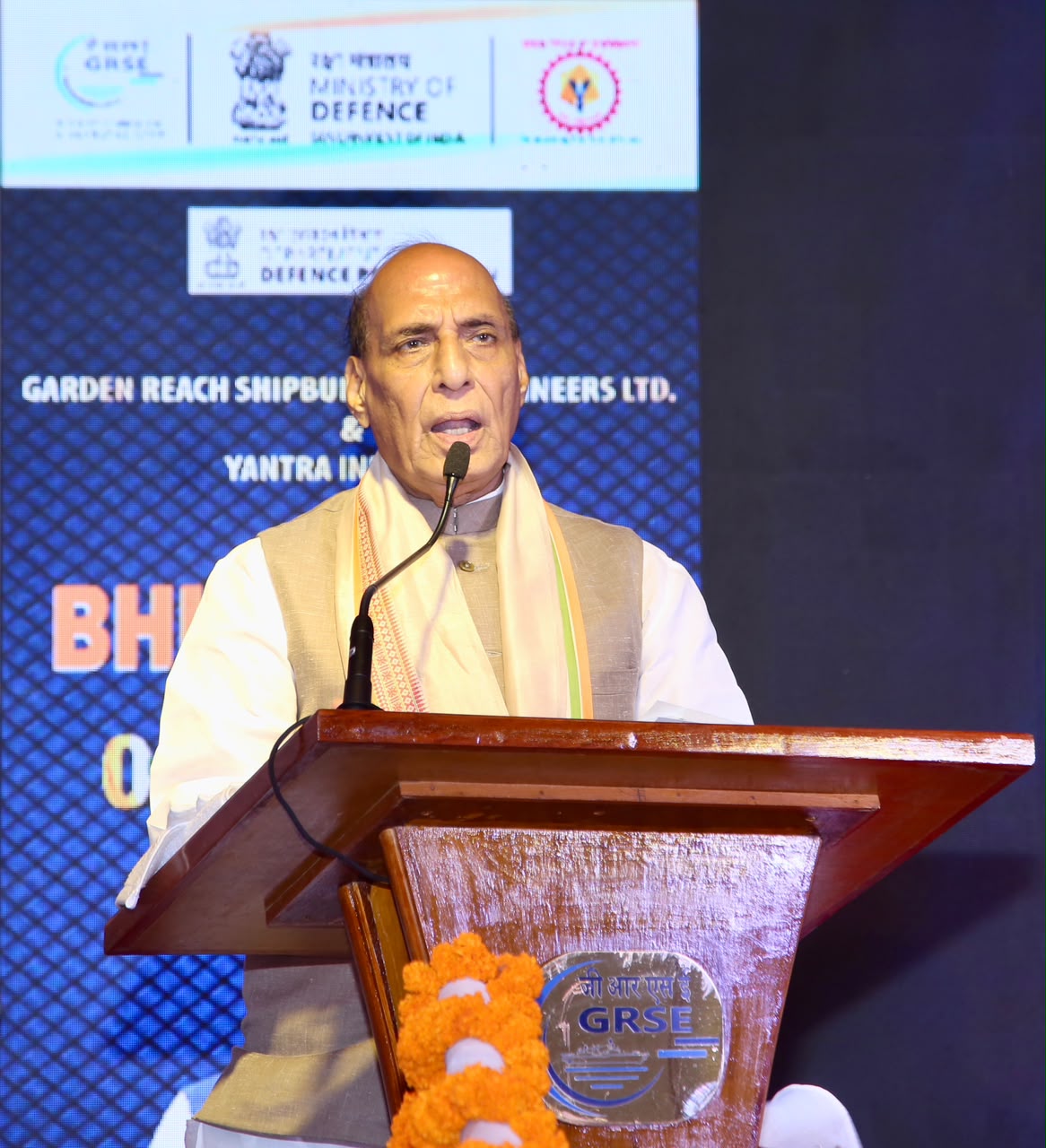
Raksha Mantri emphasised that Operation Sindoor demonstrated the critical importance of indigenous weapons & platforms, with the world witnessing the prowess of Indian defence systems. He stated that moving forward, the country’s labs, PSUs, and private stakeholders, in collaboration with the Ministry of Defence, will leave no stone unturned to equip the defence forces with indigenous platforms. “Self-reliance is not merely a policy; it is a force multiplier for battlefield capability. In this endeavor, the roles of GRSE and YIL will be crucial,” he added.
Commending GRSE for its efforts to achieve self-reliance in defence manufacturing, Shri Rajnath Singh made special mention of the advanced guided-missile frigate INS Dunagiri, which was dedicated to the nation by PM Modi earlier this year. “GRSE has constructed over 800 vessels to date. Even the next-generation offshore patrol vessels, currently under construction, will feature more than 80 percent indigenous content. This demonstrates that we are rapidly reducing our dependence on foreign sources,” he added, while extending congratulations to the shipyard for achieving the ‘Navratna’ status.
Raksha Mantri described YIL as a strong pillar of India’s defence manufacturing capability, expressing hope that the new modern facilities at the Metal and Steel Factory in Ishapore will fully secure the critical supply chain for advanced weapons and strategic components. He highlighted that despite being established in October 2021, the company has overcome initial challenges and consistently achieved financial and regulatory excellence. “YIL has invested over Rs 750 crore in MSF Ishapore. By replacing legacy systems dating back to 1976, this investment will establish Industry 4.0-capable precision manufacturing, accelerating our progress towards indigenous manufacturing of weaponry,” he said.
Shri Rajnath Singh added that as the nation advances on the path of self-reliance with a positive mindset, there is a need to consider the emerging “Capacity Paradox” in the global shipbuilding sector. He asserted that the demand for naval and commercial vessels is rising even as traditional shipbuilding nations witness a steady decline in capacity. He emphasised that this, coupled with the rapid pace of technological change, has created a global shipbuilding vacuum in design, manufacturing and Maintenance, Repair and Overhaul (MRO), presenting a significant opportunity for India to emerge as a major global shipbuilding hub.
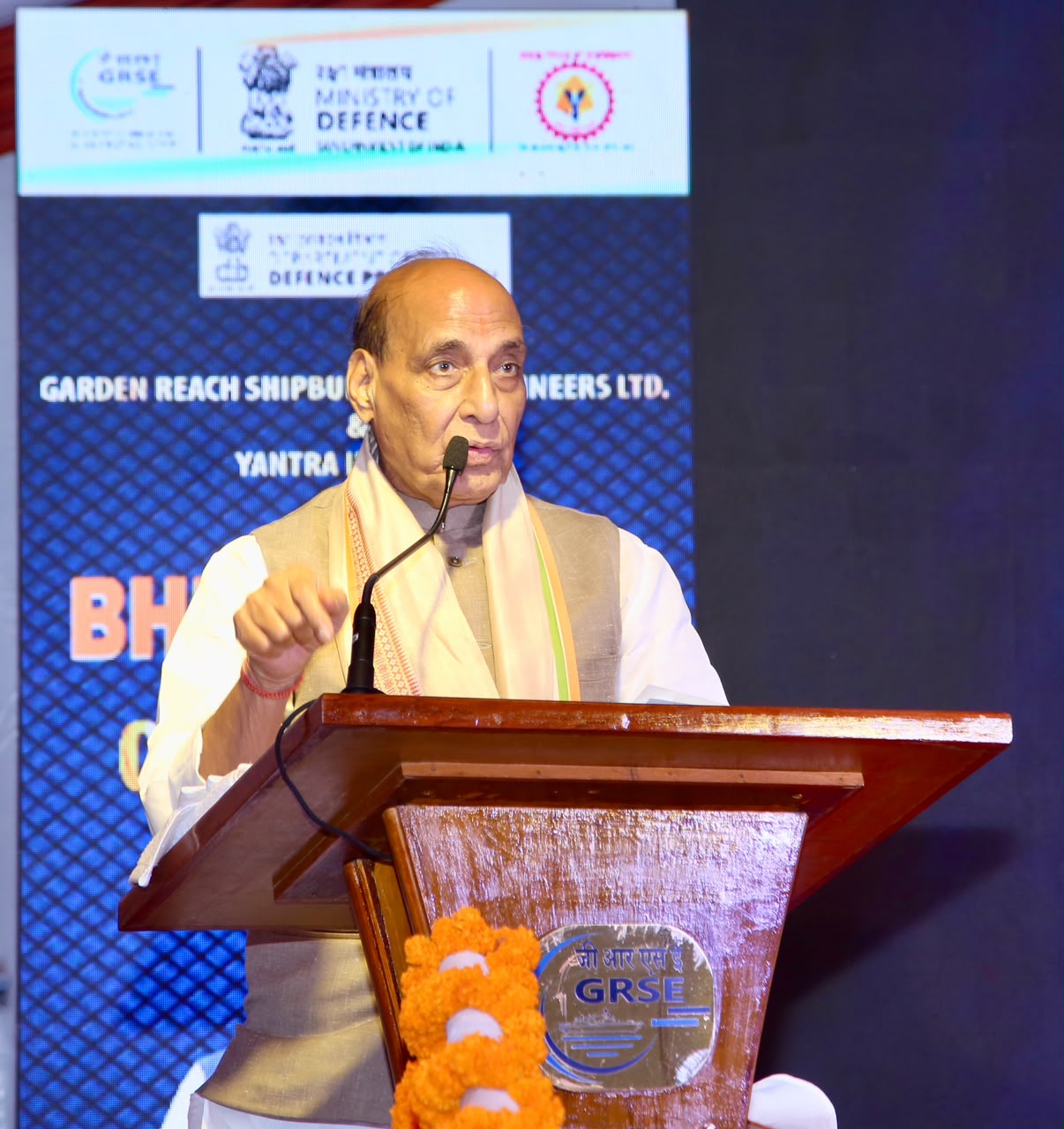
Raksha Mantri emphasised that the design expertise, once held by traditional shipbuilding nations, is gradually diminishing, and India should leverage its pool of engineers, IT professionals and expertise in simulation & artificial intelligence to develop indigenous ship designs, secure patents and export them globally. On manufacturing, he stated that many developed countries are stepping back from labor-intensive shipbuilding due to soaring costs and a shortage of skilled manpower, while India possesses a skilled workforce, a robust steel industry and a strong MSME ecosystem. He stressed the need to modernise shipyards and adhere to global quality standards. “If we modernise our manufacturing capacity and adhere to global quality standards, India can emerge as the world's next major shipbuilding hub,” he said.
Terming MRO a “low-hanging fruit” as it requires neither massive capital investment nor an enormous workforce, Shri Rajnath Singh called for India to establish itself as a hub for ship repair and overhaul in the Indian Ocean Region. “MRO simply requires quality, discipline, and reliable timelines. If we establish ourselves as a hub for ship repair and overhaul, we will not only save foreign exchange but also generate thousands of jobs,” he said.
Raksha Mantri underlined that GRSE’s Raichak facility would provide the capability to build warships up to 200 metres in length and enable the shipyard to bid for next-generation destroyers, while the facilities at Timber Pond in Howrah and the Damodar Complex would strengthen the shipbuilding value chain. He added that the two forging facilities of YIL would produce high-quality metals for heavy artillery, naval weapons and advanced defence equipment, thereby strengthening the Navy’s operational readiness.
Shri Rajnath Singh stressed that the expansion of shipbuilding and defence manufacturing would contribute to economic growth by saving foreign exchange, strengthening industries and MSMEs, and generating direct and indirect employment. He urged GRSE to make full use of its expanded capacity and compete more aggressively in domestic and international markets to realise the vision of ‘Make in India, Make for the World’. He called for globally trusted quality, competitive costs and timely delivery to secure repeat orders and establish India as a preferred supplier. “Our mindset should no longer be about what India needs to buy from the world. Instead, it should focus on what the world wants to buy from India,” he said.
Raksha Mantri stated that the five projects represented a strategic expansion of India’s defence manufacturing capabilities and called for the combined participation of defence PSUs, private industry, MSMEs and academic institutions.
Speaking on the occasion, West Bengal Chief Minister Shri Suvendu Adhikari termed the Bhumi Pujan as a historic moment. He stated that the expansion projects will not only enhance the capacities of GRSE and YIL, but also bring about a resurgence in West Bengal’s industrial sector. The projects will generate jobs and provide greater opportunities for ancillary industries, including MSMEs, he added.
Chief Secretary, Government of West Bengal Shri Manoj Agarwal; Secretary (Defence Production) Shri Sanjeev Kumar; Chairman and Managing Director, GRSE Cmde PR Hari; CMD, YIL Shri Vijaykumar Iyer, and other senior officials of Department of Defence Production, GRSE and YIL were present on the occasion.
About the GRSE Projects
In line with ‘Aatmanirbhar Bharat’ and ‘Make in India’, GRSE has undertaken the major expansion initiative to build next-generation warships and commercial platforms. As part of this plan, GRSE has signed lease agreements with Syama Prasad Mookerjee Port, Kolkata (SMPK), for two small shipyards lying unused on both banks of the river, as well as a 32-acre riverside property at Raichak. These new locations will allow GRSE to build and refit warships, as well as small and medium-size commercial vessels.
The 32-acre plot acquired by GRSE at Raichak has a 356-metre waterfront and an existing 96 metre jetty. Most importantly, it offers a draught of 8-10 metres, making it ideal for ship construction.
The shipyard plans to develop Raichak as a shipbuilding hub with an investment of over Rs 2,500 crore. This facility will allow the construction of warships up to 200 metres in length and commercial vessels of deadweight tonnage of up to 60,000 tonnes (Supramax vessels).
This facility will have a 200 metre long Dry Dock, a 200-metre-long slipway, a 200 metre long ship launching pad, two jetties of 120 metres and 86 metres, facilities for block fabrication and consolidation, hull repair shops and stores and administrative offices.
Timber Pond in Shalimar, Howrah, is spread across four acres, right across the Hooghly River from GRSE. It has been acquired on a 30-year lease from SMPK. The facility has a dilapidated drydock and a waterfront of about 88 metres. GRSE plans to invest nearly Rs 100 crore to rejuvenate and turn it into a shipbuilding and repair facility for medium-size vessels.
The plan involves restoration of the 130 metre Dry Dock, creation of a new 120 metre slipway, shoreline protection work and installation of a Dry Dock gate and Gantry Crane. The construction of facilities for block fabrication, stores and workshops have also been planned.
An old workshop and 25-metre-long waterfront has also been acquired from SMPK at the Kidderpore Docks (KPD) in Kolkata on a 30-year lease. Known as the Damodar, this is adjacent to the three dry docks at KPD that are already under use by GRSE for ship repairs and refits. The shipyard plans to invest about Rs 70 crore in developing this facility to repair medium-size vessels and construct electric ferries as well as other small craft.
About the YIL Projects
Representing a combined investment of over Rs 750 crore, these two state-of-the-art projects of YIL will strengthen indigenous manufacturing capabilities for heavy ordnance, Railways, nuclear infrastructure and advanced weapon systems. The first facility is the Heavy Duty Hydraulic Open Die Forging Press of 3,000-Ton Capacity, complete with two integrated rail-bound manipulators. It directly replaces an aging 2,650-ton press that has been in operation since 1976. Scheduled for completion within 26 months, the new installation ensures the uninterrupted, high-precision production of critical gun barrels, ammunition components, and heavy defence forgings.
Beyond enhancing operational safety and precision, the 3,000-ton press offers remarkable economic and operational viability. It is projected to yield annual savings of Rs 25.58 crore by drastically cutting downtime and maintenance costs, while supporting an annual turnover of Rs 500 crore. With a payback period of 11 years and an Internal Rate of Return (IRR) of 7.3%, this facility guarantees long-term supply chain reliability for the Defence Forces.
The second addition is the Radial Forging Plant, equipped with comprehensive upstream and downstream facilities. Built with an outlay of Rs 473.84 crore and an execution timeline of 30 months, this plant introduces advanced radial forging technology to MSF Ishapore. It significantly expands YIL’s capability to produce super alloy forgings, hollow tubes for aerial bombs, critical hardware for future ordnance systems, high-strength railway axles and nuclear reactor components.
This radial forging unit integrates Industry 4.0 standards, energy-efficient operations, and superior precision engineering. Strategically, it projects an impressive annual profit of approximately Rs 69 crore, an IRR of 10.58%, and a quick payback period of roughly 06 years. By curtailing import dependence on strategic forgings and railway infrastructure components, the plant establishes a self-reliant foundation for domestic defence programs.
*****
VK/Savvy
(Release ID: 2302489)
Visitor Counter : 2334