PIB Backgrounder
India’s Sugar Industry
Understanding the Sector, Value Chain, and Recent Price Rise
Posted On:
26 AUG 2026 2:09PM by PIB Delhi
India’s Sugar Industry at a Glance
India’s sugar industry is a major agricultural, industrial, and rural livelihood ecosystem. India is the world’s second-largest sugarcane producer. The sugarcane sector supports nearly 5 crore farmers and around 5 lakh workers in sugar factories and its allied industries.
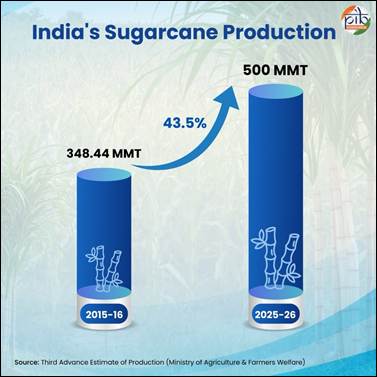
- India’s sugarcane production has reached 500 MMT in 2025-26 as per the Third Advance Estimate of Production released by the Ministry of Agriculture & Farmers Welfare. This marks approximately 43.5 percent growth over the last 10 years, compared with 348.44 MMT of production in 2015-16.
- The area under sugarcane cultivation has also increased from 49.27 lakh hectares in 2015-16 to 58.87 lakh hectares in 2025-26.
- Uttar Pradesh and Maharashtra are the top sugarcane-producing states in India.
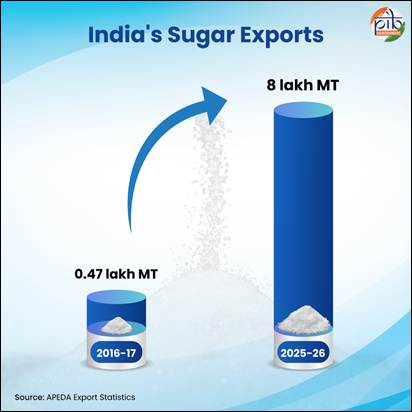
- India exported 8 lakh MT of sugar in 2025-26, compared with 0.47 lakh MT in 2016-17.
- Fair and Remunerative Price (FRP) of sugarcane for the sugar season 2026-27 (October - September) has been set at ₹365/quintal by the government. This provides a basic recovery rate of 10.25%. This price is ₹135 more than the FRP for the sugar season 2016-17, which was fixed at ₹230/quintal with a basic recovery rate of 9.5%.
- Major export destinations of Indian sugar include Sri Lanka, West Asia, and East Africa.
- Adequate sugar buffer stocks are available, and sugar production in 2025–26 is expected to remain sufficient.
The Role of the Indian Sugar Industry in Advancing Ethanol Blending
The blending of ethanol with petrol is aimed at reducing dependence on fossil fuels and enhancing energy security. This move is in sync with the government's push for sustainable fuel alternatives. This initiative also supports farmers by providing them with a stable income and reducing greenhouse gas emissions. However, this does not mean that ethanol blending would lead to a shortage in sugar for domestic consumption.
- The share of sugar diverted for ethanol production has declined from around 12% in 2022-23 to around 9% in 2025-26.
- Moreover, nearly three-fourths of the ethanol produced in the country now comes from grains, particularly maize.
In fact, the ethanol programme has helped sugarcane farmers and strengthened sugar mills:
- On an average, India produces around 300-340 lakh MT of sugar annually.
- India’s domestic sugar consumption is around 280-290 lakh MT annually.
- In years of surplus production, excess stocks block the funds of sugar mills and delay payments to sugarcane farmers. Diversion of excess sugar towards ethanol has helped address this structural problem and improved the financial health of sugar mills.
- As of August 20, 2026, 97% of sugarcane dues for the 2025-26 sugar season have already been paid to farmers.
- The improved financial position of sugar mills has reduced their dependence on government support.
- Simultaneously, retail sugar prices for consumers have also remained broadly stable, increasing by only around 3% annually between August 2024 and July 2026.
Analysing the Current Sugar Price Hike
Sugar prices have increased in recent weeks, from ₹48.18 per kg on July 20, 2026, to ₹55.70 per kg on August 20, 2026. This reflects an increase of around 15.6% within one month. It's worth distinguishing this recent movement from the longer-term trend, however: as noted earlier, sugar prices rose by only about 3% annually between August 2024 and July 2026. This suggests the current uptick largely reflects short-term supply and market factors, rather than a shift in the underlying price trend.
The present increase in sugar prices is due to a combination of factors, including:
- Lower-than-expected domestic production,
- Increased demand ahead of the festive season,
- Weather-related damage to the sugarcane crop,
- Tightening global sugar supplies and rising prices, and
- Speculation and hoarding by some sections of the industry.
Sugar production during the current season is expected to be around 306 LMT, compared to the initial estimate of around 343 LMT. Production has been affected by two factors: Red Rot and Top Borer disease, and waterlogging caused by excess rainfall. However, despite the lower-than-estimated production, adequate sugar stocks are available in the country to meet domestic demand. The new crushing season will begin in October.
The tightening of sugar supplies is a global phenomenon and is not limited just to India. The global sugar deficit for 2026-27 is estimated at around 33 lakh MT. As a result, international sugar prices have risen sharply from $474/tonnes on June 30, 2026 to $552/tonnes on August 20, 2026. This marks an increase of over 16% in less than two months.
Table 1: Myth v/s Fact of Rising Sugar Prices
|
MYTH
|
FACT
|
|
Ethanol diversion caused the sugar price rise.
|
Sugar diverted to ethanol production fell from 12% in 2022–23 to around 9% in 2025–26.
|
|
Ethanol is taking away sugar from consumers.
|
Nearly three-fourths of India’s ethanol now comes from grains, particularly maize.
|
|
India is facing a sugar shortage.
|
Adequate stocks are available to meet domestic demand until the new crushing season begins.
|
|
Global sugar prices have remained stable.
|
International prices rose from $474 to $552 per tonne, increasing over 16% in less than two months.
|
|
India’s sugar production has collapsed.
|
Current production is estimated at 306 LMT, below the initial estimate of 343 LMT.
|
|
Sugar prices have been continuously rising sharply.
|
Long-term prices increased by only around 3% annually between August 2024 and July 2026. Current hike price is short-term.
|
The government has observed that speculation and hoarding by some sugar mills and traders have also contributed to the recent price increase.
Government Efforts to Curb Hoarding of Sugar and Increase Supply
The government has taken the following steps to control the short-term price hike in sugar and curb the ongoing sugar hoarding:
- A stock limit of 400 tonnes has been imposed on sugar dealers across the country from August 1, 2026, to November 30, 2026.
- From September 1, 2026, onwards, bulk consumers will not be permitted to hold sugar stocks exceeding 15 days of consumption.
- Joint teams of central and state government officials are conducting physical verification of sugar stocks at mills to check for hoarding and artificial scarcity.
- As a precautionary measure, the government has decided to permit duty-free import of 10 lakh MT of raw sugar to augment domestic availability.
- States and sugar mills have been advised to begin crushing from October 15, 2026. This is expected to raise October sugar production from the usual 3-4 lakh MT to more than 10 lakh MT. This would improve availability during the festive season.
Looking Beyond the Current Price Rise
India’s sugar sector has evolved into a diversified industry that supports farmers, mills, energy production, and global trade. Recent price pressures reflect lower production, seasonal demand, global supply conditions, and market practices. However, these pressures remain temporary against the sector’s broader growth and diversification. The government’s priority remains balancing consumer interests, timely farmer payments, and industry stability.
References
Ministry of Agriculture & Farmers Welfare
https://dfpd.gov.in/sugar-policy/en
https://www.nfsm.gov.in/BriefNote/BN_Sugarcane.pdf
https://sansad.in/getFile/annex/241/Au1986.pdf?source=pqars
https://www.pib.gov.in/PressReleasePage.aspx?PRID=2258113®=3&lang=1
https://www.pib.gov.in/Pressreleaseshare.aspx?PRID=1555573®=48&lang=2
https://www.pib.gov.in/PressReleaseDetail.aspx?PRID=2302874®=48&lang=1
Ministry of Commerce & Industry
https://agriwelfare.gov.in/Documents/Time_Series_3rdAE_2025_26_En.pdf
https://agriexchange.apeda.gov.in/India/GenerateAPEDAProductReport/Index
https://www.ibef.org/blogs/from-fields-to-fuel-the-indian-sugar-industry-s-role-in-advancing-ethanol-blending
Ministry of Petroleum & Natural Gas
https://www.pib.gov.in/PressReleaseDetail.aspx?PRID=2249431®=3&lang=2
Ministry of Consumer Affairs, Food & Public Distribution
https://www.pib.gov.in/PressReleasePage.aspx?PRID=2302018&lang=1®=3
PIB Backgrounder
https://www.pib.gov.in/PressReleasePage.aspx?PRID=2245639®=3&lang=1
https://www.pib.gov.in/PressReleasePage.aspx?PRID=2248987®=3&lang=1
Click to see pdf
***
PIB Research
(Release ID: 2303478)
Visitor Counter : 6111