Ministry of Science & Technology
Tiny molecular switch enables nature-inspired biomaterials for self-powered healthcare
Posted On:
03 SEP 2026 5:12PM by PIB Delhi
A simple yet powerful molecular strategy to create highly efficient piezoelectric biomaterials using peptides—the natural building blocks of proteins could help develop implantable medical devices that power itself using body movements such as heartbeat, breathing, or walking
Piezoelectric materials are special materials that can convert mechanical force, such as pressing, bending, or stretching, into electrical energy. This unique property is used in devices such as pressure sensors, medical ultrasound devices, actuators, and self-powered energy-harvesting systems. However, most commercially available piezoelectric materials are made from ceramics. Although they work well, most conventional piezoelectric materials are brittle, environmentally unfriendly, and often unsuitable for use inside the human body. Scientists have therefore been searching for safer, softer, and biocompatible alternatives.
Researchers from the Centre for Nano and Soft Matter Sciences (CeNS), Bengaluru—an autonomous institute under the Department of Science and Technology (DST), Government of India in collaboration with the Indian Institute of Science Education and Research (IISER), Kolkata, and the Jawaharlal Nehru Centre for Advanced Scientific Research (JNCASR), Bengaluru focused on peptides.
Despite being safe, biodegradable and biocompatible with tissues achieving strong piezoelectric performance from peptide-based materials has remained a long-standing scientific challenge.
Using advanced techniques, the researchers discovered that the key lies not in changing the peptide itself, but in controlling how the peptide molecules assemble. From various microscopic techniques such as atomic force microscopy (AFM) and field emission scanning electron microscopy (FESEM), they found that peptide molecules form nanofibers in water but exhibit no piezoelectric response. However, introducing just one percent of a suitable co-solvent reorganized the molecules into a highly ordered supramolecular arrangement, instantly switching on a strong piezoelectric response without altering the peptide's chemical composition.
This transformation arises because the controlled chiral self-assembly aligns molecular dipoles into a non-centrosymmetric structure—a fundamental structural requirement for piezoelectricity. This elegant molecular approach demonstrates that simply controlling molecular self-assembly can activate or deactivate electrical functionality in biomaterials.
The researchers revealed how subtle molecular reorganization aligns molecular dipoles into a non-centrosymmetric structure that efficiently converts mechanical energy into electricity.
The engineered peptide nanomaterials exhibited a remarkably high piezoelectric coefficient of nearly 30 pm V⁻¹, demonstrating notable performance for a peptide-based material and highlighting their strong potential for next-generation flexible, sustainable, and biocompatible energy-harvesting technologies.
The discovery published in the journal Angewandte Chemie International Edition, provides a new blueprint for designing sustainable functional biomaterials without chemically modifying the molecules themselves. Such materials could one day power wearable electronics, implantable medical sensors, electronic skin, biosensors, and other next-generation healthcare technologies by harvesting energy directly from natural body movements. Beyond biomedical applications, this discovery also offers an environmentally friendly alternative to conventional piezoelectric materials and contributes to the development of sustainable soft electronics.
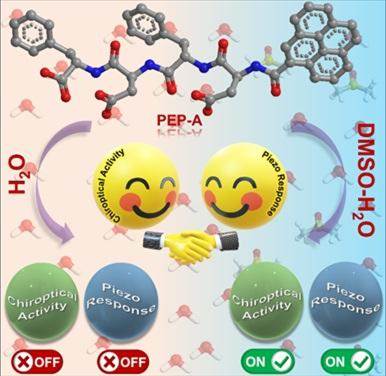
Fig: Schematic representation of the relation between chiroptical behaviour and piezoelectric response.
The research highlights India's growing strength in supramolecular chemistry, bringing together molecular design, advanced nanoscale characterization, and computational simulations, to solve complex scientific challenges.
The research was led by Dr Goutam Ghosh at CeNS, together with his PhD scholar Ms Aparna Ramesh, in collaboration with Mr Sarbajit Layek, Prof. Neelanjana Sengupta (IISER Kolkata), and Mr Tarak Nath Das (JNCASR).
Publication Link: https://doi.org/10.1002/anie.3135255
For further details, please contact Dr. Goutam Ghosh at gghosh@cens.res.in
*****
NKR/FT
(Release ID: 2306390)
Visitor Counter : 1331