Posted On:
04 SEP 2026 2:43PM by PIB Delhi
|
The intense heat in the Earth's interior is a powerful source of clean energy called geothermal energy. Given India's rich geothermal resources, this form of energy holds immense promise as a round-the-clock available source of power. The National Policy on Geothermal Energy aims to harness this potential. It seeks to make geothermal energy a key part of the nation's renewable energy story as India drives towards Net Zero by 2070. The recent commissioning of the first two geothermal wells in Ladakh marks the beginning of this journey.
|
Harnessing Geothermal Energy for a Sustainable India
Deep below the Earth's surface, emanating from the intense heat of its interiors, lies a constant, low-carbon source of energy called geothermal energy. In locations with suitable geology and tectonics, this energy can be tapped to generate power or used directly on the ground. Unlike solar and wind energy, this source provides renewable energy that is available round the clock. Recognising this potential, the Government notified the National Policy on Geothermal Energy in September 2025. The policy charts a clear roadmap for exploring and developing India's geothermal resources. The Ministry of New and Renewable Energy (MNRE) is the nodal ministry for its implementation.
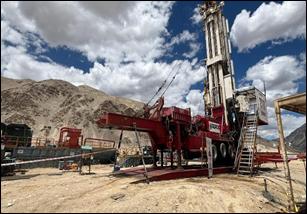
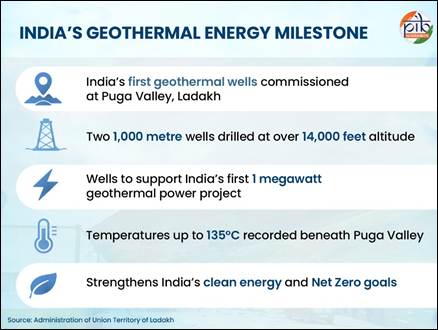
Building on this framework, India achieved a historic milestone in July 2026. The ONGC Energy Centre commissioned the country's first two geothermal wells in Puga Valley, Ladakh. At a height of over 14,000 feet above sea level, Puga Valley is among India's most promising geothermal sites, known for its hot springs and underground heat reserves. The two 1,000-metre-deep wells will support reservoir evaluation. They also pave the way for India's first 1-megawatt demonstration geothermal power project, marking the country's entry into geothermal power generation.
As India advances its clean energy transition, geothermal power offers a dependable, indigenous way to diversify the nation's renewable energy mix.
Understanding Geothermal Energy: An Overview
Geothermal Energy is a steady, low-carbon and weather-independent energy source. It holds a vast untapped resource base to strengthen India's clean energy future and cut reliance on fossil fuels.
Formation of Geothermal Energy
The Earth's interior consists of four main layers: the outermost, solid crust; the middle, semi-solid mantle; and the core divided into a dense liquid outer core and solid inner core. The temperature of the interior rises with depth - the mantle temperature reaches about 3700 Celsius degrees at its boundary with the core, while the core temperature goes up to 5000- 6000 Celsius. This heat is generated by radioactive decay of elements like uranium, thorium, and potassium, as well as residual heat left over from the planet's formation. This heat gives rise to huge convection currents in the mantle, as hot material moves up from the core boundary towards the cooler, upper parts of the mantle and crust. This material also contains water trapped as hydroxides. These convection currents give rise to all tectonic activity, including earthquakes, volcanoes and mountain building. In geologically active regions, faults and fractures let the hot material travel closer to the surface. This process creates reservoirs of hot water and steam, trapped within permeable rock. This thermal energy, harnessed from within the Earth, is known as geothermal energy.
From Geothermal Energy to Power Production
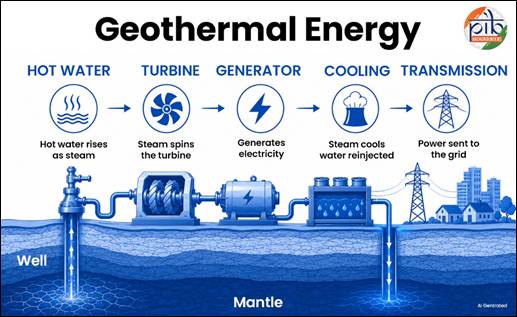
Geothermal power generation converts the earth's natural heat into electricity by tapping hot water and steam trapped beneath the surface. Deep wells bring these resources up to the surface. The steam then drives a turbine connected to a generator. This process resembles conventional thermal power generation. However, it replaces fuel combustion with naturally occurring underground heat. After power generation, the used water is condensed and reinjected into the reservoir. This supports resource replenishment and enables continued energy production. Geothermal energy also supports direct heat applications across district heating, agriculture, aquaculture, and space heating & cooling, enabling efficient utilisation of geothermal heat.
|
Inside the Earth
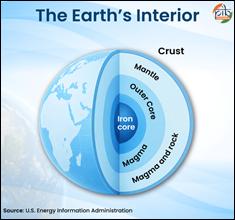
From the centre outward, the Earth is structured in four distinct layers. The inner core is a solid ball of iron and nickel, about 2,400 km wide. The outer core surrounding it is a liquid layer of molten iron and nickel, roughly 2,400 km thick. The mantle, composed mostly of hot, dense rock, extends nearly 2,900 km and forms the largest layer. Finally, the crust is the thin, solid outer layer, ranging from about 5 to 8 kilometres thick beneath the oceans to 24 to 56 kilometres thick beneath the continents.
|
India's Geothermal Resource Base
India's varied geology offers a strong foundation for geothermal development. The Geological Survey of India (GSI) has mapped 381 hot springs and identified 10 geothermal provinces nationwide. India's theoretical geothermal prospect stands at nearly 10.6 GW. Of this, 42 sites have been recognised as promising for power generation and direct heat use.
The 10 geothermal provinces include the Himalayan Geothermal Province, Naga-Lusai, Andaman and Nicobar Islands, Son Narmada Tapi (SONATA), West Coast, Cambay Graben, Aravalli, Mahanadi, Godavari, and South Indian Cratonic regions.
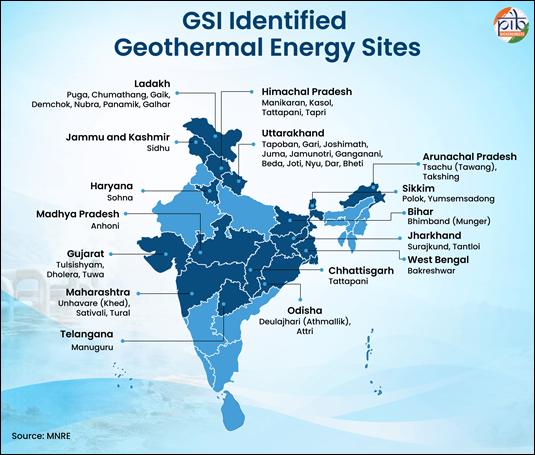
India's geothermal rift basins hold strong scope, owing to favourable geology and tectonics. But suitable projects can arise anywhere geothermal resources exist. Advanced technologies like Enhanced Geothermal Systems (EGS) and Advanced Geothermal Systems (AGS) will further widen exploration opportunities.
|
Repurposing Abandoned Oil and Gas Wells
Geothermal energy can be extracted from abandoned oil and gas wells. Inactive or unproductive wells can potentially be repurposed for geothermal initiatives, subject to technical and operational feasibility. This approach builds on existing drilling expertise, well data and infrastructure from the oil and gas sector.
|
India’s Geothermal Expansion
India is moving from resource assessment to field demonstration with remarkable speed. This momentum is reflected in the Ministry of New and Renewable Energy sanctioning five research and development projects between July and August 2025, covering resource assessment, indigenous technology development and field demonstration. The projects span electricity generation, heating and cooling applications. These efforts are generating the technical data and field experience needed for future commercial deployment.
|
Project
|
Current Status of Government-supported Projects
as of 12 December 2026
|
|
Ankleshwar, Gujarat
|
A pilot project evaluating electricity generation by retrofitting unproductive oil and gas wells. Field investigations and baseline geological and production data have been completed.
|
|
Gandhinagar, Gujarat
|
A demonstration project integrating solar and geothermal energy has drilled three geothermal wells that produce geothermal fluid at 70 to 80°C and has demonstrated electricity generation of 50 to 90 kilowatts.
|
|
Tawang, Arunachal Pradesh
|
Studies are underway at five geothermal sites to assess the region's geothermal resource through field investigations and geochemical analysis.
|
|
Hyderabad, Telangana
|
A research project is developing a geothermal cooling system for air conditioning applications using modelling and performance analysis.
|
|
Shallow Geothermal Energy
|
Pilot study is developing analytical models to evaluate shallow geothermal systems using Borehole Heat Exchangers for heating and cooling applications.
|
Significant geothermal resources, advancing technologies and early field activity are laying the foundation for a future of geothermal energy in India. While commercial-scale power generation is yet to be established, expanding well fields, demonstration activities and research and development initiatives are strengthening the ecosystem for wider deployment.
Unlocking India’s Geothermal Potential: Policy & Partnerships
Geothermal energy is a proven, established renewable technology worldwide. Global installed capacity reached 15.67 GW by the end of 2025. Indonesia, the US, the Philippines, Türkiye and New Zealand lead the field, together holding around 67% of global capacity. India is now building a strong ecosystem to advance geothermal energy from resource assessment to real-world deployment. National programmes and international partnerships are driving this mission forward, powering research, technology development and knowledge exchange across the sector.
National Policy on Geothermal Energy, 2025
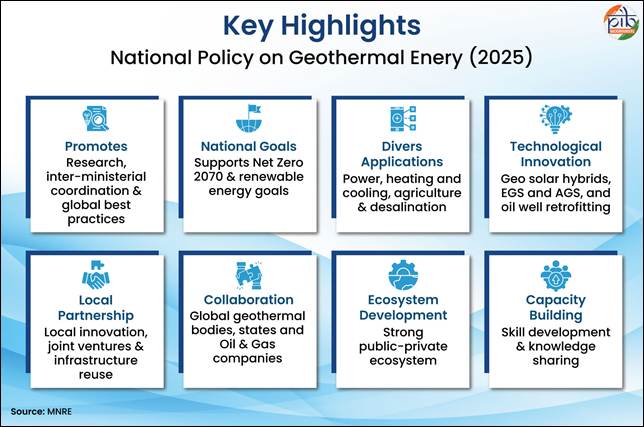
The National Policy on Geothermal Energy aims to establish geothermal energy as a major renewable pillar. It promotes systematic exploration and deployment of India's geothermal resources. The Policy prioritises research, drilling, reservoir management, and direct-use applications. It also supports Ground Source Heat Pumps (GSHPs) for heating and cooling. A clear regulatory framework encourages both public and private sector participation. The Policy facilitates repurposing abandoned oil and gas wells for geothermal use. It further supports a national geothermal data repository, pilot projects, and Centres of Excellence.
Renewable Energy Research and Technology Development Programme (RE-RTD)
MNRE is implementing the RE-RTD scheme through research institutions and industry partners. This initiative aims to develop indigenous, cost-effective technologies for renewable energy, including geothermal energy, across the country.
International Collaborations
India has advanced its geothermal energy efforts through collaborations with several international partners. Under cooperation mechanisms with Australia and Iceland, geothermal energy has been identified as a key area of cooperation. Similarly, an MoU with the Kingdom of Saudi Arabia designated geothermal energy as a focus area of bilateral engagement.
These initiatives are providing a coordinated platform for translating India’s geothermal resources into scalable solutions across sectors.
New Dimension in India’s Renewable Energy Mix
India's geothermal energy journey reflects the Government's steadfast commitment to energy security and sustainable growth. From notifying the National Policy on Geothermal Energy to commissioning the country's first two geothermal wells at Puga Valley, Ladakh, India has moved decisively from planning to implementation. The country holds a theoretical geothermal resource potential of nearly 10,600 MW. Growing pilot projects and strengthening international collaborations are expanding its applications, from power generation to heating, geo-tourism and agriculture. Geothermal energy is thus emerging as a valuable addition to India's renewable energy portfolio. As India advances towards its 2070 Net Zero target, geothermal energy will remain a steady, indigenous pillar of the country's energy transition and progress.
References:
Ministry of New and Renewable Energy
Administration of Union Territory of Ladakh
Ministry of Information and Broadcasting
Telangana Renewable Energy Development Corporation Ltd
International Renewable Energy Agency
U.S. Department of Energy
U.S. Energy Information Administration
Click here to see pdf
*****
PIB Research