Posted On:
09 SEP 2026 11:53AM by PIB Delhi
Advancing India’s capabilities in high-end medical technology and strengthening indigenous alternatives to imported healthcare products, the Technology Development Board (TDB), Department of Science & Technology (DST), Government of India, has extended financial assistance to M/s Ceramat Private Limited, Palghar, Maharashtra, for the project titled “Calcium Phosphate based Standard and Customized Patient Specific Grafts by 3D Printing via Digital Light Processing Technique and Extrusion-based Equipment.” The project aims to commercialise advanced, patient-specific bone grafts using indigenously manufactured bioceramic materials and 3D printing technologies.
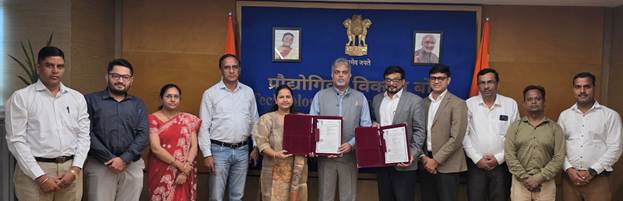
Ceramat Private Limited has been established with a focus on developing and commercialising indigenous technologies in bio-ceramics and advanced ceramics, with the objective of creating high-quality import substitutes for critical applications. The company’s product portfolio includes technologically intensive biomaterials such as hydroxyapatite, beta-tricalcium phosphate, biphasic calcium phosphate and bioactive glass, serving applications across orthopaedics, oral care, cosmetics and industrial sectors.
Hydroxyapatite and beta-tricalcium phosphate are calcium phosphate-based biomaterials that closely resemble the mineral composition of natural bone and are widely used in bone grafts and implant applications. A significant proportion of such advanced bone graft products available in India are currently imported. While Ceramat already manufactures bone grafts and granules through conventional processes, producing customised grafts matching the anatomy of individual patients presents a more complex manufacturing challenge.
The proposed project seeks to address this gap by integrating 3D printing with indigenously manufactured bioceramic raw materials. The company plans to develop standard as well as customised patient-specific grafts through two complementary approaches—Digital Light Processing (DLP)-based 3D printing and extrusion-based 3D printing. These technologies will enable greater flexibility in developing complex geometries and customised structures suited to specific clinical requirements.
The use of indigenous calcium phosphate-based materials in combination with advanced additive manufacturing is expected to expand Ceramet’s existing biomaterials capabilities from conventional graft products to more sophisticated, digitally designed and patient-specific solutions. The initiative will also enable the company to offer a broader range of bioceramic and orthobiological products through an integrated domestic manufacturing ecosystem.
The project is aligned with the Government of India’s emphasis on Aatmanirbhar Bharat, advanced manufacturing and indigenous medical technology development. By developing patient-specific graft manufacturing capabilities within the country, the initiative is expected to reduce dependence on imported bioceramic and orthobiological products, strengthen domestic supply chains and create a platform with potential for global markets.
Speaking on the occasion, Shri Rajesh Kumar Pathak, Secretary, TDB, said, “India’s transition from being a technology consumer to a technology developer requires indigenous capabilities in specialised and high-value areas of healthcare. The development of advanced bio-ceramics combined with 3D printing can open new possibilities for personalised medical solutions while reducing dependence on imported products. TDB is committed to supporting technologies that bring Indian innovation from development to commercial application and strengthen our capabilities in globally competitive medical manufacturing.”
****
NKR/FT/AA