Posted On:
10 SEP 2026 6:09PM by PIB Delhi
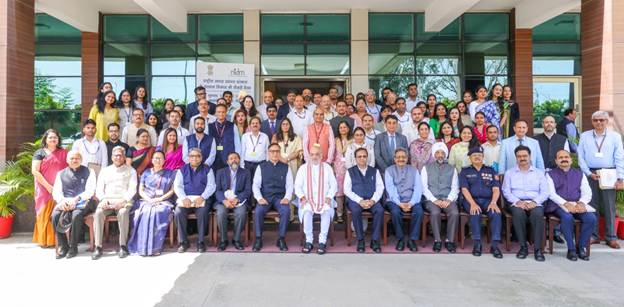
Union Home Minister and Minister of Cooperation Shri Amit Shah today chaired the third meeting of the Governing Body of the National Institute of Disaster Management (NIDM) in New Delhi. The meeting was attended by the Union Home Secretary, Vice-Chancellor of Delhi University, Member and Head of Department of the National Disaster Management Authority (NDMA), Director General of the National Disaster Response Force (NDRF), Secretary of the Department of Agriculture and Farmers Welfare, Director General of the India Meteorological Department (IMD), Director of the Lal Bahadur Shastri National Academy of Administration (LBSNAA), Executive Director of NIDM, and senior officials from several Central Ministries and State Governments.
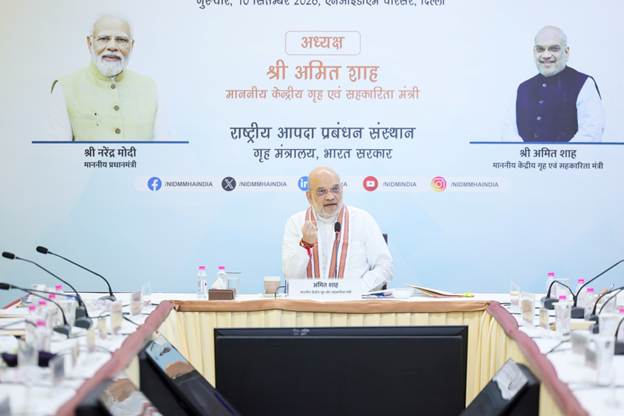
Addressing the meeting, the Union Home Minister and Minister of Cooperation said that under the leadership of Prime Minister Shri Narendra Modi there has been a comprehensive transformation in both the approach and methodology of disaster management over the last 12 years. The Modi Government has completely transformed the entire disaster management system, set the goal of ‘Zero Casualty’ and taken the country towards achieving this objective. We have also successfully faced several disasters with ‘Zero Casualty’, which is a major achievement. Shri Shah said that earlier disasters were viewed only from the perspective of relief and rehabilitation. Today, we have entered a new era based on three pillars - risk reduction, early warning systems and ‘Zero Casualty’. This is a matter of pride for all of us. He said that in this direction, the ‘Whole of Government’ approach is increasingly becoming an integral part of our work culture. Whenever a disaster occurs, all government departments actively respond. Now, with the strength of new research, we should take this process forward with greater speed and ensure continuous monitoring. Just as a ‘Whole of Government’ approach has been adopted in dealing with disasters, we must also move forward with a ‘Whole of Government’ approach to further strengthen the disaster management system.
Union Home Minister said that along with the transformation in the approach to disaster management, Prime Minister Shri Narendra Modi has also laid special emphasis on environmental protection. He said that ultimately environmental protection is the most effective means of preventing disasters. Environmental protection, risk reduction, resilience and a broad national vision are enabling India to gradually emerge as a model for the world. Initiatives such as Mission LiFE (Lifestyle for Environment), Pro-Planet People and the International Solar Alliance (ISA) are making an important contribution to disaster prevention. Shri Shah said that the ‘Zero Casualty’ approach should not be applied only at the site of a disaster. Zero Casualty can also be achieved by preventing disasters from occurring in the first place. Prime Minister Shri Narendra Modi has envisioned a safe and balanced world, going beyond the conventional approach of world leaders.
Shri Amit Shah said that there was a time when the predecessor of NIDM, the National Centre for Disaster Management was lying almost inactive in a corner of Krishi Bhawan. However, in 2003, the then Prime Minister Shri Atal Bihari Vajpayee took the historic decision to give it a new lease of life. Keeping in view the wide scope of the subject and the need for coordination among various agencies, it was decided to bring the institution under the Ministry of Home Affairs. Prime Minister Shri Narendra Modi has played a significant role in revitalizing the institution. NIDM has emerged in its present form with a transformed and strengthened role before the country.
Union Home Minister said that the relevance and significance of both NIDM and NDMA are going to increase further in the coming days. The number of disasters is likely to increase due to global warming and climate change. At the same time, new types of disasters may also emerge due to new applications of science and their expanding areas of use. Keeping all these aspects in mind, the two institutions share responsibilities ranging from policy-making to training and implementation. In some areas, both institutions are also working together.
Shri Amit Shah directed all stakeholders to constitute a dedicated cell in their respective departments for implementation of the agenda. He said that departmental heads should conduct a review meeting of the cell at least once every three months and accord priority to this subject.
Union Home Minister Shri Amit Shah said that NDMA and NIDM should study research being undertaken across the world in the field of disaster management and make efforts to implement its findings in India in accordance with local requirements. The Department of Agriculture should focus on permanent preparedness to deal with locust swarm attacks originating from the Pakistan side. He said that the best practices being adopted in other countries to deal with such attacks should be implemented in India. Shri Shah added that seriousness should be ensured in disaster management training and priority should be given to those who are genuinely committed to the subject in disaster management training programmes.
Union Home Minister said that NIDM and NDMA should jointly issue guidelines for the entire country. These guidelines should clearly specify what should and should not be done in the event of each type of disaster and how it should be done. NIDM should undertake the training component while the NDRF, State Disaster Response Forces (SDRFs) and other concerned agencies should work together to implement these guidelines on the ground.
Shri Amit Shah said that it is extremely important to prepare a document, through research, identifying the causes of disasters. Effective prevention and rescue measures can be developed on this basis. After every disaster, a joint team of NDMA and NIDM should be constituted, including the NDRF and SDRF. These four institutions should jointly study the causes of the damage and prepare a detailed report.
Shri Amit Shah said that NIDM has emerged as a national centre for research, innovation, policy support, training and departmental cooperation. We need to further strengthen these four pillars and explore new horizons. There are still unexplored areas in research, innovation, training, policy support and departmental cooperation that we should seek to address in the coming days. He said that NIDM has already taken steps in this direction. There is a need to take knowledge and best practices beyond departmental silos. In the coming days we must develop the habit of working in a coordinated manner, rising above departmental boundaries.
Union Home Minister said that Prime Minister Shri Narendra Modi has decided that the distribution of disaster funds should also be carried out through a scientific process. The allocation under the State Disaster Response Fund (SDRF) has increased nearly fourfold, while the allocation under the National Disaster Response Fund (NDRF) has increased nearly threefold. Around ₹2.5 lakh crore has been spent in this sector over the last 11 years, which is a major achievement. The Disaster Management Act was amended after 20 years. The concept of Urban Disaster Management Authorities was introduced and such authorities have also been established. The process of creating digital disaster databases at the national and state levels has begun. The National Crisis Management Committee (NCMC) has been accorded statutory status. In addition, the 16th Finance Commission has provided for ₹2 lakh crore for this period.
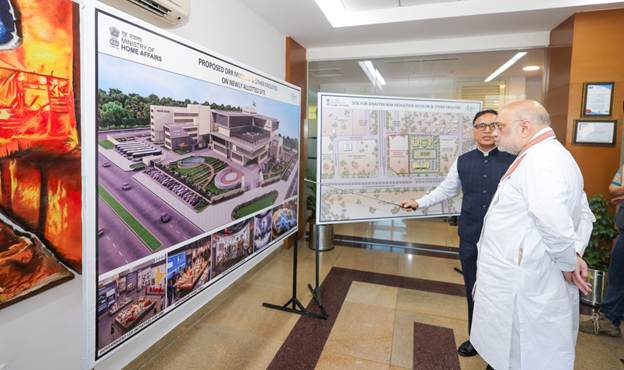
Shri Amit Shah said that the mobile application that has been developed needs to be widely promoted through primary, secondary and higher education. The Government is making every possible effort to strengthen NIDM. Recently, four acres of land have also been allocated for the institution. NIDM is working towards developing itself as a world-class model institution, and both its campuses are functioning smoothly. Shri Shah said that while enhancing international cooperation is undoubtedly commendable, our priority must continue to focus on the five lakh villages of the country. Keeping this priority in mind, there should be no objection to learning as much as possible from the world and enabling the world to learn as much as possible from us. He stated that the Modi government's goal is to create disaster-resilient villages and cities, and we must move forward by prioritizing this objective.
Union Home Minister and Minister of Cooperation Shri Amit Shah said that a provision should be made for at least one top-level meeting of NIDM to be held every year so that the meetings are meaningful and outcome-oriented and effective implementation of the decisions taken is ensured. He said that through this institution, we must transform knowledge into capacity, capacity into preparedness and preparedness into outcomes, so that together we can achieve the goal of ‘Zero Casualty’.
****
RK/RR/PR/PS