Ministry of Electronics & IT
SEMICON India 2026 Day 2 Highlights India’s Semiconductor Journey from Ambition to Execution at Scale
Union Minister Shri Ashwini Vaishnaw highlights ISM 2.0, indigenous design, manufacturing, talent and India’s emergence as a trusted global semiconductor partner
R&D, resilient supply chains, product innovation and international partnerships strengthen India’s ‘Silicon to Systems’ ecosystem
Posted On:
18 SEP 2026 10:12PM by PIB Delhi
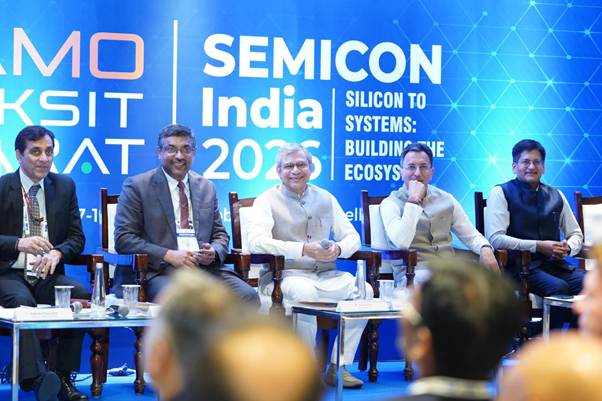
The second day of SEMICON India 2026 at Yashobhoomi, New Delhi, brought together policymakers, global semiconductor leaders, Indian industry, researchers, startups, academia and students for deliberations spanning manufacturing, supply chains, Research and Development (R&D), international partnerships, chip design, advanced packaging, materials and talent, reflecting India’s progress towards an integrated and globally competitive “Silicon to Systems” ecosystem.
In a fireside conversation, Shri Ashwini Vaishnaw, Union Minister for Electronics & Information Technology, Railways, and Information & Broadcasting, said India’s semiconductor mission has moved from proving intent to execution at scale. He said ISM 2.0 would build on the foundation created under ISM 1.0 through six pillars—Design; Machines and Materials; Setting up More Fabs; Strengthening the ATMP/OSAT Industry; Research and Development; and Talent Development. The Minister said that ISM 1.0, originally envisaged as a six-year programme, achieved its objectives in just four years, and expressed confidence that ISM 2.0 would similarly progress ahead of schedule, supported by strong and growing investor interest.
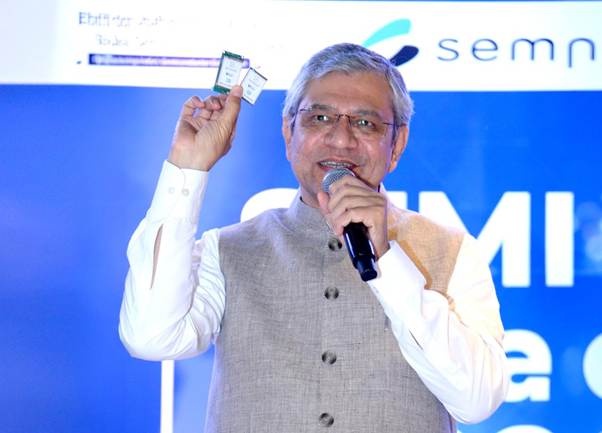
Highlighting design as one of India’s core strengths, the Minister estimated at least 200 chip design companies emerging under ISM 2.0, calling it a “game changer” for building home grown semiconductor IP. More than 105 chip design startups gained access to state-of-the-art Electronic Design Automation (EDA) tools, with 20 startups securing venture capital funding. Around 70,000 chip-design engineers have been trained in four years, against a target of training 85,000 design engineers. The Minister emphasised that global competitiveness requires both quality and competitive cost, and highlighted that five plants out the twelve plants approved under ISM 1.0 have commenced commercial production. The Minister also underlined India’s recognition as a trusted country and its strong record in intellectual property protection.
During his interaction with the media, Shri Vaishnaw highlighted the strong domestic and international response to SEMICON India 2026, extensive business-to-business engagements and significant participation from major semiconductor economies. He said the Country Roundtables demonstrated growing interest among global companies in expanding their engagement with India. The Minister also highlighted the transition from design services towards a “Product Nation”, with Indian-designed chips increasingly moving into end products. He emphasised machines and materials, specialised semiconductor logistics, sustainability, water recycling and industry-ready talent as important elements of the emerging ecosystem.
Day 2 also witnessed 25 MoUs/Announcements and strategic collaborations across semiconductor materials, manufacturing, power electronics, advanced packaging, logistics, design and skilling involving Indian and global ecosystem partners. The initiatives covered localisation of critical materials, indigenous Silicon Carbide power technologies, semiconductor design tools, deep-tech investment, specialised logistics and workforce development, further strengthening domestic capabilities across the semiconductor value chain.
Foreign Secretary Shri Vikram Misri emphasized that resilient semiconductor value chains require trusted global partnerships. He highlighted reliability, credibility, incentives and value creation as pillars of cooperation, and called for a balanced approach to self-reliance based on domestic strengths combined with global capabilities.
The ‘Supply Chain 360’ Panel discussion focused on localisation of critical inputs and resilient supply networks.
Shri Ruchir Dixit, Siemens EDA, highlighted the need to address AI-driven compute growth through advanced architecture, 3D ICs, packaging and chip-system co-design.
Shri Gokul V. Subramaniam, Intel, detailed AI applications across RTL generation, verification, floorplanning, power analysis, clock-tree synthesis and physical design, positioning AI as an optimisation engine for increasingly complex chips.
A panel on ‘From Concept to Silicon’ discussed strengthening India’s design enablement and test ecosystem. Speakers emphasised access to EDA tools, prototyping, fabrication, packaging, testing and industry-academia collaboration to bridge the gap between semiconductor design and product realisation.
Shri Sandeep Kumar, CEO, L&T Semiconductor Technologies, highlighted the architecture-led transformation of semiconductors through chiplets, Artificial Intelligence, high-speed interconnects and near-package optics, and stressed deeper capabilities in system architecture, power electronics, memory, optics and foundry supply chains.
A fireside discussion featuring Shri Ajit Manocha, President and CEO, SEMI, and Shri Mark Patel, Senior Partner, McKinsey & Company, examined the rapid expansion of the global semiconductor industry and India’s opportunity to build deeper capabilities in selected parts of the global value chain.
Ms. Nivruti Rai, MD and CEO, Invest India, highlighted the semiconductor industry’s evolution from the Integrated Device Manufacturer era to the foundry and fabless model and now towards an Artificial Intelligence and advanced-packaging-led era. She identified memory, High Bandwidth Memory (HBM), fabs, advanced packaging, materials, chiplets and heterogeneous integration as major opportunities for India, emphasising the need to combine India’s demand and engineering talent with global technology, capital and manufacturing expertise.
The session on Research and Development for Advanced Technologies, moderated by Ms. Sunita Verma, Scientist G and Group Coordinator, R&D Electronics, MeitY, emphasised indigenous R&D, intellectual property and commercialisation as critical to India’s next phase of semiconductor growth.
The State Spotlight session, moderated by Shri Vivek Tyagi, Managing Director, Analog Devices, highlighted initiatives of Assam, Odisha, Gujarat and Karnataka in incentives, infrastructure, ease of doing business and industry-linked skilling.
The Women in Manufacturing sessions highlighted expanding opportunities for women across semiconductor manufacturing, packaging, equipment engineering, quality, supply chains, automation and plant leadership, with emphasis on technical capability, mentorship and stronger pathways for women into leadership and decision-making roles.
The India Display Conference 2026 highlighted India’s opportunity to move beyond display assembly and build deeper domestic capabilities, with discussions covering advanced Liquid Crystal Displays (LCD), MiniLED, Quantum Dot and Organic Light-Emitting Diode (OLED) technologies, applications and supporting research.
The Workforce Development sessions focused on building an industry-ready talent pipeline across chip design, manufacturing, packaging, equipment, quality and supply chains through practical training and stronger industry–academia linkages.
India–Singapore Country Roundtable: Connecting Innovation and Investment
The India–Singapore Country Roundtable, attended by 142 participants representing both India and Singapore, explored cooperation by combining Singapore’s manufacturing, advanced packaging and supply-chain expertise with India’s engineering talent, market scale and expanding semiconductor ecosystem. Discussions covered equipment and materials, advanced packaging, R&D, testing, investment and talent, with emphasis on translating engagement into joint ventures and technology partnerships.
India–Europe Country Roundtable: Deepening Technology and Investment Partnerships
The India–Europe Country Roundtable, attended by 139 participants representing both India and Europe, focused on investment, supply-chain localisation, equipment and materials, manufacturing, advanced packaging, semiconductor design, R&D and talent. Discussions highlighted the complementarity between Europe’s capabilities in equipment, precision machinery, advanced materials and research and India’s strengths in design, engineering, manufacturing and market scale, including opportunities in 2.5D/3D packaging, chiplets and heterogeneous integration.
India–South Korea Country Roundtable: Strengthening Semiconductor Ecosystem Cooperation
The India–South Korea Country Roundtable, attended by 115 participants representing both India and South Korea, focused on opportunities to deepen cooperation across the semiconductor value chain, including manufacturing, technology, materials, advanced packaging, investment and supply chains, bringing together South Korea’s established semiconductor capabilities and India’s engineering talent, expanding market and growing manufacturing ecosystem.
Day 2 of SEMICON India 2026 reinforced India’s effort to build capabilities across the entire semiconductor value chain - from research, design and intellectual property to materials, equipment, fabs, advanced packaging, products and talent. The strong momentum was reflected in the participation of around 16,000 participants during the day, alongside extensive industry, research and international engagement. With growing investment, indigenous innovation and deeper global partnerships, India continues to strengthen its position as a trusted global partner for semiconductor design, manufacturing and innovation.
***
Vinod Kumar / Vineeth Narayan V / Vanshita Jaiswal / Kanishk Sharma
(Release ID: 2312288)
Visitor Counter : 165