Ministry of Environment, Forest and Climate Change
India showcases Forest and Landscape Restoration Initiatives at COFO 28, in Rome
International Cooperation must support Country-driven Implementation, Capacity Development, Technology Transfer and Measurable Outcomes on Ground: India
Posted On:
28 SEP 2026 8:21PM by PIB Delhi
India highlighted its significant achievement in forest and landscape restoration and reaffirmed its commitment to sustainable forest management, climate action and resilient forest landscapes at the Twenty-eighth Session of the FAO (Food and Agriculture Organization) Committee on Forestry (COFO 28), being held in Rome from 28th September to 2nd October 2026. Delivering its Statement during COFO 28, India welcomed FAO’s focus on Forest and Landscape Restoration, and emphasised that sustainable forest management provides an integrated framework for addressing restoration at the landscape level while responding to national circumstances and the needs of local communities.

India highlighted the consistent progress made in enhancing its forest resources. The country’s forest and tree cover stands at 82.74 million hectares, constituting 25.17% of its geographical area. The FAO Global Forest Resources Assessment 2025 ranks India 9th globally in forest area and 3rd in net annual forest area gain. Forests and trees also remain central to India’s climate commitments. India has created an additional carbon sink of 2.29 billion tonnes of CO₂ equivalent by 2021 and has enhanced its ambition to create an additional carbon sink of 3.5–4.0 billion tonnes of CO₂ equivalent by 2035, compared with 2005 levels.
The Statement further highlighted its commitment under the Bonn Challenge to restore 26 million hectares of degraded and deforested land by 2030, of which 21.76 million hectares have already been brought under restoration. Further, major landscape restoration initiatives being undertaken were showcased. Under the Aravalli Green Wall, approximately 6.45 million hectares of degraded land have been identified for restoration. In coastal landscapes, the MISHTI initiative is advancing mangrove restoration while strengthening climate resilience and supporting local livelihoods. India also highlighted that the number of Ramsar Sites in the country has reached 101.
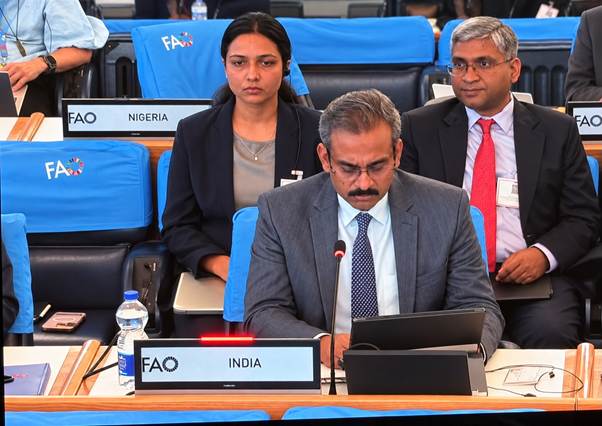
The country also showcased Ek Ped Maa Ke Naam – Plant4Mother, a whole-of-government and whole-of-society initiative under which more than 3.5 billion saplings have been planted. India emphasised that international cooperation must move beyond global commitments to support country-driven implementation, capacity development, technology transfer and measurable outcomes on the ground. It underlined the need for effective and sustainable financing, particularly for developing countries, and encouraged FAO to strengthen support for accessing climate, biodiversity and blended finance and for developing long-term restoration programmes.
India also called for stronger coherence between FAO’s forestry work, the Global Forest Goals and other forest-related international processes, along with enhanced South-South and triangular cooperation for sharing knowledge, best practices and scalable solutions. The country reaffirmed its commitment to working with FAO and Member States in shaping the proposed UN Decade for Afforestation and Reforestation in line with Sustainable Forest Management, 2027–2036, with the objective of building a coherent continuum from restoration of degraded ecosystems to resilient, productive and inclusive forest landscapes.

*****
VM
(Release ID: 2316216)
Visitor Counter : 349