PIB Backgrounder
Bankers Books Evidence Act, 2026
Posted On:
30 SEP 2026 5:41PM by PIB Delhi
The Bankers’ Books Evidence Act, 2026 modernises India’s legal system governing admissibility of banking records as evidence. It comes into force on October 1 2026, and replaces the Bankers’ Books Evidence Act, 1891. The Act introduces a technology-neutral framework covering physical, electronic and digital records, with standardised provisions for their authentication and certification. It strengthens procedural safeguards governing the production of bankers’ books. The Act also protects bank officials from routine appearance in proceedings, where the bank is not a party, solely for the purpose of proving/testifying the record of the bank. It enables extension of its provision to specified financial sector entities, supporting an evolving and increasingly digital financial ecosystem.
A Modern Legal Framework for Banking Records
The Government has undertaken reforms to strengthen India’s banking and financial sector and improve ease of doing business. These efforts also focus on modernising laws and regulations to reflect the changing needs of the economy.
The Bankers’ Books Evidence Act, 2026 comes into force on October 1, 2026, and replaces the Bankers’ Books Evidence Act, 1891.
The Act provides clear and updated rules for admissibility of bank records as evidence in legal proceedings. It applies to court cases, inquiries, arbitrations and investigations where banking records may be required to be produced as evidence.
Breaking Down Bankers’ Books Evidence Act, 2026
The Bankers’ Books Evidence Act, 2026 provides a modern framework for admissibility of banking records as evidence in line with contemporary digital banking practices. The Act will be used in any legal proceeding, an arbitration and any investigation or inquiry under the Bharatiya Nagarik Suraksha Sanhita, 2023, or under any other law for the time being in force, in which evidence is or may be taken. As per the Act-
- “Bank” and “banker” mean any company or corporation carrying on the business of banking, any entity or class of entities operating in the financial sector (to whose books the provisions of this Act are extended), any post office savings bank or money order office.
- “Bankers’ books” include ledgers, day-books, cash-books, account books and all other records used in the ordinary course of business of the bank. These can be kept in written or physical form or stored in any form of data storage mechanisms
The Bankers’ Books Evidence Act was framed in the colonial era of 1891, when banking systems were entirely paper-based. In the current times, India continues to progress in digitising its economy. Banking and financial transactions are largely driven by digital platforms, frequently accessible with a simple click on a mobile phone. In such a scenario, it is imperative that India’s legal framework evolves to keep pace with these advancements.
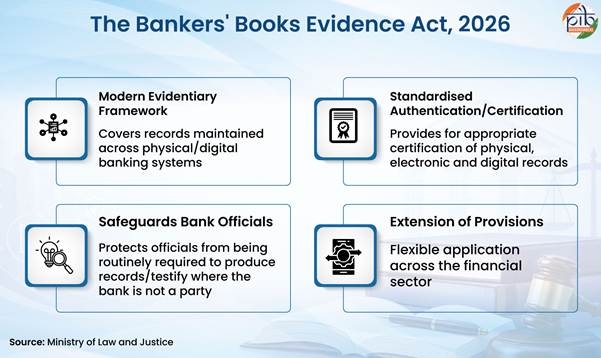
- The Act establishes a contemporary evidentiary framework for banking records, covering records maintained across physical and digital banking systems.
- It enables standardised authentication and certification of bankers’ books, providing for appropriate certification of physical and electronic records.
- The Act strengthens clarity and procedural safeguards in the production of bankers’ books. It also protects bank officials from being routinely required to produce records or testify in proceedings where the bank is not a party.
- It provides a flexible framework for extending the law across the financial sector, as it continues to evolve in India.
The Act provides for stringent and contemporary safeguards for the secure handling and verification of electronic records as a precondition for their admissibility as evidence in legal proceedings.
Major Changes under the Bankers’ Books Evidence Act, 2026
The 2026 Act retains the core evidentiary framework of the 1891 law for proving banking records through certified copies of records. It modernises and strengthens the existing framework with a technology-neutral system covering electronic and digital banking records.
- Recognition of Electronic Records as Evidence:
- As per the new Act, an electronic or digital record of a banker’s book will be admissible, valid, and legally enforceable as evidence, subject to a few conditions which include-
(i) the said copy is a true copy of such entry or information, and correctly represents or is appropriately derived from such records
(ii) no unauthorised changes to data are detected
(iii) no tampering or other event affecting the integrity and accuracy of the system is detected
-
- This change standardises the certification process and allows authentication through manual, digital, and electronic signatures.
- Compelling Production of Bankers’ Books:
- The Act provides that the contents of a banker’s book may be proved in legal proceedings through a certified copy, without requiring production of the original banker’s book.
- Accordingly, a bank officer cannot ordinarily be compelled to produce the banker’s book or appear as a witness to prove the records, particularly where the bank is not a party to the proceedings.
- The Act provides that a bank officer may, however, be required to appear as a witness or produce a banker’s book only pursuant to a written order of the Court recording a special cause. The Act specifies the circumstances constituting a special cause, where-
(i) accuracy or authenticity of the entry or information is uncertain.
(ii) the regularity or ordinary nature of record keeping is interrupted owing to any event.
(iii) the bank does not comply with any previous Court order about inspection or production of the certified copy of the books.
- Extension to Other Financial Sector Entities:
- The 1891 Act applies to entities engaged in the business of banking and any post office savings bank or money order office. The 2026 Act also retains this clause.
- However, it further allows the Government to extend its provisions to any entity or class of entities operating in the financial sector, by notification. The Government may highlight conditions, exceptions, or modifications in the notification.
Conclusion
The Bankers’ Books Evidence Act, 2026 marks a significant step towards modernising the legal framework governing banking records. By aligning evidentiary provisions with technological advancements and evolving economic needs, it strengthens the efficiency, reliability, and adaptability of India’s financial system. It reflects the Government’s continued commitment to advancing reforms that strengthen institutions and support India’s growth trajectory.
References
Ministry of Law and Justice
https://egazette.gov.in/WriteReadData/2026/275446.pdf
https://financialservices.gov.in/sites/default/files/Act-Policies/2026-01/The-Bankers-Book-Evidence-Act-1891.pdf
https://www.pib.gov.in/PressReleaseDetail.aspx?PRID=2309122®=3&lang=1
Others
https://newsonair.gov.in/parliament-passes-bankers-books-evidence-bill-to-recognise-digital-banking-records-as-legal-evidence
https://ddindia.co.in/2026/08/rajya-sabha-passes-bankers-books-evidence-bill-2026-to-recognise-digital-banking-records/
click here to see pdf
PIB Research
(Release ID: 2317151)
Visitor Counter : 202