PIB Backgrounder
From First Drop to Clean Streets
Cities Prepare for a Cleaner, Healthier Monsoon
Posted On:
01 OCT 2026 4:18PM by PIB Delhi
Before the Rains, the Cities Move
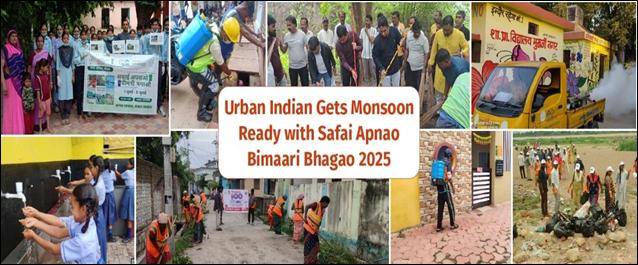
As the monsoon approaches and the first rains arrive, cities across India begin preparations to address the seasonal risks associated with waterlogging, waste accumulation, and sanitation. Drains are cleaned, vulnerable locations are identified, and measures are undertaken to maintain cleanliness and public health. Under the Ministry of Housing and Urban Affairs-led Safai Apnao, Bimaari Bhagao 2025 (SABB) campaign, urban local bodies translated pre-monsoon preparedness into a coordinated cleanliness and public health effort. From 1 July to 31 July 2025, cities undertook drain cleaning, waste removal and hygiene promotion, while engaging communities through schools, neighbourhoods and other public spaces.
At the heart of the campaign are the ‘6 Swachhata Mantras’: clean hands, homes, neighbourhoods, toilets, drains and public spaces. Together, these simple practices are becoming part of a larger city-wide effort to keep the monsoon safer and healthier. And across the country, that effort is taking many different forms.
In Delhi, the campaign took the message to its streets and schools. 400 NCC girl cadets led a 3-km Pinkathon, a walkathon promoting monsoon hygiene and sanitation. The campaign saw significant on-the-ground action, including handwashing drives in 255 schools, while 206 cleaning drives covered backlanes and garbage vulnerable points (GVPs). Another 469 sanitation drives were conducted in community and public toilets (CTs and PTs). The Patna Municipal Corporation (PMC) introduced ‘Manhole Ambulances’ to enhance urban safety and sanitation through swift, on-site manhole repairs. Each ambulance carries prefabricated manhole covers, repair tools, and a dedicated response team for immediate action, especially during rains. PMC repurposed old, unused municipal vehicles into functional units. Six ambulances, one per municipal zone, are operational and linked to PMC’s central control room for real-time complaint resolution. The initiative enables citizen-centric grievance redressal and ensures faster responses to manhole-related complaints.
In Navi Mumbai, a Swachhata rally was organised with the participation of over 600 students, parents, teachers, and citizens. Simultaneously, health awareness camps were held across 26 Urban Primary Health Centres, focusing on malaria and dengue prevention. Over two days, 52 health camps were conducted, reaching more than 22,690 citizens. In Telangana, the campaign reached nearly 13 lakh households. Around 14,210 km of drains were desilted, while 4,343 km of roadside bushes were cleared. Nearly 2.5 lakh houses were covered through anti-dengue and malaria awareness drives. Health camps also benefited over 8,500 frontline workers. Meanwhile, 140 composting pits were set up in schools, encouraging young citizens to turn waste into manure.
In Chhattisgarh, the story begins with people themselves. In Pandariya, Self-Help Group members received sanitation training and were introduced to the Swachhata App. They then took part in a cleanliness drive. In Raipur, door-to-door outreach promoted hand hygiene and waste segregation, while Garbage Vulnerable Points (GVPs) were cleaned and beautified.
Northeast Unites for a Cleaner, Safer Monsoon
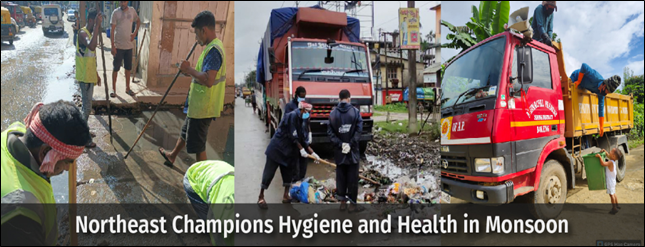
As the monsoon approaches, the Northeast is getting ready not by waiting for the rains, but by preparing for them. Across Arunachal Pradesh, Nagaland, Assam, Sikkim and Tripura, the MoHUA-led SABB campaign is strengthening monsoon preparedness through collective cleanliness and disease prevention.
In Nagaland, Urban local bodies (ULBs) across six towns led school awareness activities, drain cleaning, health camps and cleanup drives. These efforts engaged nearly 5,000 people through 60 cleanliness, 30 rainwater harvesting and 40 post-monsoon awareness drives. Across the hills of Sikkim, the campaign took aim at garbage-prone areas and the risks of water- and vector-borne diseases. Students, officials and Self-Help Groups (SHGs) came together around source segregation and better waste management. Around 4,000 people participated in 100 cleanliness and 100 post-monsoon drives, alongside awareness rallies and PET bottle shredding initiatives. In Assam, towns focused on drain cleaning, garbage removal, SafaiMitra health check-ups and waste segregation. Around 5,500 people joined 200 cleanliness and 40 rainwater harvesting activities, supported by 160 organisations and NGOs.
In Tripura, ULBs strengthened waste collection, segregation and public toilet maintenance. Around 5,000 people participated in 150 cleanliness and 30 rainwater harvesting drives, alongside health camps, school rallies and sanitation initiatives. Across 47 urban notified towns in Arunachal Pradesh, efforts covered waste management, water quality and public toilet maintenance. Water treatment plants were inspected, while mass cleanliness drives targeted garbage-vulnerable points. These efforts demonstrate how cleanliness and disease prevention can be integrated into everyday community action.
From Backlanes to Clean, Vibrant Neighbourhood Spaces
A backlane refers to the space behind houses in a neighbourhood, generally characterised by limited pedestrian movement. Such areas can become vulnerable to waste accumulation and informal dumping. Recognising this, cities across Madhya Pradesh organised backlane cleaning drives with active public participation. The initiatives included the removal of encroachments and cleaning of drains to facilitate the smooth flow of rainwater during the monsoon.
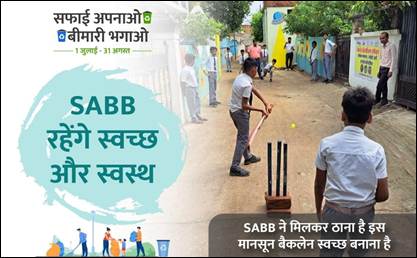
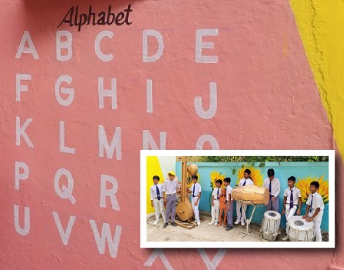
In Rewa, the Municipal Corporation extended the effort beyond backlanes to improve the cleanliness and appearance of front lanes across all wards. Murals and wall paintings were created, while play equipment and musical instruments were developed using the principles of the 3Rs-Reduce, Reuse, and Recycle. The walls also feature English and Hindi vowels and alphabets, numbers and multiplication tables. By integrating cleanliness with learning and recreational elements, the initiative has helped create safer, more engaging and child-friendly neighbourhood spaces.
In Agra, the Agra Municipal Corporation successfully cleaned and maintained nine backlanes across the city. The Urban Learning Internship Program (TULIP) trainees actively participated in the campaign, while local residents contributed to the cleaning and beautification of neighbourhood streets. Their participation demonstrates how community involvement can strengthen local ownership of cleanliness and support the sustained upkeep of shared public spaces.
From Safety to Opportunity
For Jyotsna Dhabde of Bhopal, access to institutional credit provided an opportunity to pursue entrepreneurship. At a Bhopal Municipal Corporation loan fair, she received a loan under the Swachhta Udyami Yojana, which enabled her to purchase a sanitation vehicle. In New Delhi, Raja, a supervisor with the New Delhi Municipal Council, shared his experience of mechanised sewer cleaning.
Raja says, “Earlier, we were compelled to enter the sewers to carry out sewer cleaning. But with the introduction of modern machines, the work is now executed using machines. In addition, being provided with safety gear such as gumboots, masks, safety glasses, helmets, and other protective equipment makes us feel safer.”
Together, these experiences illustrate efforts to make sanitation work safer, more skilled and more dignified.
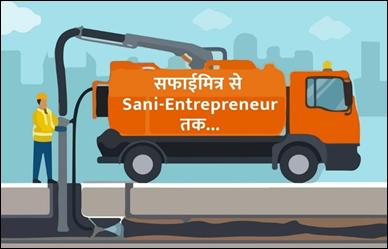
The Safai Mitra Suraksha Challenge 2021 focused on health education, the provision and use of safety equipment, worker welfare and reduction of occupational risks. Under Swachh Bharat Mission–Urban 2.0, the Ministry of Housing and Urban Affairs (MoHUA) has emphasised the provision of protective equipment, training and safety awareness by Urban Local Bodies (ULBs), to work towards zero fatalities in sanitation work.
As a pioneer in this space, Chandigarh has prohibited hazardous manual sewer cleaning since 2018. An Emergency Response Sanitation Unit (ERSU), operating under the Responsible Sanitation Authority (RSA), supports safer sanitation practices by providing Personal Protective Equipment (PPE), safety gear and regular medical check-ups.
In Assam, 83 of 96 Urban Local Bodies (ULBs) declared themselves SafaiMitra Surakshit Shehar in 2023. The state mapped 5,230 sanitation workers and organised 92 health camps. In Maharashtra, 246 Master Trainers were prepared during the first phase, followed by training for 1,917 sanitation workers. Uttar Pradesh supported SafaiMitras by facilitating access to credit and livelihood opportunities. Together, these measures seek to strengthen the safety, social and economic security, dignity and entrepreneurial opportunities of SafaiMitras, creating pathways from sanitation work towards sani-entrepreneurship.
From Preparedness to Community Action
As the rains arrive, the real value of pre-monsoon preparedness becomes visible on the ground. A cleared drain allows rainwater to flow freely, a clean street prevents waste buildup, and an early health camp helps communities spot and contain disease risks before they spread. At the heart of each measure is the active participation of citizens, making public health a shared responsibility.
From the hills of the Northeast to the streets of Delhi, and across communities in Telangana, Chhattisgarh, Madhya Pradesh, and Uttar Pradesh, the campaign has taken diverse, localized forms. Yet underlying them all is a single unified truth: true monsoon preparedness is not merely about reacting to rainfall, but about preparing together —one street, one neighbourhood, and one community at a time.
References
Ministry of Housing and Urban Affairs
https://sbmurban.org/SABB-in-Northeast
https://sbmurban.org/safai-Apnao-Bimaari-Bhagao-2025
https://sbmurban.org/Back-Lanes-Cleaning
https://sbmurban.org/Sani-Entrepreneur
Click here to see pdf
****
PIB Research
(Release ID: 2317642)
Visitor Counter : 237