Ministry of Education
Day Two of Diamond Jubilee Week Focuses on the Evolution of the Bharatiya Knowledge System, Archaeology and Ancient Civilisations
Posted On:
13 OCT 2026 10:45AM by PIB Shimla
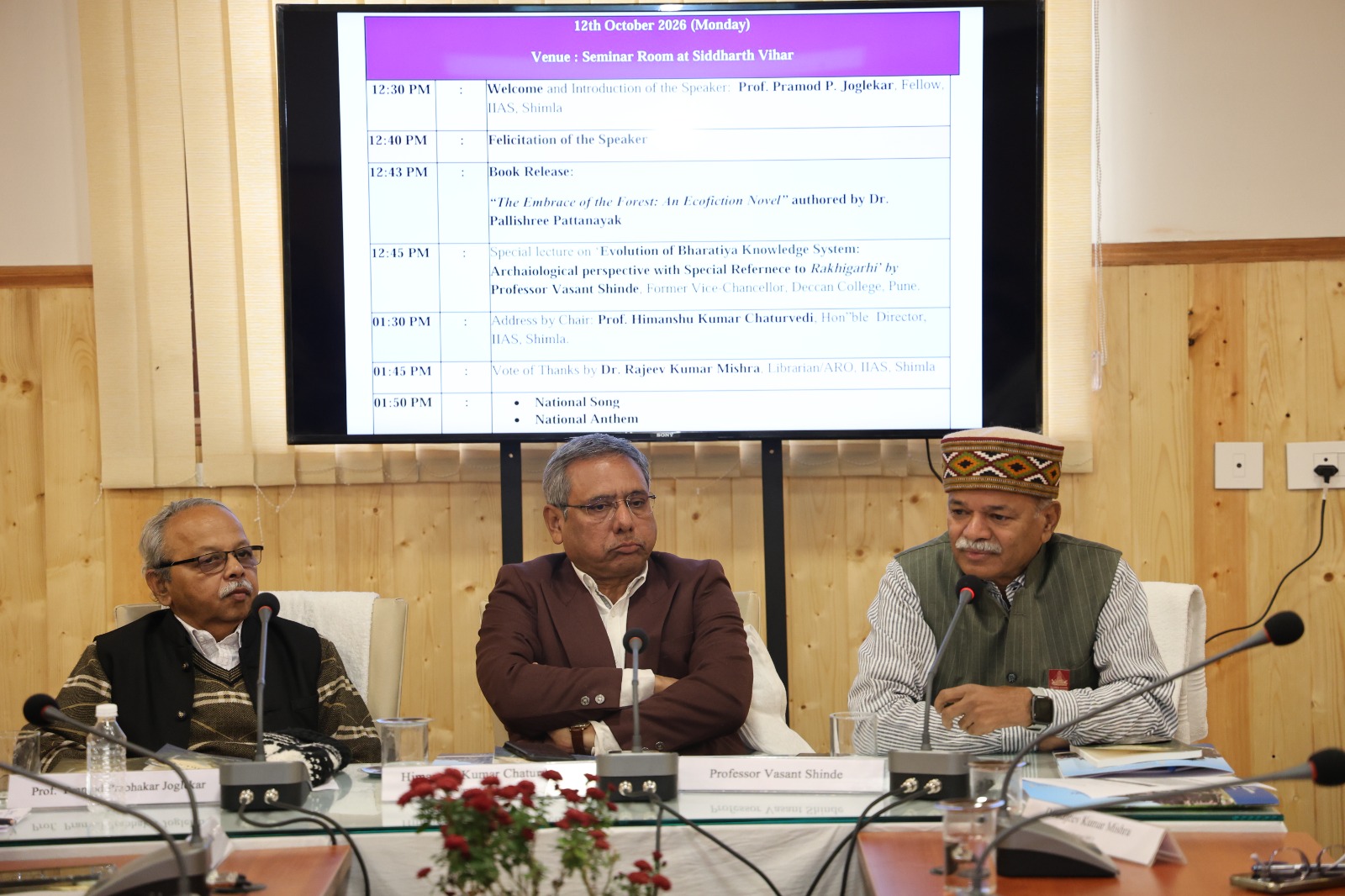
Shimla, 12 October 2026: The second day of the Diamond Jubilee Week Celebration at the Indian Institute of Advanced Study (IIAS), Rashtrapati Niwas, Shimla, featured a special lecture focusing on the evolution of the Bharatiya Knowledge System and the understanding of the past through archaeological evidence. Prof. Vasant Shinde, eminent archaeologist and former Vice-Chancellor of Deccan College Post-Graduate and Research Institute, Pune, delivered a lecture on “Evolution of Bharatiya Knowledge System: Archaeological Perspective with Special Reference to Rakhigarhi.” The session was chaired by Prof. Himanshu Kumar Chaturvedi, Director, IIAS.
Scheduled from 11 to 15 October 2026, the Diamond Jubilee Week aims to encourage dialogue on history, Bharatiya knowledge traditions, literature, art, culture and academic thought. In this context, the second day’s lecture was devoted to examining the development of the Bharatiya Knowledge System from an archaeological perspective and reflecting on the civilisational achievements of the past through the study of important archaeological sites such as Rakhigarhi.
*Exploring the Bharatiya Knowledge Tradition through the Archaeological Context of Rakhigarhi*
In his lecture, Prof. Vasant Shinde focused on the importance of understanding the evolution of the Bharatiya Knowledge System through archaeological perspectives, with particular reference to Rakhigarhi, an important site in the study of the ancient civilisational heritage of the Indian subcontinent.
Archaeology is a significant discipline for understanding the past. Excavated remains, the layout of ancient settlements, material culture, artefacts and other archaeological evidence help researchers investigate the lives of ancient communities and their patterns of development. The systematic analysis of such evidence can offer insights into the ways of life, technological capabilities, social organisation and cultural practices of past societies.
The study of Rakhigarhi is significant because it provides an opportunity to examine archaeological questions relating to ancient urban civilisation in the Indian subcontinent and its development. Research at such sites helps situate material remains within broader historical contexts and supports the analysis of processes associated with civilisational development.
The central theme of the lecture was the relationship between the evolution of the Bharatiya Knowledge System and archaeological evidence. The study of knowledge traditions is not confined to written texts alone; material remains and archaeological findings are also important sources for understanding the capabilities, experiences and ways of life of past societies. An interdisciplinary approach combining archaeology and history can therefore contribute to a more comprehensive understanding of India’s past.
*Interdisciplinary Dialogue between Archaeology and History*
Prof. Shinde’s lecture highlighted the role of archaeological research in the study of the Bharatiya Knowledge System. Understanding the past requires the examination of literary sources, historical records and archaeological evidence within their respective contexts. A comparative and evidence-based study of different sources can contribute to a more balanced interpretation of historical processes.
The study of archaeological sites such as Rakhigarhi enables researchers to investigate questions concerning the organisation of ancient societies and the development of civilisations. It also draws attention to the fact that our understanding of the past continues to evolve through new evidence, research methodologies and academic discussions.
The lecture at the Indian Institute of Advanced Study provided an important platform for reflecting on the interconnections between history, archaeology and the Bharatiya Knowledge System. The inclusion of this subject in the academic programme of the Diamond Jubilee Week underscored the relevance of interdisciplinary approaches to the study of India’s civilisational past.
*Prof. Vasant Shinde’s Academic Contribution*
Prof. Vasant Shinde is known for his academic work in the field of archaeology and previously served as Vice-Chancellor of Deccan College Post-Graduate and Research Institute, Pune. His lecture offered an opportunity to reflect on the usefulness of archaeological research in understanding the evolution of the Bharatiya Knowledge System and the importance of evidence obtained from ancient sites.
 By taking Rakhigarhi as a specific point of reference, the lecture invited reflection on how the study of material remains from ancient civilisations can enrich our understanding of their social and cultural life. The discussion highlighted the role of archaeological research in the study of Indian history and the importance of continued academic engagement with the subject.
*Session Chaired by Prof. Himanshu Kumar Chaturvedi*
The session was chaired by Prof. Himanshu Kumar Chaturvedi, Director of the Indian Institute of Advanced Study. His address connected the subject of the lecture with the Institute’s broader academic vision and the objectives of the Diamond Jubilee Week.
The Indian Institute of Advanced Study provides an academic platform for dialogue across disciplines and knowledge traditions. The lecture on the evolution of the Bharatiya Knowledge System from an archaeological perspective was consistent with this multidisciplinary approach.
The session began with a welcome address and introduction of the speaker by Prof. Pramod P. Joglekar, Fellow, IIAS. The speaker was subsequently felicitated. Following the lecture, Prof. Chaturvedi delivered the chair’s address. The programme concluded with a vote of thanks by Dr. Rajeev Kumar Mishra, Librarian and Academic Resource Officer, IIAS.
*Ongoing Art Exhibition: An Expression of Indian Art and Cultural Consciousness*
The art exhibition titled “Bharatiya Forms, Expressions and Consciousness” continues to be a major attraction of the Diamond Jubilee Week at IIAS. Featuring the work of artist Nisha Jaiswal, the exhibition presents diverse aspects of Indian epics, traditional artistic forms and cultural consciousness through visual art. Inaugurated on 11 October by Padma Shri Smt. Shovana Narayan, the exhibition offers visitors an opportunity to engage with India’s cultural heritage and artistic expressions. It will remain open to visitors at the Rabindranath Tagore Art Gallery, near the Pool Theatre, until 15 October 2026, daily from 11:00 AM to 7:00 PM. Entry is free, and visitors are exempted from the regular entry ticket.
*Ongoing Book Fair: A Centre for Knowledge, Literature and Academic Engagement*
The book fair organised as part of the Diamond Jubilee Week continues to attract readers, students, research scholars and book enthusiasts. Inaugurated on 11 October by Prof. Raghuvendra Tanwar and Prof. Reicha Tanwar, the fair features books and academic publications presented by distinguished national and international publishers. The range of publications offers visitors an opportunity to explore new ideas, research material and literary works across diverse subjects. The initiative seeks to promote a reading culture while encouraging interaction between the publishing industry and the academic community. The book fair will continue at the Indian Institute of Advanced Study, Rashtrapati Niwas, Shimla, until 15 October 2026, daily from 11:00 AM to 7:00 PM. Entry is free, with exemption from the regular entry ticket.
*Diamond Jubilee Week: A Shared Platform for Knowledge, Research and Cultural Heritage*
The second day of the Diamond Jubilee Week brought archaeological research and the study of the Bharatiya Knowledge System into focus. Following the discussions on history, art, books and scholarly publications on the opening day, the programme on 12 October extended the academic dialogue towards ancient civilisations and archaeological evidence.
Through the week-long celebration, the Indian Institute of Advanced Study is encouraging dialogue on the diverse dimensions of history, literature, culture, art and knowledge. The programme seeks to connect these subjects not only with the academic community but also with wider intellectual and cultural discourse.
The forthcoming programme on 13 October will feature a special lecture on “Vande Mataram” by Shri Akhilesh Jha, Indian Civil Accounts Service (ICAS), Ministry of Rural Development, Government of India, New Delhi. On 15 October, the Institute will host the unveiling of the bust of Dr. Sarvepalli Radhakrishnan, the inauguration of an art gallery dedicated to Kangra Miniatures, a book release and cultural programmes.
The Diamond Jubilee Week at the Indian Institute of Advanced Study, Rashtrapati Niwas, Shimla, is an important initiative to advance meaningful dialogue on knowledge, history, art and cultural heritage.
SS/GS/NK
(Release ID: 2322615)
Visitor Counter : 12