Ministry of Fisheries, Animal Husbandry & Dairying
Union Fisheries Secretary Dr. Abhilaksh Likhi Visits Mandapam Seaweed Cultivation Site; Interacts with Seaweed Farmers, Self-Help Groups and Scientists
Dr. Abhilaksh Likhi Emphasizes Technology Adoption, Value Addition and Sustainable Livelihoods through Seaweed Cultivation
Posted On:
13 OCT 2026 4:06PM by PIB Delhi
Dr. Abhilaksh Likhi, Secretary, Department of Fisheries, Ministry of Fisheries, Animal Husbandry and Dairying (MoFAH&D), Government of India, visited the seaweed cultivation site at Munnaikadu, Mandapam Camp, Tamil Nadu, and interacted with seaweed farmers associated with Self-Help Groups (SHGs). The visit was undertaken as part of the Department's efforts to promote seaweed farming, strengthen coastal livelihoods, and accelerate the development of the seaweed value chain in the country.
A day earlier, Dr. Likhi had chaired a meeting on seaweed farming at the ICAR-CMFRI Regional Centre, Mandapam, Tamil Nadu, to review the progress of seaweed cultivation initiatives and discuss measures for scaling up production, value addition, and market linkages in the sector.
During the interaction, the farmers explained various cultivation techniques adopted in Tamil Nadu, including monoline and raft-based methods, and demonstrated different farming, maintenance and harvesting operations. The Secretary appreciated the contribution of women-led Self-Help Groups in creating sustainable livelihood opportunities through seaweed farming and encouraged the members to enhance production, bring more farmers into organized cultivation and avail benefits under Government schemes, including the Pradhan Mantri Matsya Sampada Yojana (PMMSY) and the Pradhan Mantri Matsya Kisan Samridhi Sah-Yojana (PM-MKSSY).
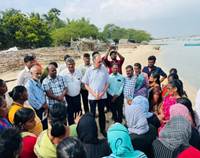
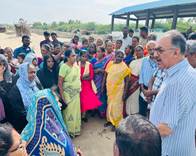
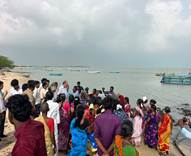
Earlier, the Union Secretary chaired a Meeting on Seaweed Farming at the ICAR-CMFRI Regional Centre, Mandapam, with representatives from Coastal States and Union Territories, research institutions, technical agencies and seaweed stakeholders from across the country. He highlighted the significant potential of seaweed cultivation in India and noted that the country's coastline of 11,099 km provides favourable conditions for large-scale expansion of the sector. Research institutions have identified 384 suitable sites covering 24,707 hectares for seaweed cultivation across Coastal States and Union Territories.
The Secretary informed that under the Pradhan Mantri Matsya Sampada Yojana (PMMSY), seaweed cultivation has been identified as a priority activity for promoting employment generation and augmenting the incomes of fishers and coastal communities. During the period 2020-27, projects worth ₹181.11 crore have been approved for seaweed development, including the establishment of a Seaweed Park in Tamil Nadu. Financial assistance has been extended for installation of 37,255 seaweed culture rafts and 44,080 seaweed culture monoline units, along with support for seed banks, awareness, training and capacity-building initiatives.
The meeting was attended by Dr. Surabhi Rai, Joint Secretary (Marine Fisheries); Smt. Gunjan Krishna, Joint Secretary (Inland Fisheries), Department of Fisheries, Government of India; Dr. J. K. Jena, Deputy Director General (Fisheries Science), ICAR; Dr. Bijay Kumar Behera, Chief Executive, National Fisheries Development Board (NFDB); and officials from the Department of Fisheries, Government of India, and State Fisheries Departments through hybrid mode.
Deliberations were held on key priorities for accelerating the growth of the seaweed sector, including the implementation of identified seaweed development action points, strengthening inter-agency coordination, establishing decentralized seed banks, addressing implementation challenges in projects supported under the Pradhan Mantri Matsya Sampada Yojana (PMMSY), promoting entrepreneurship and market linkages, facilitating offshore seaweed cultivation, enhancing farmer outreach and capacity building, and expediting the operationalization of the Tamil Nadu Seaweed Park. Discussions also covered opportunities to expand the applications of seaweed in food, animal feed, fertilizers and other value-added products, as well as the formulation of a long-term roadmap for the sustainable and holistic development of the sector.
Background
Seaweed cultivation has emerged as a priority area under India's Blue Economy initiatives owing to its potential for livelihood generation, coastal community development and promotion of marine-based bio-economy activities. Seaweed production in India has increased from 18,890 tonnes in 2015 to 74,083 tonnes in 2024 and 82,728 tonnes in 2025.
The Department of Fisheries has adopted a cluster-based approach and notified 34 fisheries production and processing clusters across the country to strengthen value chains, improve competitiveness and enhance export potential. Under these initiatives, Lakshadweep has been notified as a Seaweed Cluster and the ICAR-CMFRI Regional Centre, Mandapam has been designated as a Centre of Excellence for seaweed development and research. Institutional mechanisms in the form of an Inter-Ministerial Committee (IMC) and Technical Advisory Committee (TAC) on Seaweed Development have also been established to facilitate coordinated sectoral development.
****
JP
(Release ID: 2322786)
Visitor Counter : 195