PIB Backgrounder
India’s Nutrient-Rich Purple Potato
Kufri Jamunia: Integrating Nutrition into one of India’s Most Common Staple Crops
Posted On:
18 OCT 2026 1:44PM by PIB Delhi
Hidden hunger remains a major nutritional challenge despite adequate calorie intake in many populations. Biofortified crops are being developed to improve the intake of essential vitamins and minerals through daily food consumption. In this context, ICAR-CPRI (Indian Council of Agricultural Research- Central Potato Research Institute) developed nutrient-rich coloured potato varieties, including Kufri neelkanth, Kufri manik, and Kufri jamunia. These varieties contain important antioxidants and micronutrients, such as anthocyanins, iron, and zinc. Among them, Kufri jamunia represents a major advancement due to its higher levels of Vitamin C, anthocyanins, and carotenoids. Its improved nutritional profile, attractive purple flesh, and strong consumer appeal make it an important variety for addressing hidden hunger and improving nutritional security.
Potatoes Beyond Calories: Addressing Hidden Hunger
Hidden hunger remains a major public health challenge despite adequate calorie intake. It occurs when people consume sufficient food but lack essential vitamins and minerals in their diet. To address this challenge, scientists are increasingly developing biofortified crops with enhanced nutritional value. Biofortification improves the nutrient content of crops through plant breeding, enabling food to naturally provide higher levels of essential nutrients. Unlike conventional food fortification, which adds nutrients during processing, biofortification integrates nutrition directly into the crop. This makes it a sustainable and cost-effective approach to improving nutritional quality in commonly consumed foods. It also strengthens long-term nutritional security.
One important outcome of biofortification research has been the development of coloured potato varieties with enhanced nutritional value. These include red, purple, and blue-fleshed potatoes. These potatoes contain natural pigments, such as anthocyanins and carotenoids, which give them their distinctive colours. Coloured potatoes are rich in antioxidants and micronutrients such as iron and zinc.
Nutrient-Rich Coloured Potato Varieties Developed by ICAR-CPRI
ICAR-CPRI (Indian Council of Agricultural Research- Central Potato Research Institute) has developed the following nutrient-rich coloured potato varieties:
- Kufri Neelkanth was the first purple-skinned specialty potato variety developed by ICAR-CPRI (Central Potato Research Institute), released in 2018. The variety is suitable for cultivation in Punjab, Haryana, Uttar Pradesh, Uttarakhand, Bihar, Madhya Pradesh, and Chhattisgarh. It is known for its high antioxidant content. The variety is suitable for people of all age groups.
- Kufri manik was released in 2021. It produces attractive, deep red tubers with a round shape, medium eyes, and yellow flesh. The variety is rich in nutrients and contains high levels of anthocyanin, zinc, and iron.
- Kufri jamunia was officially released in 2024. The variety contains higher levels of ascorbic acid, anthocyanin, and carotenoids than Kufri manik and Kufri neelkanth. Its purple flesh indicates high antioxidant content and better nutritional quality. Kufri jamunia also contains enhanced levels of zinc and iron. The variety is suitable for table purposes and adds novelty to different food preparations due to its unique purple colour. Hence, this variety is observed to have very high consumer appeal.
Kufri jamunia: A Biofortified Purple Potato for Nutritional Security
Kufri jamunia is a medium-maturing potato variety with medium-tall plants and a semi-compact canopy. The tubers are dark purple on the skin and purple in the flesh. They are oblong, with shallow eyes and a mealy texture. Each plant produces 10–12 medium to large tubers.
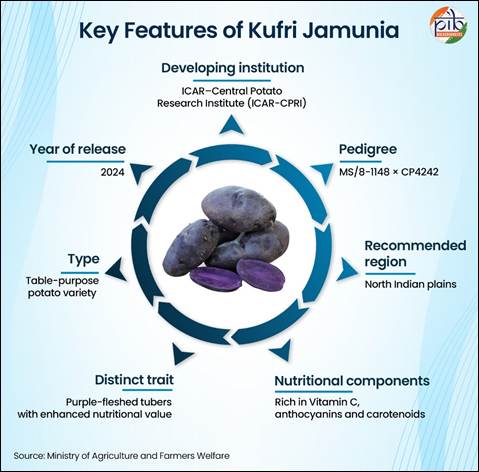
Salient characteristics of Kufri jamunia are:
• Produces 32-35 tonnes per hectare under recommended cultivation practices.
• Recorded around 49 tonnes per hectare yield in station trials at 90 days duration.
• Marketable yield reached nearly 90% of total production in trials.
• Shows medium dormancy of around 6-8 weeks. Hence, tubers do not sprout quickly.
• Possesses good storage quality with low rottage and minimal weight loss.
Key Nutritional Components in Kufri Jamunia
Kufri jamunia contains 42.05 mg/100 g of anthocyanins in flesh and 80.66 mg/100 g in skin. It also contains around 42.75 mg/100 g of Vitamin C in the flesh. The carotenoid content is around 161 µg/100 g fresh weight in flesh. In addition, the variety contains about 22.77 ppm zinc and 32.23 ppm iron in the flesh. The following table compares the nutritional value of Kufri jamunia with conventional yellow-skinned potato:
|
Nutrient (per 100 gm)
|
Kufri Jamunia
|
Common Potato
|
|
Vitamin C
|
42.75 mg
|
23.15 mg
|
|
Zinc
|
2.28 mg
|
0.28 mg
|
|
Iron
|
3.22 mg
|
0.57 mg
|
Culinary Uses of Kufri jamunia
Apart from its nutritional advantages, Kufri jamunia is suitable for a wide range of culinary applications. The variety is valued for its attractive purple colour, mealy texture, and pleasant flavour. This makes it suitable for both traditional preparations and processed food products. Its distinctive pigmentation also enhances the visual appeal of dishes and processed foods.
Purple-fleshed potatoes such as Kufri jamunia can be used in several preparations, including:
- Traditional dishes: vegetable curry, paratha, puri, and raita
- Breakfast and snack preparations: daliya, halwa, upma, dosa, and idli batter
- Processed products: potato flour for bakery items, soups, and cookies
In addition, the tubers can be processed into dehydrated products such as anthocyanin-rich daliya, suji, and flour, which can be used as ingredients in various food formulations.
States Suitable for Kufri jamunia Cultivation
For large-scale adoption, a crop variety must perform reliably across different agro-climatic conditions. Kufri jamunia has demonstrated stable performance in multi-location trials and has been recommended for cultivation in the North Indian plains. The variety is considered suitable for several states where potatoes are widely grown.
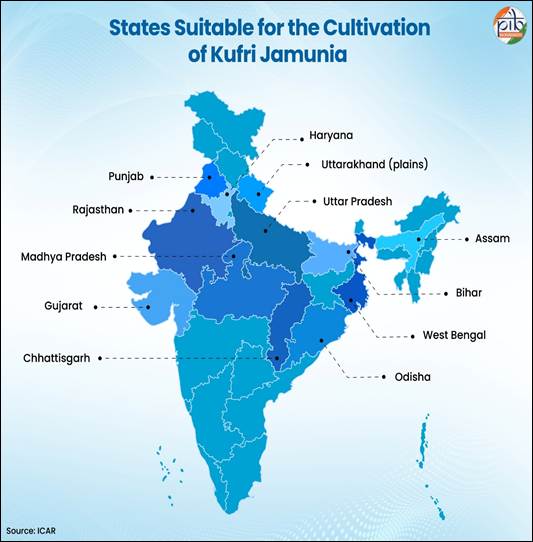
These regions provide favourable climatic and soil conditions for the successful cultivation of this variety.
The Nutritional and Agricultural Promise of Kufri jamunia
Kufri jamunia represents an important advancement in the development of biofortified potato varieties in India. By combining good agronomic performance with enhanced nutritional quality, the variety offers benefits for both farmers and consumers. Its rich content of antioxidants, vitamins, and micronutrients makes it a valuable addition to efforts to improve dietary diversity and address hidden hunger. With its attractive appearance, culinary versatility, and adaptability to several states in the North Indian plains, Kufri jamunia has strong potential for wider cultivation and consumption in the future.
References
Ministry of Agriculture and Farmers Welfare
https://icar.org.in/node/12076
https://epubs.icar.org.in/index.php/PotatoJ/article/view/168402/64949
https://epubs.icar.org.in/index.php/PotatoJ/article/download/155865/63758/501828
https://krishikosh.egranth.ac.in/items/446b4307-d85b-48d0-8815-bdc31235367a
Ministry of Ayush
https://ccrhindia.ayush.gov.in/sites/default/files/site/default/files/news/11Compendium0c3fc504-fd77-45ab-9148-2407a787276c.pdf
Government of Jharkhand
https://advantage.jharkhand.gov.in/ExportJH/district_exportplan/DISTRICT%20EXPORT%20ACTION%20PLAN_Koderma.pdf
Click here to see pdf
****
PIB Research
(Release ID: 2324875)
Visitor Counter : 379