PIB Backgrounder
Wings of Change
10 Years of Redefining Regional Air Connectivity through UDAN
Posted On:
20 OCT 2026 10:17AM by PIB Delhi
| UDAN completes ten years in 2026. Over the past decade, it has expanded India’s regional aviation network, connecting unserved & underserved regions and improving access to air travel. Regional connectivity has supported tourism, medical access, agricultural trade and local employment, with airports such as Tezu, Deoghar and Kishangarh illustrating its impact. The launch of Modified UDAN marks the next phase of the scheme. It focuses on strengthening aviation infrastructure, ensuring operational sustainability and expanding regional air connectivity. |
Connecting Regional India
Air connectivity plays an important role in regional development. It facilitates access to markets, supports tourism and expands economic opportunities. However, connecting remote and underserved areas remains important for ensuring wider access to air travel. Recognising this need, the National Civil Aviation Policy 2016 prioritised affordable regional connectivity through financial support and infrastructure development.
 In line with this objective, the Regional Connectivity Scheme (RCS), also known as UDAN (Ude Desh ka Aam Nagrik), was launched on 21 October 2016. The scheme anchors its ambition on a simple yet transformative premise: making affordable yet economically viable and profitable air travel on regional routes.
As UDAN completes ten years, it has expanded regional air connectivity and improved access to air travel for citizens by connecting unserved and underserved airports. A recap of the past decade reflects the rapid expansion of India’s civil aviation footprint. India is now the world’s third-largest domestic aviation market, with operational airports increasing from 74 in 2014 to 166 till date. At the heart of this, transformation lies the UDAN scheme.
Building on this progress, the next phase of UDAN was launched on 4 July 2026. The scheme now places greater emphasis on Centre-State/UTs partnerships. It will be complemented by a Challenge Mode Portal for Aerodrome Development dedicated to identifying airstrips and helipads. Together, these measures will further expand regional aviation infrastructure.
UDAN entered its operational stage with the inauguration of the first RCS-UDAN flight from Shimla to Delhi in April 2017. Since then, the scheme has expanded regional air connectivity.
- Routes Operationalised: The scheme has operationalised 687 regional routes across India.
- Aerodromes Operationalised: A total of 95 aerodromes have been operationalised, including 17 heliports and 02 water aerodromes.
- Flights Operated: More than 3.68 lakh flights have been operated under the scheme.
- Passengers Carried: The scheme has facilitated air travel for 1.72 crore passengers.
The scheme uses market-based selection, airfare caps, concessions, and Viability Gap Funding (VGF) to encourage airline participation. As of 15 October 2026, Rs 5091.23 crore has been disbursed under VGF.
Alongside expansion of civil aviation, sectoral jobs have grown from around 3 million in 2014 to nearly 7.7 million in 2026. Additionally, it has the potential to reach 25 million by 2040.
North-Eastern Region under UDAN
Due to the difficult hilly terrain, the north-eastern states remain under-connected, which makes strengthening air connectivity an important development priority.
- Under UDAN, across the North-Eastern States, 90 priority RCS routes have been operationalised.
- 52 aerodromes, including heliports and water aerodromes, have also been identified in the region, of which 12 have been operationalised.
Transitioning to Next Phase of UDAN
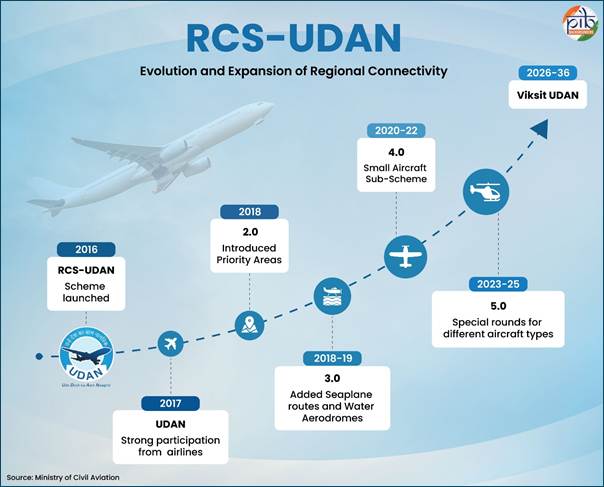
Since its inception, RCS-UDAN has released multiple versions of the scheme. Building on the achievements under it, the next phase of UDAN Scheme was formally launched on 4 July 2026. The scheme will be implemented in ten years, from FY 2026-27 to FY 2035-36, with a total outlay of Rs 28,840 crore. The focus is now on building an ecosystem towards facilitating Made in India Civil aircraft.
The scheme emphasises affordable air travel, sustainable regional aviation operations, aerodrome development through a Challenge Mode framework, and indigenous aircraft manufacturing.
The Modified UDAN Scheme introduces targeted measures to support sustainable growth and long-term viability of regional aviation.
- Development of Aerodromes (CAPEX): 100 airports will be developed from existing unserved airstrips, with an outlay of Rs 12,159 crore over eight years. This amounts to a proposed allocation of Rs 100 crore per airport.
- Operation and Maintenance (O&M) of Aerodromes: Three years of O&M support will be provided for approximately 441 aerodromes, with an estimated outlay of Rs 2,577 crore. The financial support is capped at Rs 3.06 crore per airport per year and Rs 0.90 crore per heliport or water aerodrome per year.
- Development of Modern Helipads: 200 modern helipads to be developed at an estimated cost of Rs 15 crore each. The total projected outlay is Rs 3,661 crore over eight years.
- Viability Gap Funding for Airlines: Rs 10,043 crore allocated over ten years to support airlines operating regional routes. Funding is available for up to five years, with tapered support from the third year and route exclusivity limited to three years.
- Atmanirbhar Bharat and Indigenous Aviation Capacity: An allocation of Rs 400 crore is proposed for two HAL Dhruv helicopters for Pawan Hans and two HAL Dornier aircraft for Alliance Air. The initiative supports indigenous aviation under Atmanirbhar Bharat and aims to strengthen connectivity in remote areas and challenging terrain.
The Next Phase Takes Shape
In the next phase of UDAN, the scheme will have a three-pronged approach focusing on strengthening Centre-State/UT partnerships, creating aviation infrastructure and expanding regional air connectivity.
- Centre-State/UT Coordination: A total of 21 MoUs were signed between the Government, participating States and Union Territories, and the Airports Authority of India (AAI). These establish a framework for coordinated identification, development and operationalisation of aviation assets. The framework will align with regional connectivity requirements and State/UT priorities.
- Challenge Mode Portal for Aerodrome Development: The dedicated portal enables State Governments and UT Administrations to nominate airstrips and helipads for development under the next phase of UDAN. This allows States and UTs to identify locations with potential for aviation connectivity. This will facilitate the creation and upgradation of aviation infrastructure based on local requirements.
Regional Changes under UDAN
The operationalisation of regional airports under UDAN has driven socio-economic transformation across regional hubs, boosting local trade, medical access, tourism, and employment.
Purnea Airport in Bihar
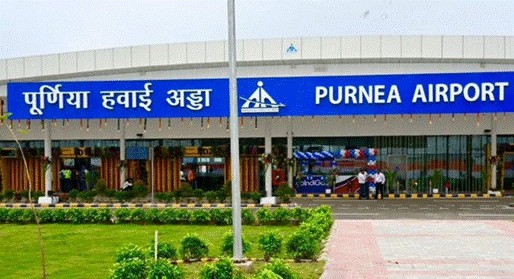
Prior to 2025, residents of the Seemanchal and Kosi regions, including Purnea, Araria, Kishanganj, Katihar, and Bhagalpur, were required to travel over 200 km to Bagdogra Airport for air connectivity. Journeys to major cities such as Kolkata and Patna often involved arduous road travel of 10 hours and 8 hours, respectively. Despite being a prominent agricultural hub known for products such as makhana, litchi, and vegetables, the region lacked direct air connectivity and air cargo facilities, constraining its economic potential. The operationalization of Purnea Airport in 2025 transformed regional connectivity by providing air access to more than 10 districts of Bihar. Travel time to Kolkata has been reduced to nearly 2 hours and to Patna to about 1 hour, significantly improving accessibility for residents, businesses, and institutions. The airport, equipped with Bihar’s longest runway of approximately 2.8 km capable of handling A320 and B737 aircraft, has strengthened the region’s integration with major economic centres. Furthermore, the enhanced connectivity has stimulated local economic activity.
Tezu Airport in Arunachal Pradesh
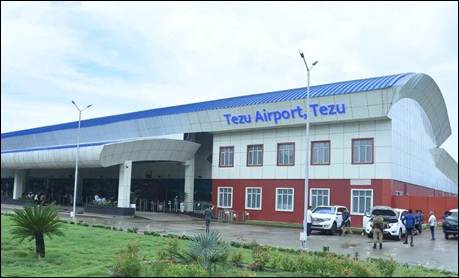
Situated in India’s easternmost frontier near the China border, the Lohit district of Arunachal Pradesh previously lacked air connectivity. It forced residents to undertake journeys of over 10+ hours across 164 km to Dibrugarh or 610 km to Guwahati for flights and medical emergencies. Operationalised in 2021, Tezu Airport now connects over 2 lakh people in this remote territory. The airport has reduced travel time to Guwahati to 1 hour. The facility has enabled air cargo exports for agricultural produce such as ginger, cardamom, and rice.
Deoghar Airport in Jharkhand
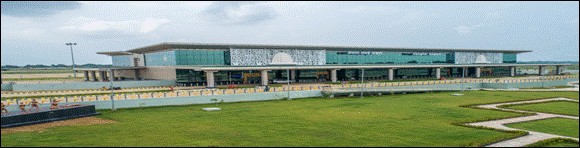
Prior to July 2022, reaching Deoghar required arduous journeys of over 15 hours from Delhi or 7.5 hours from Kolkata by road or rail. Pilgrims visiting Baba Baidyanath Dham were forced to travel more than 150 km to 200 km to reach the nearest operational airports in Ranchi or Patna. The opening of Deoghar Airport drastically cut travel time from Delhi to just 2 hours. Post July 2022, over 10 lakh+ pilgrims fly directly to Deoghar annually. The airport provides direct access for 50+ lakh devotees visiting during the peak Kanwar Yatra month. Furthermore, the airport has promoted medical tourism by facilitating patient travel to AIIMS Deoghar from East India. Additionally, it has boosted local hospitality, leading to the establishment of over 30+ new hotels.
Kishangarh Airport in Rajasthan
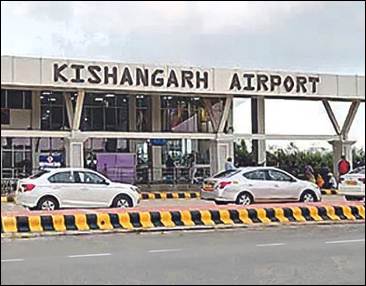
Before direct air access in 2017, travellers in Kishangarh, Ajmer, and Pushkar travelled 100+ km to Jaipur for flights. This bottleneck affected the region’s marble hub business. It also impacted over 2 crore annual pilgrims visiting Ajmer Sharif Dargah and Pushkar Temple. Post 2017, direct air cargo connectivity has enabled marble exports to Italy, the UAE, and the USA. In 2022, the airport hosted Avyanna Aviation Academy, the region’s only Category ‘A’ Flying Training Organisation (FTO). The airport generated 200+ direct jobs. It also spurred a 40–50% rise in local real estate values.
The Horizon Ahead
UDAN has spent the last decade redefining India’s regional connectivity by operationalising routes and aerodromes and carrying crores of passengers. The next phase of regional aviation will depend on developing infrastructure that supports reliable and sustained operations across diverse geographies. Through the Modified UDAN Scheme, the focus extends to aerodrome development, operational support and indigenous aviation capacity. These measures seek to address the infrastructure and viability challenges of regional air travel. They aim to create a stronger foundation for connectivity across India.
References
Cabinet
Ministry of Civil Aviation
PIB Backgrounders
Click here to see pdf
PIB Research
(Release ID: 2325359)
Visitor Counter : 413