Ministry of Science & Technology
Pulsing signals reveal hidden structure around a famous neutron star
Posted On:
21 OCT 2026 4:46PM by PIB Delhi
Scientists have discovered that one of the brightest X-ray pulsars, Centaurus X-3 is gobbling up material through an accretion disk, which is rare for pulsars of its kind.
The study will not only have implications in developing better-informed models of the system, which is one of the most widely studied binary pulsars that has drawn the attention of scientists because of its intense brightness, but also lead to enhanced understanding of binary pulsars in general.
An X-ray binary pulsar consists of a pulsar— a highly magnetised neutron star, and a Sun-like star bound in a gravitational dance. A neutron star is a celestial body with the mass of our sun crunched into a ball the size of Bangalore. In an X-ray binary, the pulsar’s extreme gravity pulls in material ejected by its companion star, and the pulsar starts accreting material from it, shooting out X-rays in the process.
Centaurus X-3, a high-mass X-ray binary (HMXB) where the companion is more than 10 times the Sun’s mass, was one of the first X-ray pulsars to be discovered, and the third X-ray source to be discovered in the constellation Centaurus, 24000 light years away.
Pulsars emit radiation from their magnetic poles, known as the primary emission. As the pulsar spins, this radiation sweeps past any satellite waiting to detect it. This radiation also falls around the neutron star. Structures in its wider environment (such as the pulsar’s surface, the surface of its companion star, stellar wind blown out from the companion star), absorb and re-emit this radiation, which scientists call the secondary radiation. Studying these structures is important to understand the system’s physical parameters, such as its orientation and magnetic field strength, leading to enhanced understanding of binary pulsars.

Fig 1. An artistic impression of the high-mass X-ray binary system Centaurus X-3. Not to scale.
The problem in studying these intricate structures is that X-ray binaries are so distant that they appear as point sources. The secondary radiation is a promising tool to study these structures.
Earlier studies have found that the intensity of secondary emission lines varied with pulsar rotation. Now scientists from the Raman Research Institute (RRI), an autonomous institution of the Department of Science and Technology (DST), led by Kinjal Roy, researcher at RRI, investigated four secondary emission lines in depth and found that the structure responsible for the varying lines must be co-rotating with the pulsar.
Like a sleuth trying to deduce facts from observational evidence, Roy detected that it is the accretion stream, which is a structure that channels material from the accretion disk towards the pulsar, that is causing the variability in the secondary emission lines.
An accretion stream can exist only if there’s an accretion disk. The accretion stream ushers material from the accretion disk, which gets funnelled into the pulsar’s poles following its magnetic lines. When the accretion stream obscures the satellite’s view of the pulsar while rotating, the primary emission from the pulsar decreases and the secondary emission from the accretion stream increases.
So, accretion in this system occurs through an accretion disk, which is rare in high-mass binaries. In HMXBs, accretion in general happens through direct capture of stellar wind.
“Accretion disk is not expected to occur in [HMXBs] So, if an accretion disk is forming in this system, emission models have to be modified,” says Roy. “When Centaurus X-3 modelling happens in future work, emission from the disk must be accounted for,” he added.
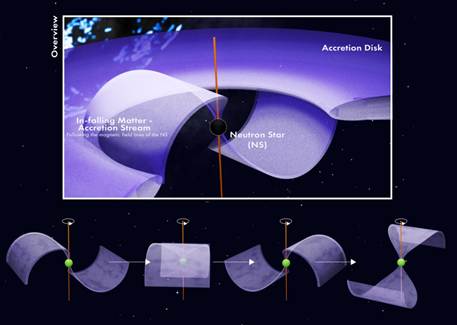
Fig 2. The accretion stream falling onto the neutron star along its magnetic field lines.
Publication link: DOI 10.3847/1538-4357/adf8e6
****
NKR/FT/AA
(Release ID: 2326032)
Visitor Counter : 117