Ministry of Agriculture &
Farmers Welfare
“Solar panels above, thriving crops below”: Union Minister Shri Shivraj Singh Chouhan inaugurates the 7th AgriVoltaics World Conference at Bharat Mandapam
“Farmers as both food providers and energy producers: Integrating agriculture with solar power will increase farmers’ incomes”: Shri Shivraj Singh Chouhan
“AgriVoltaics policy must be designed with the interests of 85 per cent of small and marginal farmers at its core”: Union Agriculture Minister Shri Shivraj Singh
“Under the leadership of Prime Minister Shri Narendra Modi, India is leading the world in clean energy alongside its overflowing foodgrain reserves”: Shri Shivraj Singh Chouhan
“Agriculture and Energy Ministries will work hand in hand: New employment opportunities for rural youth in their own villages”: Shri Shivraj Singh
“Non-fossil energy capacity exceeds 308 GW; AgriVoltaics can meet India’s electricity demand by 2050”: Shri Pralhad Joshi
“World’s largest AgriVoltaics campaign to be launched in the next phase of PM-KUSUM”: Union Minister Shri Pralhad Joshi
Posted On:
21 OCT 2026 7:56PM by PIB Delhi
Union Minister for Agriculture and Farmers’ Welfare, and Rural Development, Shri Shivraj Singh Chouhan has said that under the visionary leadership of Prime Minister Shri Narendra Modi, Indian farmers are set to become not merely ‘annadatas’ (food providers), but, by adopting solar energy, will truly emerge as both ‘annadatas and urjadatas’ (food and energy providers). Addressing the inaugural session of the three-day 7th AgriVoltaics World Conference as the keynote speaker at Bharat Mandapam in New Delhi on Wednesday, Shri Chouhan said that integrating agriculture with solar energy was opening up a new pathway towards global welfare and greater economic prosperity for farmers. He stressed that the AgriVoltaics policy must be designed to work effectively on the fields of the country’s 85 per cent small and marginal farmers, ensuring that the benefits of this technology reached those who needed them most.
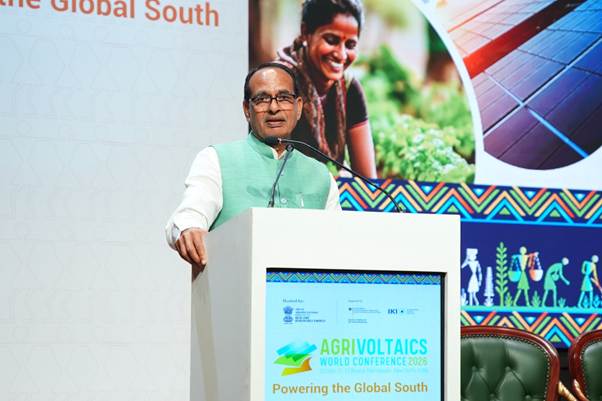
Welcoming delegates from India and abroad, along with the large number of farmers who had gathered at the venue, Union Agriculture and Farmers’ Welfare Minister Shri Shivraj Singh Chouhan explained that AgriVoltaics technology would enable solar panels to generate electricity above the ground while crops continued to flourish beneath them. Explaining the concept in simple, familiar terms, he described it as a model that delivers the best of both worlds, invoking the Hindi expressions ‘aam ke aam aur guthliyon ke daam’ and ‘hing lage na fitkari, rang bhi chokha’ to illustrate the multiple benefits of using the same land for agriculture and energy generation. He observed that while the traditional saying was ‘Rahiman paani raakhiye’ (preserve water), the needs of the modern age called for ‘Rahiman bijli raakhiye’ (preserve electricity), because modern life and agriculture would come to a standstill without power. Integrating energy production with farming, he said, was therefore one of the most important steps that could be taken in the interests of farmers.
Union Agriculture Minister Shri Shivraj Chouhan proudly highlighted India’s transformation from a country dependent on foodgrain imports to meet its food security requirements to one whose granaries were now overflowing with wheat and rice, thanks to the hard work and dedication of its farmers. Indian agriculture continues to maintain a robust growth rate of 4.5 per cent, which is a significant achievement in itself. Exports of agricultural products have reached a new record of US$52.55 billion, while sowing for the 2026–27 rabi season has recently commenced, with particular emphasis on pulses and oilseeds. He noted that these achievements reflected the progress made by Indian agriculture and underscored the importance of developing new approaches to sustain farmers’ prosperity while meeting the country’s evolving needs.
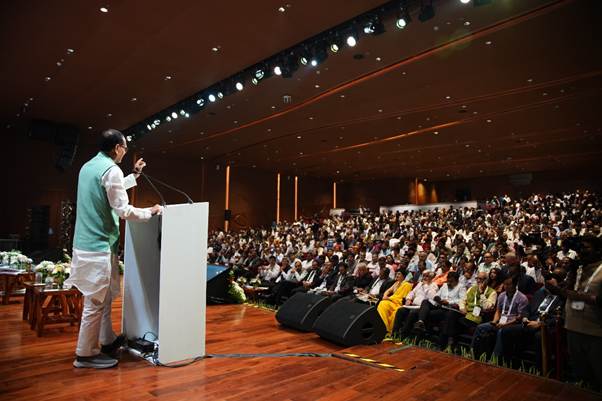
Presenting the realities on the ground before scientists and policymakers, Shri Shivraj Singh Chouhan pointed out that India’s average landholding was just 0.96 hectares and that more than 85 per cent of farmers were small and marginal farmers. Such farmers did not have enough land to abandon cultivation and install solar power plants exclusively on their holdings. He emphasised that while laboratories and government institutions could receive funding for experiments, farmers had to invest their hard-earned money. Therefore, the model must be practically viable on small farmers’ fields, and agricultural production must not be disrupted under any circumstances. He said the objective could not be achieved merely by planting a few crops beneath solar panels. Instead, the height of the panels, the distance between supporting structures and the arrangements for ploughing must be carefully designed to allow farmers to cultivate their land efficiently. The system should also enable them to choose different crops and change their crop cycles according to their preferences every year, without compromising agricultural productivity.
Emphasising the need to address practical challenges before projects were implemented, Shri Chouhan said that robust arrangements must be made for the safe drainage and collection of rainwater falling from solar panels. This would prevent soil erosion in agricultural fields and ensure that every drop of water was put to productive use. He also called for reliable arrangements for purchasing the electricity generated, connecting projects to the power grid and ensuring transparent and timely payments to farmers. He suggested that Farmer Producer Organisations (FPOs) should be actively involved in the initiative and that local rural youth and women should receive training in operating, repairing and maintaining the equipment. This would create substantial employment opportunities within villages themselves. He further made it clear that appropriate safeguards and responsibilities must be established from the outset to ensure that farmers did not bear any financial or physical burden if a company abandoned a project midway or if solar panels had to be removed upon the expiry of a contract. The interests of farmers, he stressed, must remain protected throughout the project’s lifecycle.
Shri Chouhan expressed his appreciation for the leadership of Union Minister for New and Renewable Energy Shri Pralhad Joshi and assured him that the Ministry of Agriculture would work hand in hand and shoulder to shoulder with the Ministry of New and Renewable Energy to ensure the success of this initiative. He emphasised that close coordination between the two ministries would be essential to develop a model that simultaneously supports agricultural production, promotes renewable energy and improves farmers’ economic well-being.
On the occasion, Union Minister for Consumer Affairs, Food and Public Distribution and New and Renewable Energy, Shri Pralhad Joshi, said that the seventh edition of the conference was the largest and most historic of the international conferences held so far. Record participation had necessitated arrangements for additional halls to accommodate the attendees. He noted that, at a time when countries across the world were facing economic challenges, India continued to be the world’s fastest-growing major economy, recording GDP growth of 7.8 per cent in the first quarter of the current financial year. Shri Joshi stated that India’s total electricity generation capacity, which stood at approximately 249 GW before 2014, had now increased to more than 560 GW. Of this, installed non-fossil energy capacity had crossed 308 GW, with 100 GW added in just the past two and a half years. He further highlighted the significant reduction in the cost of non-fossil electricity, which had fallen from ₹11 per unit in 2012-13 to just ₹2.60 per unit today, owing to large-scale production. These developments, he said, demonstrated India’s growing strength in renewable energy and the opportunities available to expand its use in agriculture.
Citing a study by The Energy and Resources Institute (TERI), Union Minister Shri Pralhad Joshi said that, of India’s 116 million hectares of agricultural land, 47.5 million hectares – approximately 30 per cent – were technically suitable for AgriVoltaics. Maharashtra, Rajasthan, Andhra Pradesh, Madhya Pradesh, Karnataka and Uttar Pradesh together accounted for 50 per cent of this suitable land. He emphasised that if AgriVoltaics installations were established on just 10 per cent of this suitable area, India could meet its entire projected electricity demand up to 2050 through this approach alone. In addition to generating electricity, the technology had also been found to increase crop yields by 10 to 20 per cent. He highlighted the potential of AgriVoltaics to support the country’s long-term energy requirements while allowing agricultural land to continue producing crops, thereby creating a dual benefit for farmers and the wider economy.
Shri Joshi stated that, under the PM-KUSUM scheme, 30 lakh (3 million) agricultural pumps had so far been connected to solar energy. This had relieved farmers of the risks and difficulties associated with irrigating their fields at night while enabling them to access uninterrupted electricity during the day. He announced that the government would soon launch the world’s most ambitious AgriVoltaics programme under the next phase of PM-KUSUM. According to studies, the sector had the potential to generate approximately 3.32 lakh full-time local jobs. These employment opportunities would help rural youth find work in their own communities, reducing the need to migrate to district headquarters or major cities in search of livelihoods. The initiative, he said, could thus contribute to both the expansion of renewable energy and the creation of sustainable rural employment.
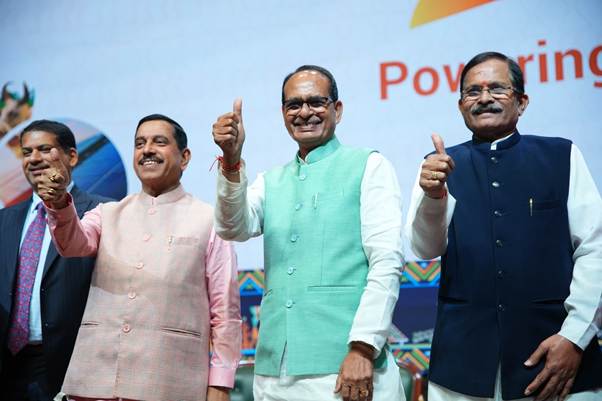
The inaugural session was attended by several distinguished dignitaries on the dais, including Union Minister of State for New and Renewable Energy Shri Shripad Yesso Naik; Dr Jasper Wieck, Ambassador of Germany to India and Bhutan; Shri Santosh Kumar Sarangi, Secretary, Ministry of New and Renewable Energy; Shri Atish Chandra, Secretary, Department of Agriculture and Farmers’ Welfare; Dr Mangi Lal Jat, Secretary, Department of Agricultural Research and Education and Director General of the Indian Council of Agricultural Research (ICAR); and Shri Ashish Khanna, Director General of the International Solar Alliance (ISA).
During the inaugural session, important technical tools and communication materials related to AgriVoltaics were also formally released and launched. These resources are intended to help farmers and other stakeholders make informed and precise decisions at the field level, supporting the practical implementation of AgriVoltaics and enabling more effective integration of agricultural activities with solar energy generation.
***
SS/DK/MK
(Release ID: 2326152)
Visitor Counter : 298