Posted On:
23 OCT 2026 8:43PM by PIB Delhi
The Ministry of Tribal Affairs (MoTA), Government of India, convened the Third Regional Review Conference on the implementation of the Scheduled Tribes and Other Traditional Forest Dwellers (Recognition of Forest Rights) Act, 2006 (FRA), in Srinagar, Jammu & Kashmir, today. Senior officials from Maharashtra, Gujarat, Himachal Pradesh, Uttar Pradesh, Goa, Rajasthan and Jammu & Kashmir reviewed implementation progress, discussed challenges and identified priority actions. The conference concluded the regional review series, following the first conference in Bengaluru on 10 September 2026 and the second in Kolkata on 9 October 2026.
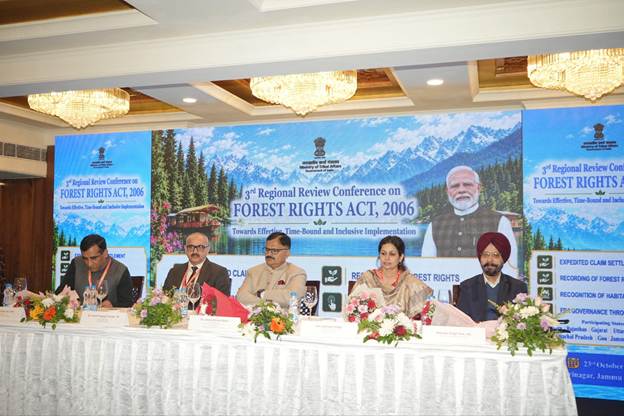
Shri Mohd Mumtaz Ali, Director, Tribal Affairs Department, Government of Jammu & Kashmir, delivered the welcome address, highlighting the region’s difficult terrain, dispersed settlements and seasonal pastoral movements, and the need for locally appropriate administrative arrangements.
Shri Javed Ahmed Rana, Hon’ble Minister for Tribal Affairs, Jal Shakti and Forest, Ecology & Environment, Government of Jammu & Kashmir, emphasised that the FRA safeguards the dignity, livelihoods and future of forest-dependent communities. He called for transparent and timely claim disposal, stronger interdepartmental coordination and greater Gram Sabha participation, stressing that forest rights recognition, conservation and sustainable development must advance together.
In the keynote address, Shri Anant Prakash Pandey, Joint Secretary, MoTA, reported that, as of 31 August 2026, approximately 54 lakh claims had been received nationally, 43.56 lakh (80.64%) disposed of, 25.42 lakh titles distributed over nearly 238 lakh acres, 10.45 lakh claims pending and 18.13 lakh rejected. He stressed that every rejection must be supported by a reasoned order communicated to the claimant, with statutory appeal rights preserved, and urged States to prepare district-wise plans to expedite pending claims and review rejected cases, particularly in Gujarat, Maharashtra, Goa and Himachal Pradesh.
Highlighting Community Forest Resource Rights (CFRR), he called for sustainable management and convergence of CFR Management Plans with Forest Department Working Plans, enabled by the joint communication of MoTA and the Ministry of Environment, Forest and Climate Change dated 27 July 2026. Incorporating recognised rights into revenue records can facilitate access to PM-KISAN and agriculture, fisheries and livelihood schemes. He also urged States to expedite Habitat Rights recognition for Particularly Vulnerable Tribal Groups (PVTGs), noting that rights have so far been recognised for only 11 of the country’s 75 PVTGs. Other priorities included quarterly State Level Monitoring Committee (SLMC) meetings, regular Monthly Progress Reports, integration of State FRA records with the National FRA Portal through Application Programming Interfaces (APIs), and use of free FRA courses on iGOT for awareness and capacity building.
Smt. Samidha Singh, Director (FRA), MoTA, outlined financial assistance of ₹25 lakh per State under the Support to Tribal Research Institutes scheme for FRA mapping and ₹15 lakh per Community Forest Resource Management Plan under DA-JGUA, along with ₹1 lakh for technical support. She also highlighted support for PVTG Habitat Rights under Ministry guidelines dated 5 January 2026, urging States to reconcile data discrepancies, strengthen Gram Sabhas, raise awareness, provide post-claim support and facilitate CFR Management Plans.
State-wise progress
Maharashtra: The State has distributed 2,03,510 individual and 8,821 community titles against 3,90,397 individual and 10,740 community claims; CFR rights cover approximately 13.87 lakh acres, with 7,518 CFR Committees constituted and 1,875 management plans prepared. A Government Resolution dated 10 July 2026 provides separate Village Forms 7-E and 12-E for Individual Forest Rights (IFR) holders, facilitating crop loans, Kisan Credit Cards, crop insurance and Direct Benefit Transfer; success stories from Jalgaon, Thane and Nashik highlighted improvements in farm income and water security.
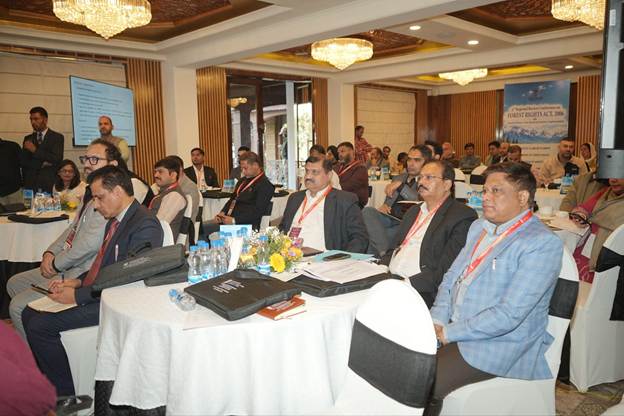
Gadchiroli, Maharashtra: The district has distributed 34,813 titles (33,361 individual and 1,452 CFR) covering over 5.56 lakh hectares, including 5.16 lakh hectares under CFR rights; 1,442 CFR Committees have been constituted for 1,138 CFR Gram Sabhas, and 391 management plans approved. It has entered 32,601 IFR titles in 7/12 revenue records, scanned 99.6% of case files and trained 3,630 Gram Sabha representatives through Project Ekal with Gondwana University; mapping by ISB Hyderabad estimated annual non-timber forest produce potential at ₹98 crore. Proposals included a dedicated CFR budget, committee guidelines, an online NTFP sales platform and alignment of Working Plans with CFR Management Plans.
Gujarat: The State has distributed 1,00,747 individual and 3,879 community titles against 1,83,055 individual and 6,274 community claims, with CFR rights covering approximately 10.18 lakh acres. Satellite verification with the GEER Foundation and State-sponsored FRA Cells is addressing pendency in Dahod, Sabarkantha, Panchmahal, Mahisagar and Chhota Udepur. Identified PVTGs include Kotwalia, Kolgha, Kathodi, Siddi and Padhar; the State will submit a Habitat Rights Action Plan to MoTA.
Jammu & Kashmir: Of 48,287 claims received, 6,191 have been approved by District Level Committees (DLCs) and 6,178 titles distributed, covering approximately 3,960 hectares, predominantly under community rights. The UT has an SLMC under the Chief Secretary, DLCs in all 20 districts and a circular dated 30 July 2026 directing that eligible ST and OTFD families not be evicted before due process is completed. It sought clarifications on the continuation of non-official SDLC/DLC members after District Development Council terms expire, Gram Sabha quorum, satellite imagery as evidence, a one-time window to review rejected claims, and funds for awareness and capacity building.
Himachal Pradesh: Up to March 2026, the State had granted 1,144 individual and 166 community titles against 6,546 individual and 791 community claims, with community rights covering 27,624 hectares, mainly in Chamba and Kinnaur. Record-entry instructions were issued in April 2022 for community titles and February 2026 for individual titles; the State launched an FRA Calendar in April 2025, conducted workshops and held three SLMC meetings. DLC and SDLC meetings at least three times a month are planned following committee reconstitution after the May 2026 Panchayat elections.
Uttar Pradesh: The State has distributed 22,537 individual and 893 community titles against 92,972 individual and 1,194 community claims, with 14,339 titles incorporated into records. It is reviewing rejected claims, particularly in Sonbhadra and Chandauli, has set 30 January 2027 as the deadline for completing record incorporation in the remaining districts, and identified the Buxa PVTG in Bijnor.
Goa: The State has distributed 3,908 individual and 29 community titles against 9,983 individual and 401 community claims. It launched its FRA Atlas on 25 May 2026, engaged a private agency for surveys and demarcation, constituted special committees under Joint Mamlatdars in six talukas and provided spot-verification allowances to Forest Rights Committee (FRC) members. Revenue records are updated suo motu after title distribution, with DLCs meeting fortnightly and SDLCs weekly.
Rajasthan: As of 30 September 2026, the State had distributed 49,383 individual and 2,531 community titles against 1,21,707 individual and 5,433 community claims. Of these, 40,045 titles have been incorporated into revenue and forest records, while 11,869 incorporations remain pending.
Way forward
MoTA called upon States and the UT to prepare district-wise action plans identifying the stage and cause of delay and the responsible authority for each pending claim; review rejected claims with written reasons and the right of petition; submit reconciled Monthly Progress Reports regularly; and complete digitisation and incorporation of recognised rights into revenue and forest records in accordance with the advisory dated 24 June 2026. They were also asked to develop PVTG-wise Habitat Rights roadmaps, strengthen convergence with livelihood and welfare schemes, prepare capacity-building action plans and review progress quarterly through SLMCs chaired by the Chief Secretary.
The conference concluded with a valedictory address by the Joint Secretary, MoTA, followed by a vote of thanks by the Deputy Director, Tribal Research Institute, Jammu & Kashmir UT Administration.
******
RN/