Posted On:
26 OCT 2026 11:33AM by PIB Delhi
|
Immersive technologies are expanding across India’s education, industry and creative sectors. The Ministry of Information and Broadcasting is promoting the Animation, Visual Effects, Gaming, Comics and Extended Reality (AVGC-XR) ecosystem through initiatives such as the Indian Institute of Creative Technologies (IICT) in Mumbai. Established as a National Centre of Excellence, IICT collaborates with global technology companies, including Google, Meta, Adobe and Netflix, to strengthen creative education, skills and innovation. Further supporting this ecosystem, the Union Budget 2026–27 allocated ₹250 crore for AVGC Content Creator Labs in 15,000 secondary schools and 500 colleges across India.
|
From Digital to Immersive: India's Next Leap
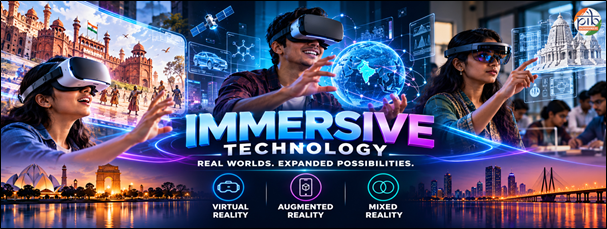
Over the last decade, India has built a strong digital ecosystem that has transformed everyday interactions with technology. Platforms such as UPI, Aadhaar, DigiLocker, UMANG and BHASHINI have expanded access to services and information. As digital platforms become more widespread, the next opportunity is to make these interactions more interactive, visual and experiential. Rapid advances in Artificial Intelligence, high-speed connectivity and computing are enabling this shift from simply accessing digital services to experiencing them. Click to Read More: India’s Digital Public Infrastructure and Transforming India with AI
This emerging phase is being shaped by immersive technologies, which bring digital content closer to the way people experience the physical world. Virtual Reality, Augmented Reality, Mixed Reality and 360-degree experiences can create interactive environments and enable users to engage with digital content in new ways. These capabilities can transform education through virtual simulations, healthcare through immersive training, and tourism through virtual exploration. They can also create more engaging experiences across culture, gaming, entertainment, retail and other sectors. In doing so, immersive technologies can expand the impact of India’s existing digital ecosystem beyond conventional screen-based interactions.
The scale of this opportunity is reflected in India’s rapidly growing immersive technology market. The market generated USD 1,259.5 million in revenue in 2023 and is projected to reach USD 7,818.7 million by 2030, growing at a CAGR of 29.8 per cent. India is projected to be the fastest-growing regional market in Asia Pacific, supported by its digital ecosystem, expanding middle class and rising e-commerce adoption. This growth presents an opportunity for India to move beyond being a large market and emerge as a global hub for immersive technology. Building capabilities in research, startups, talent, content and indigenous technologies can help India shape the next generation of immersive experiences and strengthen its position in the global digital economy.
|
Creative Minds, Catalyzing Science, Empowering Technologies
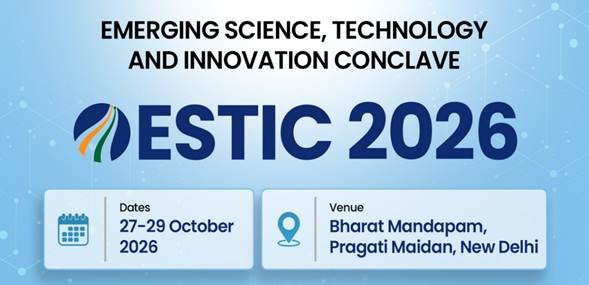
ESTIC-2026, the second edition of India’s Emerging Science, Technology and Innovation Conclave, will be held from 27–29 October 2026 at Bharat Mandapam, New Delhi. The event will be organised under the theme “Creative Minds, Catalyzing Science, Empowering Technologies.” Organised by the Council of Scientific & Industrial Research (CSIR), ESTIC-2026 will bring together ministries, researchers, innovators, industry leaders, deep-tech start-ups and global experts to advance emerging science and technology. The conclave will feature 12 thematic areas, including Immersive Tech: Generative XR and Spatial Computing. The event will feature plenary sessions, technical discussions and exhibitions. Read More on Agenda: ESTIC 2026
|
Understanding Immersive Technologies
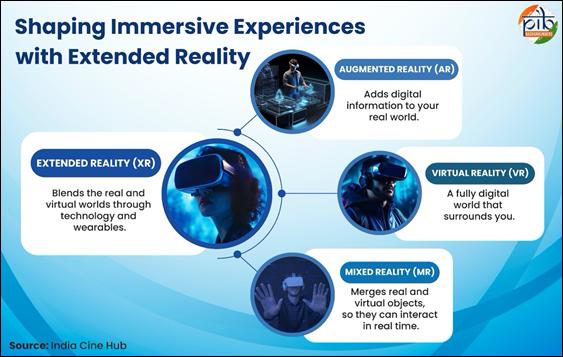
Immersive technologies are an emerging suite of technologies that create interactive, engaging and realistic digital experiences. Immersive technologies can combine the physical and digital worlds. They enable users to interact with digital content in ways that feel more natural and experiential. Users can interact with digital objects and respond to simulated situations. Unlike conventional digital media, these technologies can engage multiple senses and create a stronger sense of presence. For example, a student can explore a virtual laboratory instead of only viewing diagrams on a screen. Similarly, a tourist can virtually explore a heritage site before visiting it physically. The three most common forms of immersive technology are Virtual Reality (VR), Augmented Reality (AR), and Mixed Reality (MR). Collectively, these technologies are often referred to as Extended Reality (XR).
|
Extended Reality (XR)
Extended Reality (XR) refers to technologies that combine real and digital environments through computer systems and wearable devices. It creates different levels of interaction between people and digital content. XR includes Virtual Reality (VR), Augmented Reality (AR) and Mixed Reality (MR).
- Virtual Reality (VR) creates a completely digital environment that surrounds the user. It mainly engages sight and sound to create a strong sense of presence. Users can explore and interact with this simulated environment using specialised devices.
- Augmented Reality (AR) adds digital information to the user’s existing physical surroundings. It can engage sight and sound, while keeping the real-world environment visible. For example, AR can display directions, information or digital objects over the physical world.
- Mixed Reality (MR) combines the physical and digital worlds in an interactive environment. It can engage sight and sound, while allowing digital objects to interact with physical surroundings. Users can see and interact with digital objects as if they were part of the real environment.
|
Other related tech, such as 360-degree video and Haptic Technology, also form part of the wider immersive technology ecosystem. 360-degree video allows users to view a scene in every direction. Users can change their viewing direction and explore different parts of the recorded environment. Haptic Technology uses vibrations, pressure or other physical sensations to provide touch-based feedback. It can make digital interactions feel more realistic by simulating physical sensations during virtual or interactive experiences.
Stepping Into the Experience: How India Is Using Immersive Technology
Researchers at IIT Madras are developing AR/VR-enabled learning solutions for rural schools. The initiative uses digital technologies to improve teaching and learning for secondary school students. It aims to create immersive, VR-based learning environments where students can explore subjects such as history, social science, science and languages through interactive experiences.
These technologies can make classroom learning more engaging. For example, an AR-based mobile application could bring 500 years of Indian history to life through animated photographs, interactive maps and archival documents. Similarly, VR simulations could allow students to explore the solar system or study the human body through three-dimensional models. By making abstract concepts easier to visualise and understand, these approaches can enrich learning and help students prepare for higher education.
The Government is using Extended Reality (XR) and other digital technologies to make India’s cultural heritage more accessible and engaging. The Ministry of Culture has adopted digital tools to improve visitor experiences and preserve information about museum collections. One such tool is JATAN software, which helps digitise museum artefacts and their records. So far, eight national-level museums and two Archaeological Survey of India (ASI) museums have been digitised using JATAN. Their collections are accessible through the Museums of India digital repository, enabling people to explore India’s heritage online.
Building on this digital foundation, museums are also introducing interactive experiences for visitors. The Indian Museum in Kolkata has introduced AI-based interactive features and AR tools to enrich gallery visits. It has also collaborated with Google Arts & Culture on a virtual exhibition showcasing cultural heritage through digital technology. Similarly, ASI museums at Hampi in Karnataka and Nalanda in Bihar offer mobile-based virtual tours of their collections. These initiatives help visitors explore artefacts digitally, making cultural experiences more engaging and accessible beyond the museum premises. Click for the Virtual Tour of the Indian Museum, Kolkata
Governance and Infrastructure
Immersive technologies are also shaping how India plans and manages its infrastructure. The Department of Telecommunications launched the "Sangam: Digital Twin" initiative, combining digital twin technology with 5G, IoT, and AI for better infrastructure planning. Digital twin mapping is already supporting city planning, as seen in the Varanasi Urban 3D Spatial Planning project. By 2035, India aims to build a National Digital Twin for major urban centres, creating digital replicas to improve city planning and management.
|
What is Digital Twin?
A digital twin is a virtual model of a real-world object, system or place. It uses data from the real world to represent conditions and behaviour, helping users monitor situations and test possible changes digitally. For example, a digital twin of a machine can help identify potential faults, while a city model can help planners assess the likely impact of infrastructure projects before implementation. One example is the Mobility Digital Twin showcased by the Department of Telecommunications (DoT) at India Mobile Congress 2025. It uses telecom-derived mobility data to analyse how people travel and move through different areas. Demonstrations in Vasant Kunj and Central Vista in Delhi examined commuting patterns and helped assess metro station catchment areas. In Ayodhya, mobility data was used to study tourist flows, travel modes and stay patterns. These insights can help authorities plan transport links, improve tourism infrastructure and make better-informed decisions before finalising projects.
|
Creative Economy and Entertainment
Immersive technology is a growing part of India's media and entertainment sector, closely tied to the AVGC-XR framework. India's gaming sector is projected to grow from $3.8 billion in 2024 to $9.2 billion by FY29, according to an independent report, reflecting the scale of this emerging economy. National platforms such as the WAVES summit are further showcasing India's creative and immersive media capabilities to a global audience.
Powering Immersive Technology: India's Key Initiatives
Immersive technology is supported through the Government's broader AVGC-XR framework. This framework covers Animation, Visual Effects, Gaming, Comics, and Extended Reality. India's policy support for immersive technology comes as part of the larger, unified push, not as a standalone scheme. Click to Read More: Powering the AVGC-XR Revolution
AVGC-XR Promotion Task Force
The AVGC Promotion Task Force was constituted by the Ministry of Information and Broadcasting (MIB) in April 2022. It brings together representatives from the Animation, Visual Effects, Gaming and Comics (AVGC) industry, academia and Government. The Task Force provides a platform for coordinated efforts to strengthen the sector’s growth and development. Its mandate is guided by three key principles. These include public-private collaboration, inter-ministerial convergence and an integrated approach to sectoral development.
Indian Institute of Creative Technologies (IICT)
On the Task Force's recommendation, the Government set up a National Centre of Excellence (NCoE) to build skilled talent for the AVGC-XR sector. This took shape as the Indian Institute of Creative Technologies (IICT), established in 2025. As of March 2026, IICT has introduced 18 courses across various domains of the AVGC-XR sector, with over 135 students enrolled.
|
GENESIS (Gen-Next Support for Innovative Startups)
To boost the startup ecosystem in Tier-II and Tier-III cities, MeitY approved the GENESIS Scheme. Launched in 2022, it aims to support around 1,600 tech startups over five years. This includes startups working in immersive technologies like AR, VR, and spatial computing. Through the MeitY Startup Hub, the scheme currently supports 84 AR/VR startups. It also backs 106 incubators across the country.
|
AVGC Content Creator Labs
Under the Union Budget 2026–27, the Government allocated ₹250 crore to establish Animation, Visual Effects, Gaming and Comics (AVGC) Content Creator Labs in 15,000 secondary schools and 500 colleges. The Indian Institute of Creative Technologies (IICT), Mumbai, will serve as the nodal agency for planning, coordinating and implementing the initiative. These labs aim to equip students with practical skills in animation, visual effects, gaming and digital content creation. They will provide opportunities to develop creative ideas and gain hands-on experience using industry-relevant tools and technologies. The initiative seeks to nurture young talent and prepare students for emerging careers in India’s growing creative economy.
WaveX is a dedicated media-tech startup accelerator and incubator launched by the MIB. It supports startups working in AVGC-XR and other emerging media technologies. WaveX aims to help startups strengthen their technologies, develop market-ready solutions and explore global opportunities.
|
States Leading India's AVGC-XR Growth Story
- Karnataka’s AVGC-XR Policy 3.0 supports skill development, infrastructure, production grants and financial incentives for AVGC-XR companies. The state also operates the KITVEN AVGC Fund, with a ₹20-crore corpus to invest in companies working in AVGC and related sectors.
- Maharashtra’s AVGC-XR Policy 2025 has a financial plan of ₹3,268 crore and a vision extending to 2050. The policy provides a dedicated framework for expanding the state’s AVGC-XR ecosystem through government-backed support and infrastructure.
- Telangana’s 2016 IMAGE Policy established a dedicated framework for Animation, VFX, Gaming and Comics, anchored by Hyderabad’s IMAGE Tower. The ecosystem features 150+ AVGC/VFX companies, 140+ gaming and animation companies, 30,000 direct jobs and 100 startups onboarded through Software Technology Parks of India (STPI)-IMAGE, supported by production infrastructure, training and global cloud access.
- Tamil Nadu’s AVGC-XR Policy 2026 targets 200+ startups, around 2 lakh jobs and up to 20% of India’s AVGC-XR market by 2030. It also provides a support for the "ELCOT Viyan AVGC-XR Centre of Excellence” in Chennai as a hub and spokes at Coimbatore, Madurai, Tiruchirappalli, Salem and Tirunelveli regions over the next three years.
- Kerala’s AVGC-XR Policy 2024 focuses strongly on building a specialised talent pipeline. It proposes industry-aligned job roles, faculty development and AVGC-XR courses covering VR, AR, gaming, VFX and digital art, from schools through higher education. The mission aims to create 50,000 new jobs in the AVGC-XR industry, by 2029, solidifying Kerala’s commitment to fostering a thriving knowledge-based economy.
- Madhya Pradesh’s AVGC-XR Policy 2025 combines Centres of Excellence, AVGC-XR labs and targeted skilling with investment incentives. The policy also supports capital investment, employment generation, production costs, quality certification and IP creation.
- Uttar Pradesh is developing an AVGC-XR Park in Jewar, near Noida International Airport and the proposed International Film City. The park will integrate animation, VFX, gaming, motion capture, virtual production and XR facilities. It aims to attract investment, support startups, create skilled employment and strengthen the state’s digital creative economy.
- Rajasthan announced its AVGC-XR Policy 2024 in the State Budget 2024-25 to strengthen the animation, VFX, gaming, comics and immersive technology ecosystem. The policy provides production incentives of up to ₹50 lakh for eligible animation/VFX/AR/VR projects and ₹1 crore for eligible game development.
- Gujarat is actively positioning itself as a key AVGC-XR hub through focused government initiatives. The state is in an advanced stage of preparing a comprehensive AVGC-XR policy supporting infrastructure, skilling, and startups. Moreover, the state already has a strong educational base - 16 institutions offering Animation, VFX and Gaming courses - providing a ready talent pipeline.
|
Way Forward
Immersive technologies represent more than a new entertainment medium. They are a strategic lever for India's creative economy, education system, and cultural preservation. As India strengthens its AVGC-XR ecosystem through coordinated national and state-level efforts, it is well-positioned to become a global hub for immersive content and innovation. This convergence of creativity and cutting-edge technology aligns closely with the vision of Viksit Bharat 2047, where a technologically empowered, self-reliant India leads in emerging sectors.
References:
Ministry of Information & Broadcasting
Ministry of Culture
Ministry of Communications
Others
Click here to see pdf
*****
PIB Research