Posted On:
26 OCT 2026 6:26PM by PIB Delhi
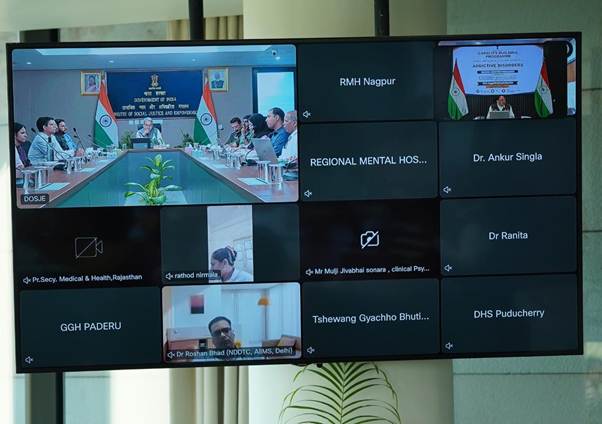
Union Minister of Health and Family Welfare Shri J.P. Nadda today launched the Capacity Building Training Programme for Medical and Allied Healthcare Professionals engaged in drug de-addiction services at Kartavya Bhawan-1, New Delhi. The programme was launched in hybrid mode in the presence of the Secretary, Ministry of Health and Family Welfare, and senior officers from the Ministries of Health and Family Welfare, Social Justice and Empowerment, and Home Affairs.
The programme aims to strengthen the capacity of healthcare professionals involved in the prevention, identification, assessment, treatment and management of substance use disorders across the country.
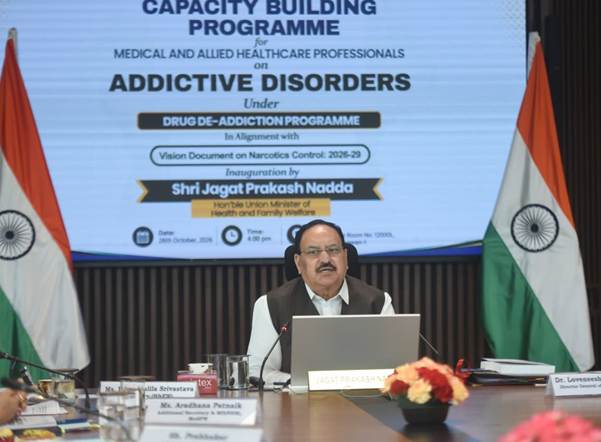
Addressing the gathering, Union Minister for Health and Family Welfare Shri J.P. Nadda congratulated the team for developing a comprehensive capacity-building programme with a structured implementation plan, incorporating online and offline training for doctors, medical officers, nurses, counsellors and other healthcare professionals. He appreciated the phased approach to training, which envisages collaboration among regional and national institutions, followed by the expansion of capacity-building activities across States and Union Territories.
The Union Health Minister reiterated the Government of India’s commitment, under the leadership of Prime Minister Shri Narendra Modi, to achieving the goal of a Nasha Mukt Bharat by 2029. He emphasised that addressing substance abuse disorders requires a coordinated, whole-of-government approach, with different Ministries and departments working in synergy towards clearly defined objectives.
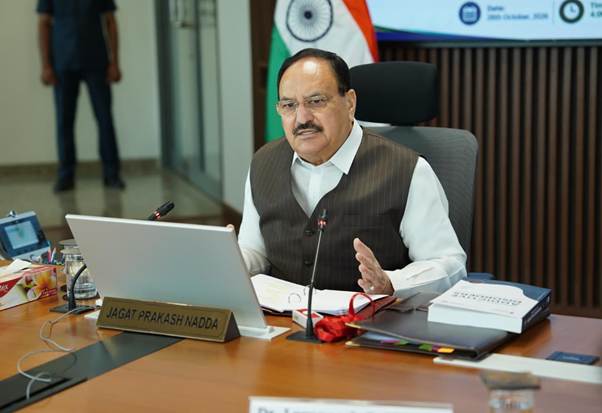
Shri Nadda observed that fragmented efforts and the functioning of different departments in silos had created gaps in coordination and service delivery. He noted that the Vision Document on Narcotic Control: 2026–2029, unveiled by Union Home Minister and Minister of Cooperation Shri Amit Shah, represents a coordinated effort to address these gaps by defining the responsibilities and targets of various Ministries and departments. He stressed that effective implementation would require sustained inter-ministerial coordination and collective accountability.
Highlighting the role of the Ministry of Health and Family Welfare, Shri Nadda stated that strengthening treatment services and building the capacity of healthcare professionals and de-addiction centres are central to the Ministry’s contribution to this national endeavour. He also underscored the importance of supporting de-addiction facilities under the Ministry of Social Justice and Empowerment through appropriate training, institutional strengthening and adequate financial resources.
The Minister emphasised that the response to substance abuse disorders must extend beyond treatment to encompass prevention, enforcement and coordinated action against drug trafficking. He highlighted the importance of collaboration with law enforcement agencies, border-management authorities and other relevant stakeholders to address the challenge comprehensively. He encouraged healthcare professionals and participating institutions to share practical suggestions, including those requiring inter-departmental coordination, to strengthen implementation and address emerging challenges.
Concluding his address, Shri Nadda congratulated the Ministry of Health and Family Welfare, the Ministry of Social Justice and Empowerment, and the participating institutions on the initiative. He expressed confidence that the capacity-building programme would strengthen the availability and quality of evidence-based treatment services and contribute to the collective national resolve of achieving a Nasha Mukt Bharat.
Speaking at the Occasion, Smt. Punya Salila Srivastava, Secretary, Ministry of Health and Family Welfare, quoted Hon’ble Prime Minister Shri Narendra Modi, emphasising that as India works towards the goal of a Viksit Bharat, it is essential to ensure that the country’s youth are physically healthy, mentally well, confident and free from the harmful effects of substance abuse. She highlighted that protecting young people from the dangers of drugs is crucial to nurturing a healthy, empowered and productive generation that can contribute meaningfully to the nation’s development.
She further underscored the importance of adopting a whole-of-government approach to address the challenge of substance abuse, stressing the need for coordinated efforts across Ministries, departments and institutions to strengthen prevention, awareness, treatment and rehabilitation services.
Dr. Anju Dhawan, Professor and Chief, National Drug Dependence Treatment Centre (NDDTC), AIIMS, New Delhi, delivered a presentation outlining the implementation of the capacity-building programme for healthcare professionals engaged in the treatment of substance use disorders. She highlighted the Ministry of Health and Family Welfare’s mandate under the Vision Document on Narcotics Control (2026–2029), particularly the focus on strengthening treatment services and building the capacity of medical and paramedical personnel. She explained that the programme would be conducted through six institutions under the Drug De-Addiction Programme (DDAP), with NDDTC, AIIMS serving as the coordinating centre.
Dr. Dhawan elaborated on the training framework, which includes online live sessions for doctors, self-paced online modules for doctors, nurses and counsellors, and offline training for designated personnel. The curriculum covers different substances, including alcohol, cannabis, opioids, sleeping tablets and inhalants, along with the management of substance use disorders among specific groups, including women and adolescents.
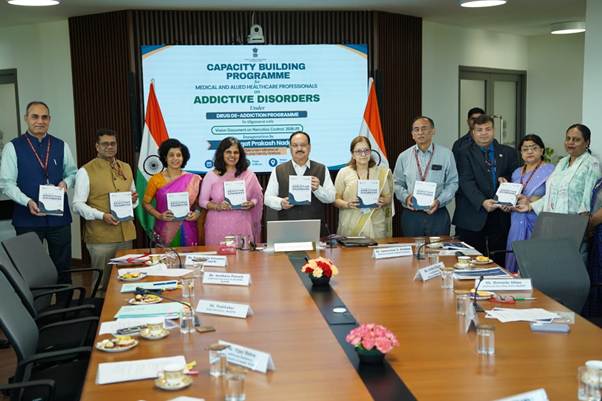
During the event, Shri J.P. Nadda inaugurated the online live training programme for doctors and medical officers to be conducted by all six institutions under the Drug De-addiction Programme (DDAP). He also inaugurated the online self-paced training programme for nurses, Community Health Officers (CHOs) and Auxiliary Nurse Midwives (ANMs). The Union Health Minister, along with the Secretary, Ministry of Health and Family Welfare, and other dignitaries, also released the second edition of ‘Substance Use Disorder: Manual for Physicians (Management of Addictive Disorders)’.
About Drug De-Addiction Programme (DDAP)
The training programme will be conducted through six Central Government institutions under the Drug De-addiction Programme (DDAP): the National Drug Dependence Treatment Centre (NDDTC), AIIMS, New Delhi, located in Ghaziabad; the National Institute of Mental Health and Neurosciences (NIMHANS), Bengaluru; the Postgraduate Institute of Medical Education and Research (PGIMER), Chandigarh; the Central Institute of Psychiatry (CIP), Ranchi; Dr. Ram Manohar Lohia Hospital, New Delhi; and AIIMS Bhubaneswar. NDDTC, AIIMS will coordinate the overall implementation of the capacity-building initiative.
The programme will adopt a blended learning approach comprising online live training, in-person training and online self-paced courses. The online live training for doctors and medical officers will include weekly sessions over a 12-week period, combining theoretical lectures with clinical case discussions. The six designated institutions will conduct the sessions simultaneously, with a combined capacity of 300 participants per week. In-person training will be delivered through five-day programmes using a common curriculum developed by the participating institutions.
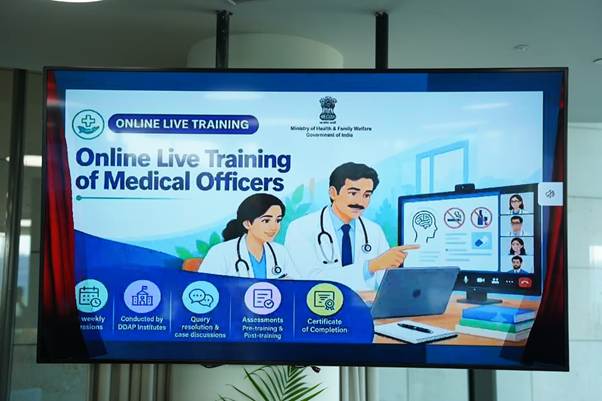
Self-paced online learning modules will also be made available for different categories of healthcare personnel. Doctors will have access to the NDDTC-developed NAAT online course, while the Addiction Rx application developed by NIMHANS will provide additional support for treatment-related prescribing. NIMHANS e-learning modules will be used for counsellors and psychologists, while NDDTC’s online course will support training for nurses, CHOs and ANMs. Certificates will be issued by the respective DDAP institutions upon completion of the training programmes.
The initiative will cover doctors, nurses, counsellors, psychologists, social workers and other medical and allied healthcare personnel involved in the delivery of substance use disorder treatment services. Participants will be nominated by State Governments through the National Health Mission (NHM), as well as by Central Government services, including the Armed Forces, Central Armed Police Forces and Railways. Personnel working in addiction treatment facilities funded by the Ministry of Social Justice and Empowerment will also be covered under the initiative.
More than 800 nominations have already been received through the Ministry of Health and Family Welfare and DDAP institutions via the National Health Mission for online and offline training from various States. In addition, approximately 150 personnel from de-addiction centres supported by the Ministry of Social Justice and Empowerment are expected to participate in offline training over the next two months. The training programme will leverage the existing clinical expertise, multidisciplinary faculty, academic infrastructure and e-learning resources of the six designated institutions.
The second edition of Substance Use Disorder: Manual for Physicians (Management of Addictive Disorders), released during the event, provides practical guidance to physicians on the assessment and management of substance use disorders. First published in 2005, the manual has been extensively revised to incorporate significant advances in the scientific understanding of addiction, treatment approaches and service delivery over the past two decades, while retaining its emphasis on practical, evidence-based clinical care.
Designed for physicians working in both specialised addiction treatment facilities and general healthcare settings, the revised manual aims to strengthen their capacity to recognise, assess and manage substance use disorders with greater confidence and competence. It is expected to serve as a valuable resource in strengthening the delivery of evidence-based addiction treatment and improving access to quality care across the country.
Background
In June 2026, Union Home Minister and Minister of Cooperation Shri Amit Shah unveiled the Vision Document on Narcotic Control: 2026-2029, which outlines the Government of India’s strategy to tackle the entire drug trade ecosystem over the next three years. In line with the vision document, the Ministry of Health and Family Welfare has been entrusted with the responsibility of building the capacity of 10,000 service providers, including medical and allied healthcare personnel engaged in de-addiction services, by March 2029. The Ministry aims to train 2,000 service providers during the current financial year, followed by 3,000 in 2027-28 and 5,000 in 2028-29.
Through this initiative, the Ministry of Health and Family Welfare seeks to expand access to competent, evidence-based and patient-centred addiction care, strengthen linkages across different levels of the healthcare system and contribute to the national commitment towards a Nasha Mukt Bharat.
The programme was attended by Smt. Punya Salila Srivastava, Secretary, Ministry of Health and Family Welfare; Smt. Aradhana Patnaik, Additional Secretary and Managing Director, National Health Mission; Dr. Loveneesh G. Krishna, Director General of Health Services; Dr. (Ms.) Vinod Kotwal, Additional Secretary, MoHFW; and other senior officers of the Ministry.
Shri Sudhansh Pant, Secretary, Ministry of Social Justice and Empowerment, participated virtually, along with senior officials of the Ministries of Social Justice and Empowerment and Home Affairs, heads and faculty of the six designated DDAP institutions, State and Union Territory health officials, representatives of the Ministry of Education and Central Government healthcare organisations, and nominated doctors and allied healthcare professionals participating in the training programme.
*****
SR
HFW/ HFM launches DDAP /26 October 2026/3