Posted On:
28 OCT 2026 12:19PM by PIB Delhi
|
India’s space journey began in 1963 with a sounding rocket launched from Thumba, Kerala. It now looks ahead to the planned Bharatiya Antariksh Station. New technologies are driving this progress. They include reusable launch vehicles, electric, green and nuclear propulsion, and in-orbit servicing. Through SpaDeX, India also became the fourth country to achieve autonomous docking of two spacecraft in orbit. These advances strengthen self-reliance. Meanwhile, Gaganyaan is advancing India’s human spaceflight goals.
|
Space Science & Relevance for Today
India’s organised space activities began in 1962 with the establishment of the Indian National Committee for Space Research (INCOSPAR) under the vision of Dr Vikram A. Sarabhai. The first sounding rocket was launched from Thumba, Kerala on 21 November 1963. The Indian Space Research Organisation (ISRO) was formed on 15 August 1969, superseding INCOSPAR, and was subsequently brought under the Department of Space in 1972. Since its inception, ISRO followed a development-first philosophy: using space technology to solve problems on the ground. Over the decades, it grew far beyond a launch service provider, and its efficiency and technical excellence have earned global recognition. That reputation now rests on a simple promise: every mission must serve the common citizen.
That vision now shapes daily life across the country. Communication satellites extend connectivity to remote and underserved areas. Earth observation data support agriculture, disaster assessment, planning, environmental monitoring and other national requirements. Weather satellites track cyclones and monsoons, enabling early warnings that save lives. Fishermen, farmers and coastal communities rely on these alerts to protect their livelihoods. These systems connect citizens, protect communities, strengthen governance and drive inclusive, sustainable growth. Beyond these services, space also guards India’s frontiers and shapes its future. Space-based communication systems support national security and strategic requirements.
Building on these strengths, emerging technologies are opening fresh avenues for innovation, connectivity and service delivery. Private enterprises and start-ups are now joining this journey. This positions India as a confident, self-reliant and globally respected space power. Click To Read More in Detail: India's Space Odyssey
|
Creative Minds, Catalyzing Science, Empowering Technologies
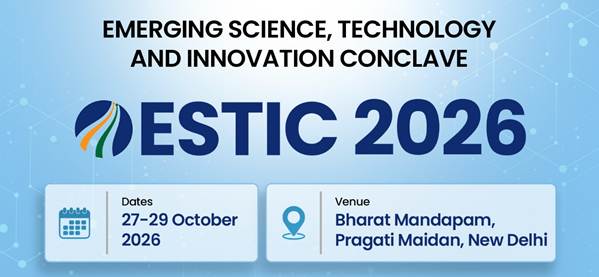
ESTIC-2026, the second edition of India's Emerging Science, Technology and Innovation Conclave. ESTIC 2026 is being scheduled for 27–29 October 2026 at Bharat Mandapam, New Delhi. The Space Science & Technologies thematic session, organised by the Department of Space/ISRO on 29 October 2026, is one of the conclave’s thematic programmes. Read More on Agenda: ESTIC 2026
|
Emerging Space Technologies
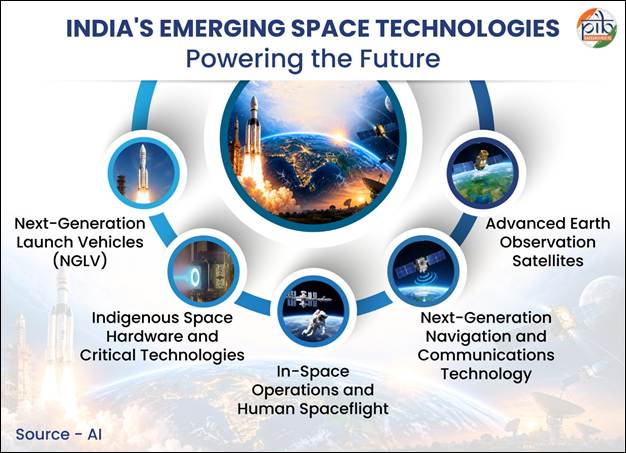
As India moves toward greater self-reliance and bolder goals, a new generation of technologies is taking shape to power this journey. These innovations span next-generation launch systems, in-space operations, human spaceflight, and advanced navigation and communications. They mark a shift from India’s early achievements to a future-ready space programme. Built for the decades ahead, these associated programmes aim to keep India competitive, connected and firmly self-reliant.
Next-Generation Launch Vehicles (NGLV)
Access to space begins with the ability to launch. A country that can build and fly its own rockets decides when, how and at what cost it reaches space. India’s launch journey has moved from small, single-use (expendable) rockets to heavy-lift vehicles, and it is now moving towards reusable systems.
|
India's Traditional Launch Vehicles
- PSLV (Polar Satellite Launch Vehicle): PSLV (Polar Satellite Launch Vehicle), ISRO’s workhorse, can carry up to 1,750 kg to a 600-km Sun-Synchronous Polar Orbit (SSPO) and up to 1,425 kg to Sub-Geosynchronous Transfer Orbit (Sub-GTO), depending on mission configuration.
- GSLV (Geosynchronous Satellite Launch Vehicle): It uses the indigenous Cryogenic Upper Stage and can carry communication satellites of up to the 2-tonne class.
- LVM3 (Launch Vehicle Mark-3) is India’s heavy-lift launch vehicle. It can carry communication satellites of the 4-tonne class to Geosynchronous Transfer Orbit (GTO), and payloads of the 10-tonne class to Low Earth Orbit (LEO).
- SSLV (Small Satellite Launch Vehicle): SSLV is a three-stage vehicle weighing ~120 tonnes at lift-off. It can launch satellites of up to the ~500-kg class into a 500-km planar orbit.
|
In September 2024, the Union Cabinet approved the development of the Next Generation Launch Vehicle (NGLV). The approved outlay of ₹8,240 crore covers development costs, three developmental flights, essential facilities, programme management and the launch campaign. Designed for a maximum capacity of 30 tonnes to Low Earth Orbit (LEO), the NGLV triples India's current launch payload capability compared to the 10-tonne LEO limit of the LVM3. In addition, a partially reusable NGLV variant with a 14-tonne LEO payload capability is being developed to support lower-cost access to space. Its reusability feature will also lower the cost of reaching space.
NGLV will enable both national and commercial missions. These include human spaceflight missions to the Bharatiya Antariksh Station, as well as lunar and interplanetary exploration. It will also launch communication and earth observation satellite constellations to Low Earth Orbit. These missions will benefit the entire space ecosystem and boost the nation’s capability and capacity.
|
Understanding Key Terms
Sun-Synchronous Orbit (SSO): A Sun-Synchronous Orbit (SSO) is a near-polar orbit in which a satellite passes over an area at approximately the same local solar time, enabling comparisons under similar illumination. The interval between repeat observations of a particular location varies with the satellite and its orbit.
Geostationary Transfer Orbit (GTO): GTO is an elliptical intermediate orbit used to transfer a satellite into geostationary orbit (GEO). Its lowest point (perigee) is typically a few hundred kilometres above Earth, while its highest point (apogee) is near 35,786 km above Earth's surface. The launch vehicle typically places the satellite in GTO rather than directly into GEO. Near apogee, the satellite fires its onboard apogee motor to raise its perigee and circularise the orbit. Additional manoeuvres may be required to align the orbit with Earth's equatorial plane. In GEO, the satellite orbits above the equator with a period matching Earth's rotation, appearing stationary relative to the ground.
Cryogenic Upper Stage: A cryogenic upper stage is the final stage of a launch vehicle that uses these propellants to provide the high efficiency needed to place satellites into their intended orbits. ISRO’s indigenous cryogenic upper stage used on GSLV employs liquid hydrogen (LH₂) as fuel and liquid oxygen (LOX) as oxidiser, both stored at extremely low temperatures. It replaced the Russian-supplied stage used in earlier GSLV flights, strengthening India’s self-reliance in advanced launch vehicle technology.
|
Reusable Launch Vehicle (RLV)
RLV technologies can help reduce launch costs and improve operational efficiency. Unlike conventional expendable (single-use) launch vehicles, reusable systems are designed to recover major components for subsequent missions. Their development requires controlled atmospheric re-entry, autonomous navigation, aerodynamic flight and precision landing. ISRO has demonstrated autonomous runway-landing technologies using its winged Reusable Launch Vehicle technology demonstrator, Pushpak. The three RLV Landing Experiments were completed on 2 April 2023, 22 March 2024 and 23 June 2024, respectively. LEX-03 validated autonomous landing under more challenging cross-range and wind conditions.
|
Scramjet Technology: Powering India’s Reusable Space Transportation
A scramjet (supersonic combustion ramjet) is an air-breathing jet engine. It carries only fuel and draws oxygen from the surrounding air. Conventional rockets haul both fuel and oxidiser. A scramjet is therefore lighter and can deliver more payload for the same lift-off mass. It works only within the atmosphere at very high velocity, so a booster must first accelerate it. Its velocity is expressed as a Mach number. Mach 1 equals the speed of sound. Anything above Mach 5 is called hypersonic. Scramjets can complement reusable launch vehicles, which retrieve and refly major parts to cut costs. They offer a promising path to affordable space access. India flight-tested its scramjet in 28 August 2016. It reached Mach 6, a hypersonic velocity, making the country the fourth to demonstrate this. On 22 July 2024, ISRO separately conducted an experimental RH-560 sounding-rocket flight to demonstrate air-breathing propulsion systems and assess their performance.
|
Indigenous Space Hardware and Critical Technologies
Every space mission relies on critical technologies, including engines, thrusters, fuels and power systems. Developing these technologies within India helps reduce dependence on foreign suppliers and strengthens the country’s ability to build and operate spacecraft independently. ISRO is advancing indigenous propulsion technologies, including electric propulsion and alternative fuels. It is also exploring technologies for future missions. These efforts contribute to India’s long-term goal of self-reliance in space.
One important area of progress is electric propulsion, which uses electrical energy to accelerate propellant and generate thrust. Compared with conventional chemical propulsion, it can achieve the same orbital changes using much less propellant. This reduces the fuel carried by a satellite and frees up mass for communication equipment and other payloads. On 27 March 2025, ISRO successfully completed a 1,000-hour life test of its indigenous 300 mN stationary plasma thruster. Its specific impulse, a measure of propulsion efficiency, is at least six times that of conventional propulsion systems. ISRO plans to validate the technology aboard its Technology Demonstration Satellite (TDS-01). It is intended to support future electric-propulsion satellites, including orbit raising and station keeping.
Alongside electric propulsion, ISRO is developing alternative propellants to reduce environmental impacts and improve propulsion efficiency i.e., Green Propulsion. One example is ISROSENE, a rocket-grade kerosene. Liquid oxygen–kerosene propellants are being developed for semicryogenic rocket-engine applications.
Progress in green propulsion also extends beyond ISRO’s own development programmes. Under DRDO’s Technology Development Fund, Bengaluru-based Bellatrix Aerospace developed a 1 N-class green monopropellant thruster for microsatellite attitude control and orbit keeping. Its in-orbit functionality was demonstrated on a payload launched aboard PSLV-C58 in January 2024.
These developments illustrate India’s progress in indigenous electric and green propulsion technologies. Continued testing and validation will help determine their readiness for wider use in future space missions.
|
Radioisotope Heating and Power Technologies
ISRO and Department of Atomic Energy (DAE) are collaborating on requirements for Radioisotope Heater Units (RHU), which supply heat, and Radioisotope Thermoelectric Generators (RTG), which convert radioisotope heat into electrical power ISRO is collaborating with the DAE on RHU and RTG requirements for possible future Chandrayaan and Mars missions.
|
In-Space Operations and Human Spaceflight
In-space operations are the activities spacecraft carry out once they are in orbit, such as rendezvous, docking and undocking. Launching a satellite is only the first step: complex missions such as a space station, a crewed flight or a lunar sample return depend on what spacecraft can do after launch. In-space docking technology is essential when multiple rocket launches are needed to achieve common mission objectives, and it underpins ambitions such as sample return from the Moon and the building and operation of the Bharatiya Antariksh Station.
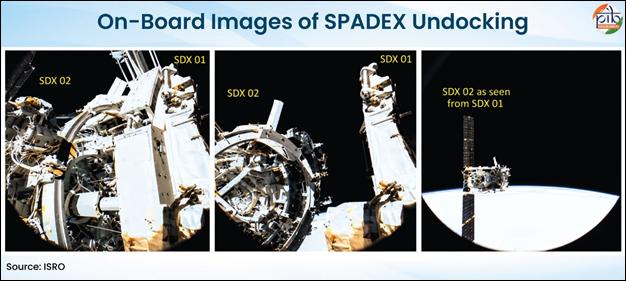
ISRO’s SpaDeX mission first docked its two satellites on 16 January 2025 and subsequently demonstrated undocking. A second docking was completed with full autonomy from an inter-satellite distance of 15 m on 20th April 2025. Bidirectional power transfer between the docked satellites was demonstrated on 21st April 2025. India thereby became the fourth country to demonstrate space docking, after the United States, Russia and China. This achievement also advances technologies required for future missions.
Beyond joining spacecraft, docking enables them to work together in orbit. In-orbit servicing could, in future, enable refuelling, repair or upgrading of spacecraft in orbit, without bringing them back to Earth. SpaDeX demonstrated docking, undocking and power transfer. These interventions can extend satellite lifespans and reduce the need for replacement missions. These achievements provide important technological building blocks for developing future in-orbit servicing capabilities.
Next-Generation Navigation and Communications
Satellite navigation and communication systems support essential services across India. Navigation satellites provide positioning, navigation and timing information, while communication satellites relay television, telephone, broadband and other data signals. Together, these systems support transportation, financial services, telecommunications, disaster management and national security. India is strengthening these capabilities through ISRO’s indigenous NavIC navigation system and communication satellites.
Navigation with Indian Constellation (NavIC) is India’s independent regional satellite navigation system, developed and maintained by ISRO. It provides positioning, navigation and timing services across India and up to 1,500 kilometres beyond the Indian mainland. NavIC offers a Standard Positioning Service for civilian users and an encrypted Restricted Service for authorized users. These capabilities support terrestrial, aerial and maritime navigation, surveying, vehicle tracking and precise timing. NavIC also supports emergency warning messages for fishermen operating beyond terrestrial network coverage. Its integration into compatible devices and applications can further expand its use across civilian and strategic sectors.
Additionally, India’s communication satellites support broadcasting, broadband connectivity and secure communications. GSAT-24, launched aboard Ariane-5 from Kourou, French Guiana, on 23 June 2022 at 03:20 IST (22 June local time), was realised to meet Direct-to-Home (DTH) television requirements in India. Building on this capability, GSAT-N2 (GSAT-20) was launched on 19 November 2024. This high-throughput satellite has a capacity of approximately 48 Gbps and is designed to support broadband and in-flight connectivity across India, including remote island regions.
Communication satellites also serve India’s defence requirements. CMS-03, also known as GSAT-7R, was launched on 2 November 2025. It is a dedicated communication satellite for the Indian Navy. These satellites strengthen India's space-based communication infrastructure and support civilian connectivity, maritime operations and national security.
Advanced Earth Observation Satellites
Earth observation satellites monitor the land, oceans, ice-covered regions and atmosphere from space. Their data supports agriculture, disaster management, water resource planning, climate research and national security. Between December 2020 and December 2025, ISRO launched 22 satellites, including seven Earth observation satellites. These satellites provide images and data for monitoring natural resources, tracking environmental changes and supporting informed planning. India continues to strengthen these capabilities through advanced technologies, including radar imaging and hyperspectral observation.
A major advancement in Earth observation is the NASA-ISRO Synthetic Aperture Radar (NISAR) mission. It was launched on 30 July 2025 aboard GSLV-F16 from Sriharikota. It is the first satellite mission to use two radar frequencies together: NASA’s L-band and ISRO’s S-band. Radar can collect data through clouds and in darkness, enabling observations in almost all-weather conditions, both day and night. NISAR is designed to observe the Earth’s land and ice-covered surfaces every 12 days. Its data can help scientists monitor ground deformation, glacier movement, vegetation changes, soil moisture and natural hazards. These observations can also support coastal monitoring and disaster response.
While radar reveals changes in the Earth’s surface, hyperspectral imaging helps identify different materials and surface characteristics. ISRO launched the Hyperspectral Imaging Satellite (HysIS) on 29 November 2018. It observes the Earth’s surface in visible, near-infrared and shortwave-infrared wavelengths. By recording information across numerous narrow bands of light, HysIS can distinguish features that ordinary imaging may not readily identify. Its data supports applications in agriculture, forestry, soil and geological studies, coastal zones and inland waters.
|
Did You Know? HysIS was launched alongside 30 foreign satellites from eight countries. These comprised one micro-satellite and 29 nano-satellites. The participating countries were Australia, Canada, Colombia, Finland, Malaysia, the Netherlands, Spain and the United States. Of these, 23 satellites were from the United States. The launch also demonstrated PSLV’s capability to deploy multiple satellites for international customers.
|
Way Forward: Building a US$44 Billion Space Economy
India’s space sector is increasingly contributing to economic growth, private investment and industrial capability, alongside its scientific and strategic goals. As per the Department of Space, India’s space economy is targeted to reach US$44 billion by 2033. Emerging technologies such as reusable launch vehicles, air-breathing propulsion, electric propulsion and in-space docking are supporting this growth.
This technological momentum is already creating economic opportunity. NewSpace India Limited (NSIL) has signed 118 Technology Transfer Agreements to transfer 83 technologies developed by ISRO to Indian industry. As a result, investor confidence is also growing. Cumulative investment in Indian space start-ups reached approximately US$618.5 million as of 31 March 2026, with funding shifting from early-stage seed support to larger, growth-stage rounds.
Together, these developments show that India's emerging space technologies are not only advancing national capability but also building a strong, enterprise-led space economy for the years ahead.
References:
Department of Space
ISRO
Click here to see pdf
PIB Research