Posted On:
29 OCT 2026 12:16PM by PIB Delhi
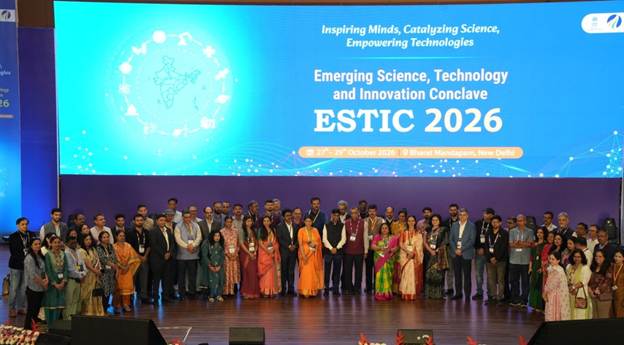
Eminent experts mulled over how Autonomous Systems, Physical AI and Robotics would change scientific research and technological innovations in the near future, in the session on Autonomous Systems, Physical AI and Robotics at the Emerging Science, Technology and Innovation Conclave (ESTIC) 2026 at Bharat Mandapam, New Delhi.
Prof. Umesh V. Waghmare, Secretary, Department of Science and Technology (DST), said while inaugurating the session that, “Collaboration among industry, academia, researchers, start-ups and technology users is crucial to advancing autonomous systems, Physical Artificial Intelligence (AI) and robotics and translating scientific ideas into solutions with societal impact,”
He emphasised that synergy among users, academicians, researchers and industry representatives is essential for progress in these emerging technology areas. He said that their interaction is particularly important in translating research into practical applications that can benefit society.
Highlighting DST’s National Mission on Interdisciplinary Cyber-Physical Systems, Prof. Waghmare said that technology innovation hubs had been established at 25 leading academic institutions across the country. These hubs facilitate interaction between academia and industry and start-ups to help translate ideas from laboratories into the marketplace.
He noted that Phase I of the mission was scheduled to conclude in December 2027. He added that the discussions and feedback from speakers and participants at the session would help inform the formulation of plans for the mission’s second phase.
The session featured a keynote address, invited talks and a panel discussion, bringing together perspectives from industry, academia, research institutions and start-ups. Prof. Waghmare encouraged active participation and discussion to draw on the experience and insights of the different stakeholders.
Speaking during the session, Prof. Abhay Karandikar, Member, NITI Aayog, said that Physical AI is not merely an artificial intelligence challenge but also a systems engineering challenge. He emphasised that the successful functioning of intelligent physical systems depends on several interconnected components, including reliable sensors, efficient actuators, real-time computing, robust control algorithms, low-latency communication and energy-efficient hardware.
Prof. Karandikar observed that physical AI systems differ from conversational AI tools because errors involving robots operating in factories or autonomous vehicles can have immediate physical consequences. He stressed that reliability, verification, safety, security and trustworthiness must therefore remain central to research and development in this field.
He pointed out that India has an opportunity to develop autonomous systems by building on its capabilities in systems engineering, electronics, manufacturing, embedded systems, design, telecommunications and software. Integrating intelligence and advanced algorithms into existing capabilities in robotics, autonomous vehicles and other cyber-physical systems could enable the development of more reliable, safe and trustworthy autonomous technologies.
Prof. Karandikar also highlighted the interdisciplinary nature of Physical AI, noting that progress would require collaboration among experts working on embedded systems, AI models and algorithms. He said that these collaborations would be important in addressing the significant research challenges in autonomous systems.
Referring to the possibility of a dedicated national initiative, Prof. Karandikar said that stakeholder consultations had considered the proposal for a Physical AI Mission. He suggested that the next phase of the National Mission on Interdisciplinary Cyber-Physical Systems could provide an opportunity to take up this area, building on the capabilities developed under the existing mission.
The session was part of ESTIC 2026, being held from October 27 to 29 at Bharat Mandapam, New Delhi, bringing together stakeholders from science, technology, research and industry to deliberate on emerging technologies and innovation.
Other dignitaries who participated in Session 6 included: Shri Jalaj A. Dani, Chairman, Addverb Technologies Ltd.; Prof. P. Rajalakshmi, IIT Hyderabad; Shri Ashutosh Dutt Sharma, IIT Delhi; Dr. Rohan Paul, IIT Delhi; Prof. Santosh K. Vishvakarma, IIT Indore; Dr. Rohini Srivathsa, Microsoft India (former CTO); Prof. K. Madhava Krishna, Robotics Research Centre and Kohli Centre for Intelligent Systems; Shri Aditya Pratap Rajawat, xTerra Robotics; Shri Manas Upadhyay, DTown Robotics Pvt. Ltd.; and Shri Ritukar Vijay, Ottonomy.io.
****
NKR/FT/AA