Posted On:
05 NOV 2026 12:19PM by PIB Delhi
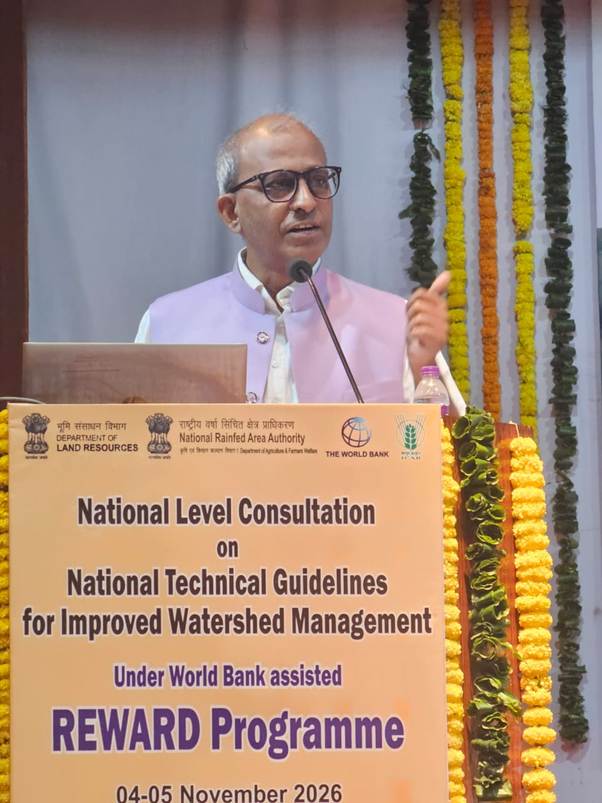
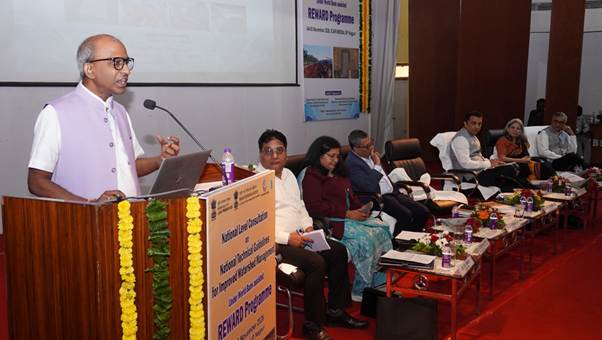
The Department of Land Resources (DoLR), Ministry of Rural Development, The National Rainfed Area Authority (NRAA), Ministry of Agriculture and Farmers Welfare, in collaboration with the ICAR–National Bureau of Soil Survey and Land Use Planning (ICAR-NBSS&LUP), Nagpur, has organised a two-day , 3rd National Level Consultation Meeting on the Draft National Technical Guidelines (NTG) for Improved Watershed Management under World Bank Assisted “Rejuvenating Watersheds for Agricultural Resilience through Innovative Development (REWARD)” Programme on November 4–5, 2026, at ICAR-NBSS&LUP, Nagpur. The consultation brings together senior policymakers, technical experts, development partners, researchers and representatives of various States to deliberate on strengthening watershed development through scientific, technology-driven, cost-effective and participatory approaches.
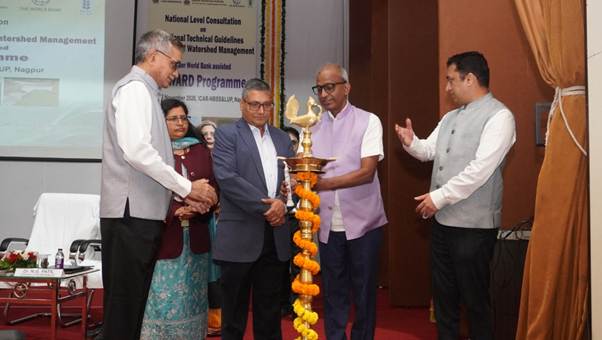
The inaugural session was attended by Shri Dilip Kumar, IAS, Secretary, Department of Land Resources, Dr. Chandra Sekhar Kumar, IAS, CEO, National Rainfed Area Authority (NRAA), Shri Nitin Khade, IAS, Joint Secretary, Department of Land Resources, Ms. Priti Kumar, Senior Agriculture Specialist and Task Team Leader, World Bank, Dr. Susama Sudhishri, Technical Expert (Watershed Development) NRAA and Dr. N.G. Patil, Director, ICAR-NBSS&LUP, along with other distinguished delegates.
Addressing the inaugural session, Secretary, DoLR, Shri Dilip Kumar emphasised the need to strike a balance between scientific rigour and practical implementation in watershed development programmes. He observed that technical guidelines should not become so rigid that they create difficulties for field-level implementation. Flexibility must be provided to States, taking into account their institutional capacities, technical capabilities and varying administrative arrangements.
Highlighting the importance of efficient financial management, he stressed that funds allocated to the Department should be utilised effectively and speedily by the States.
Shri Dilip Kumar emphasised the importance of identifying a set of essential parameters to be followed uniformly by all States, while allowing flexibility in adopting other desirable parameters according to local requirements. He called for robust baseline data and comprehensive impact assessments to evaluate the outcomes of WDC-PMKSY 2.0, identify implementation gaps and draw lessons for the effective design and execution of WDC-PMKSY 3.0.
He further stressed that watershed development should remain focused on tangible outcomes for farmers and communities. Scientific interventions must translate into practical, location-specific solutions that can be effectively implemented at the grassroots level. He also called for recognising and motivating well-performing States and field-level officers to strengthen institutional commitment and improve implementation.
Shri Dilip Kumar observed that the proposed National Technical Guidelines should be finalised with a practical and implementable approach. He expressed confidence that achieving 80–90 per cent of the intended objectives through a flexible and realistic implementation framework would be more meaningful than adopting overly rigid standards.
Dr. C.S. Kumar, CEO, NRAA, highlighted the critical importance of data accessibility and availability for effective planning and implementation of watershed development programmes. He stressed the need for comprehensive capacity building of stakeholders at different levels and advocated effective utilisation of legacy datasets and existing scientific information. He also emphasised the development of a harmonised national-level Decision Support System, incorporating the best features of the systems developed by Odisha and Karnataka, to facilitate effective and integrated watershed planning.
Speaking on the occasion, Shri Nitin Khade highlighted the importance of finalising the National Technical Guidelines (NTGs) in a time-bound manner, stating that the consultation was an important step towards completing the draft guidelines. He emphasised that the guidelines would serve as a foundational framework for future watershed development programmes.
Referring to India's vision of becoming a developed nation by 2047, Shri Khade highlighted the aspiration to contribute towards building a drought-resilient India through the scientific treatment of rainfed areas.
Emphasising the importance of Land Resource Inventory (LRI), he stated that LRI-based scientific data, digital soil libraries and Decision Support Systems (DSS) can transform watershed planning and implementation. These tools can enable village communities and individual farmers to make informed decisions regarding soil and water conservation plans, cropping patterns and nutrient management through accessible digital platforms.
He appreciated the contribution of ICAR-NBSS&LUP and the Soil and Land Use Survey of India (SLUSI) in developing digital soil mapping databases covering large areas. He emphasised that the extent of LRI coverage under future watershed development programs should be determined by considering the availability of existing datasets, implementation timelines, cost-effectiveness and field-level feasibility.
Shri Khade also highlighted the need to accelerate project implementation under WDC PMKSY 2.0. He noted that project timelines had progressively been reduced from seven years under WDC-PMKSY 1.0 to five years under WDC-PMKSY 2.0.
He further emphasised the need for appropriate use of GIS, remote sensing, high-resolution satellite imagery and drone technology, depending on local requirements.
Highlighting the importance of community participation, he stressed the need to strengthen Farmer Producer Organisations (FPOs), User Groups ( UGs),Self-Help Groups (SHGs) and other community-based institutions for livelihood enhancement, value addition and better market access. He also underlined the need to strengthen community ownership and participation in the maintenance of water harvesting structures beyond the project period.
Dr. N.G. Patil, Director, ICAR-NBSS& highlighted the significance of Land Resource Inventory as a holistic, science-based approach for integrated watershed planning and landscape development.
The consultation is witnessing participation from representatives of the Department of Land Resources, NRAA, World Bank, REWARD project States of Odisha and Karnataka, NGOs, consortium partners including ICRISAT, WASSAN, NRSC and MANAGE, NABARD and various ICAR institutes.
The two-day consultation provides a platform for detailed technical deliberations and knowledge sharing on LRI, hydrological assessments, GIS and remote sensing applications, Decision Support Systems, community participation, livelihood interventions and monitoring and evaluation mechanisms.
The deliberations are expected to contribute towards finalising the National Technical Guidelines under the World Bank-assisted REWARD programme. These guidelines will also serve as an important technical input for WDC-PMKSY 3.0, facilitating science-based, cost-effective, scalable and participatory watershed planning, implementation and monitoring across States.
The consultation reaffirms the collective commitment of national and State-level institutions towards building climate-resilient landscapes, strengthening water security and improving the livelihoods of farming communities through scientific and sustainable watershed management.
****
SS/HR