Posted On:
06 NOV 2026 5:40PM by PIB Thiruvananthpuram
Kochi: The Government focuses on ensuring that scientific research and new technologies benefit ordinary people, especially coastal and marginalised communities affected by climate change, Union Secretary of the Ministry of Earth Sciences Dr T Srinivasa Kumar has said.
Addressing the valedictory function of the three-day international symposium on fisheries and remote sensing at the ICAR-Central Marine Fisheries Research Institute (CMFRI), he said the government was taking steps to translate scientific research and technological advances into practical solutions to tackle the growing challenges of climate change.
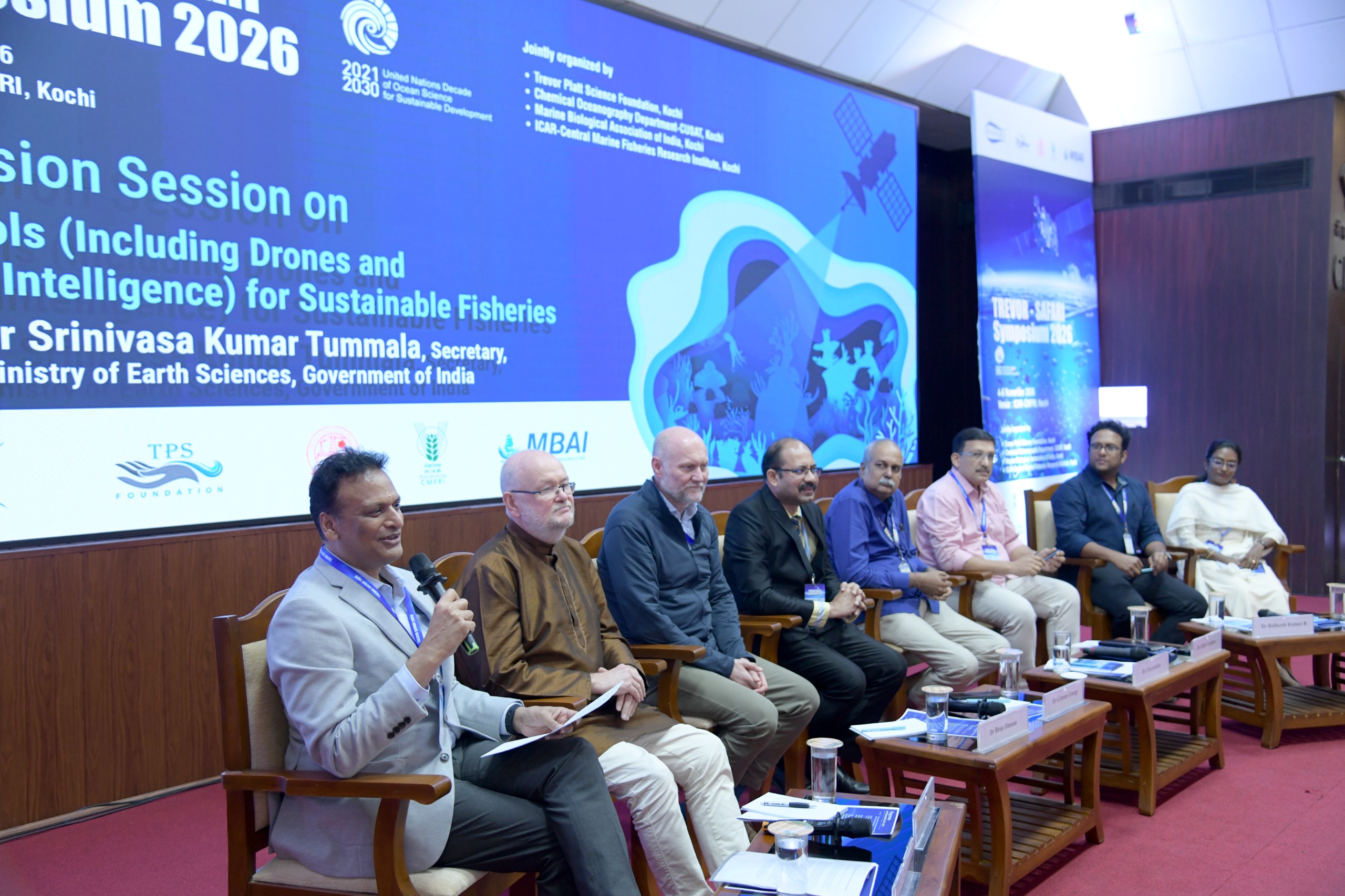
Highlighting the Ministry's key initiatives, he said the Deep Ocean Mission focuses on exploring the deep sea, developing indigenous technologies and strengthening ocean observation services. He also highlighted PRITHvi Vigyan (PRITHVI), an integrated Earth system science programme that brings together research on the atmosphere, oceans, cryosphere and solid Earth to strengthen weather, climate, ocean and hazard services.
“Mission Mausam, another major initiative, aims to make India a weather-ready and climate-smart nation by strengthening observation networks, weather modelling, high-performance computing and AI-based forecasting. The mission seeks to improve the accuracy of forecasts and ensure timely early warnings for monsoons, cyclones and extreme weather events, the Union Secretary said.
“The Ministry is also working on the Blue Economy framework to ensure that ocean observation, scientific research and related services support sustainable fisheries, coastal livelihoods and marine conservation without compromising ocean health”, he added. He moderated a panel discussion on novel tools including drones and artificial intelligence for sustainable fisheries.
Symposium calls for multinational ocean monitoring system, open access to marine data
Calling for a coordinated international effort to address mounting threats to marine ecosystems, the three-day international symposium on fisheries and remote sensing adopted the Kochi Declaration. It proposed an integrated, multinational ocean observation system and free, open and timely access to ocean data to strengthen climate resilience and sustainable management of marine resources.
The declaration was handed over to the Union Secretary of Minstry of Earth Science for consideration and policy-level action.
The symposium also proposed treating ocean data as a shared global resource, with free, open and timely access, alongside proper preservation and curation of historical datasets.
The three-day international symposium was jointly organised by Trevor Platt Science Foundation, Department of Chemical Oceanography of the Cochin University of Science and Technology (CUSAT), CMFRI and Marine Biological Association of India.
The meet featured around 250 scientific presentations, with participation of over 300 delegates from 30 countries.
CUSAT Vice Chancellor Dr Junaid M Bushiri, CMFRI Director Dr Grinson George, Prof. Shubha Sathyendranath, Dr Nandini Menon and Dr Eldho Varghese also spoke on the occasion.
**