Posted On:
12 NOV 2026 7:57PM by PIB Delhi
Under the leadership of Hon’ble Prime Minister, the Union Cabinet declared 15th November, the birth anniversary of Bhagwan Birsa Munda, as Janjatiya Gaurav Diwas, to celebrate the rich tribal heritage and bring the contributions of tribal heroes into the national consciousness. Carrying forward this vision, the Ministry of Tribal Affairs, Government of India, inaugurated the second edition of the two-day National Tribal Literary Festival today at the India Habitat Centre, New Delhi. Held on the occasion of Janjatiya Gaurav Diwas Pakhwada, the festival celebrates tribal literature, languages, and oral traditions under the inspiring guidance of the Hon’ble Prime Minister. Bringing together tribal writers, poets, researchers and language experts, the festival celebrates the evolution of tribal expression from oral tradition to contemporary literature. In line with the Hon’ble Prime Minister Shri Narendra Modi’s mantra of “Virasat bhi, Vikas bhi,” it reaffirms the vision of a Viksit Bharat 2047 that draws strength from its heritage and ensures that tribal languages and knowledge systems are preserved, promoted and woven into the national mainstream.
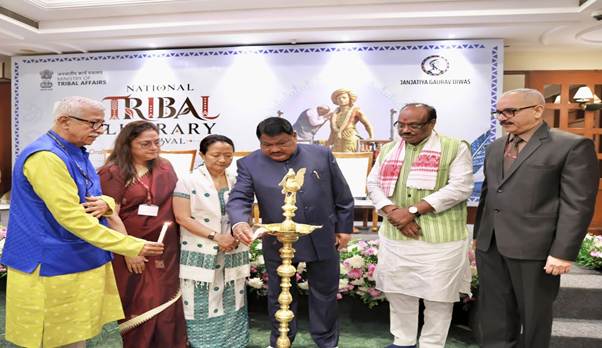
The festival was inaugurated by the Hon’ble Union Minister of Tribal Affairs, Shri Jual Oram, along with the Hon’ble Minister of State for Tribal Affairs, Shri Durgadas Uikey, the Hon’ble Member of NITI Aayog, Dr. Joram Aniya, Padma Shri Shri Chamu Krishna Shastry, Chairman, Bharatiya Bhasha Samiti, Smt. Ranjana Chopra, Secretary, Ministry of Tribal Affairs, and Shri Anant Prakash Pandey, Joint Secretary, Ministry of Tribal Affairs, by lighting the ceremonial lamp. Tribal writers, researchers and language experts from across the country were present.
Welcoming the dignitaries, tribal writers and experts, the Joint Secretary, Ministry of Tribal Affairs, Shri Anant Prakash Pandey, said that the knowledge and traditions of tribal communities must be given national recognition, and that new and young tribal writers have to act as a bridge in translating the rich oral traditions of their communities into written literature, carrying the wisdom of their ancestors to future generations and to the wider nation.
In her opening remarks, the Secretary, Ministry of Tribal Affairs, Smt. Ranjana Chopra, said that the festival gives tribal writers and publishers a platform and creates an opportunity for dialogue between senior and young writers. She stressed the importance of preserving the languages and cultural traditions of tribal communities in the country and said that oral traditions must be documented before they disappear. She said the festival aims to give tribal heritage national recognition and secure it for future generations. Noting that this is the second edition of the National Tribal Literary Festival, she said that this will continue as an annual feature in all the Pakhwada periods to come.
Padma Shri Shri Chamu Krishna Shastry, Chairman, Bharatiya Bhasha Samiti, said that a nation’s awakening rests on knowledge (Gyana Shakti), action (Kriya Shakti) and willpower (Iccha Shakti). He said that with willpower, the nation can be awakened to build a grand, prosperous and united India. He stressed on unity in diversity and how language can strengthen national integrity.
Dr. Joram Aniya, Hon’ble Member, NITI Aayog, describing the festival as a historic gathering celebrating India’s self-respect, ancient traditions and tribal pride, paid homage to Bhagwan Birsa Munda and said his Ulgulan was a struggle to protect tribal culture, language, traditions and identity. She said, “The real and living literature of India is not found only in books, but resides in the hearts of the people in the form of folk songs, lullabies and stories of our tribal societies.” She complimented the Ministry of Tribal Affairs for curating such a platform for the documentation of tribal literature.
Shri Durgadas Uikey, Hon’ble Minister of State for Tribal Affairs, expressed gratitude for the Hon’ble Prime Minister’s visionary leadership in honouring tribal heritage, saying, “The Hon’ble Prime Minister has taken the historic initiative of celebrating the birth anniversary of Bhagwan Birsa Munda as Janjatiya Gaurav Diwas. It is a resolve to connect the country’s tribal heroes, freedom fighters, social reformers and their glorious heritage with the national consciousness.” He presented a ten-point (Das Bindu) framework on the essence of tribal oral traditions, covering folktales, folk songs, heroic sagas, myths, proverbs, riddles, rituals and prayers.
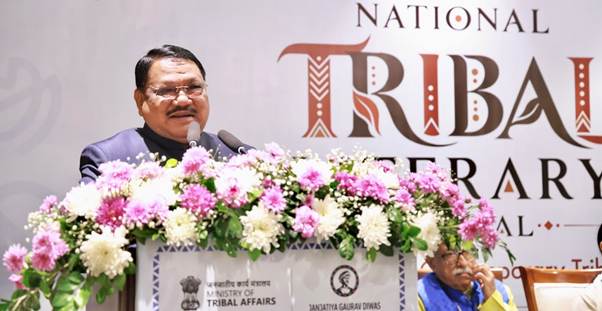
Shri Jual Oram, Hon’ble Union Minister of Tribal Affairs, said that systematic documentation of the literature, folk songs, folktales and oral traditions of tribal languages is essential for their preservation, and that this effort must include not only writers but also lyricists, musicians, folk artists and digital content creators. Noting that many tribal languages have no script and some dialects are on the verge of extinction, he said the absence of a script must not become a barrier, and that oral traditions can be preserved through available Indian languages. He informed that the Ministry will collaborate with the Sahitya Akademi and other organisations working in this field to promote and preserve tribal literature
The first session, “Tribal Literature: From Community Memory to Contemporary Expression”, explored tribal literature as a continuum encompassing oral traditions, cultural memory and contemporary literary creativity. The session was moderated by Prof. Anil Kumar Boro, with Ms. K. Vasamalli, Dr. Damayanti Beshra and Dr. Dharmendra Pare as discussants.
Ms. K. Vasamalli, representing the Toda community of the Nilgiris, said that without language, a community’s traditions and culture cannot develop. She spoke of her efforts to document the endangered Toda language, which has only about 2,000 speakers, through radio recordings, her published work and a 5,700-word dictionary created using the International Phonetic Alphabet and modified Tamil script. Highlighting the close bond between the Toda people and nature, she said the community does not practise idol worship, and that for them “the mountains are the temple of the gods.” She also shared ecological markers embedded in Toda culture, including sacred mountains and rivers and the reverence for native flora used by priests and in clan naming.
Prof. Anil Kumar Boro, reflecting on concerns about the erosion of traditional values due to modernisation and growing individualism, cited the example of the Mizo people in Aizawl, who maintain strict self-discipline even in city traffic. He said, “We may be following a modern urbanised way of life, but still we can follow the values that our tribal forefathers had been following and preserving.”
Dr. Dharmendra Pare said that while memories may fade, knowledge, awareness, conduct and traditions are never destroyed. He noted that the unlettered wisdom once shared in fields and homes is being replaced by screens, and illustrated the essence of tribal consciousness through a festival in which honey is shared by the entire community rather than consumed individually, a Gond story of siblings who turned away from a city market because there was no place for their gods, and the ethical hunting practices of the Baiga and Pardhi communities, who do not hunt pregnant birds. He said true preservation lies in understanding and living these values, and not merely in compiling dictionaries.
The second session, “The Joy of Life: Tribal Poets’ Meet”, was held in two parts, with poetry readings by poets from different tribal languages. The session was moderated by Prof. Kanji Patel. Dr. Rekha Kharadi, Dr. Jitendrabhai Vajirsing Vasava, Ms. Yashoda Murmu, Dr. Jomyir Jini, Prof. Snehlata Negi and Ms. Parwati Tirkey presented their poems.
The third session, “Tribal Folklore: Songs, Myths, Tales, Proverbs, Sayings and Oral Narratives”, explored the diversity of tribal oral traditions, including songs, myths, riddles and tales. The session was moderated by Prof. Sylvanus Lamare, with Dr. Lisa Lomdak, Mr. Anuja Mohan Pradhan and Ms. Swati Anand as discussants.
Drawing on her research in Arunachal Pradesh, Dr. Lisa Lomdak spoke of the custodians of oral traditions, such as the Nyibu, Midi and Abatani, and Njik-Njegam, who preserve knowledge through memory rather than writing. She highlighted the role of women as repositories of oral tradition, preserving narratives through songs during daily chores, marriages and funerals. She underlined that researchers must publish sacred traditions and knowledge only with explicit community permission.
Mr. Anuja Mohan Pradhan, representing the Kui-speaking community of Odisha, said that the Kui language has a rich oral heritage of creation myths, riddles and songs, but is gradually disappearing due to the lack of a formal script and the pressures of modern multilingualism. He shared a traditional Kui riddle and folk tales, including one that symbolises how tribal communities risk losing their roots and culture to outside influences.
Ms. Swati Anand shared the cultural heritage of Bastar, Chhattisgarh, including the Bastar Madai festival and local legends of protective deities, which continue to live in community memory and practice.
In his concluding remarks, the moderator made three suggestions: linking all state tribal affairs websites to the Ministry’s main portal; digitising and making accessible information on tribal communities available with the international institutions and libraries; and scientifically studying and documenting tribal scientific and engineering knowledge, such as the living root bridges of Meghalaya.
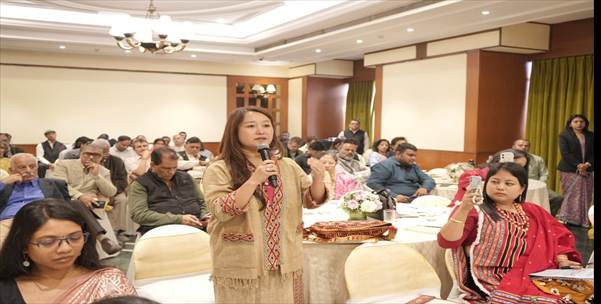
On Day 2, the festival will hold sessions on oral epics and heroic traditions and on oral tradition in multilingual education, along with story and poetry readings in various tribal languages, followed by the valedictory session.
*****
RN/