Posted On:
13 NOV 2026 6:52PM by PIB Delhi
The journey of Mr. Ramasamy (name changed), a 56-year-old sanitation worker belonging to the Other Backward Classes (OBC) community, employed with Oulgaret Municipality in Puducherry, reflects the role of targeted interventions in addressing occupational risks and improving the livelihoods of sanitation workers.
Through the NAMASTE Scheme, the Ministry of Social Justice and Empowerment continues to promote safer working conditions, social security and dignified livelihoods, contributing to a more inclusive, sustainable and mechanised sanitation ecosystem.
Ensuring safe working conditions, occupational health and dignified livelihoods for sanitation workers, is an important step towards building an inclusive and sustainable sanitation ecosystem.
The National Action for Mechanised Sanitation Ecosystem (NAMASTE) Scheme of the Ministry of Social Justice and Empowerment seeks to strengthen the safety, dignity and socio-economic well-being of sanitation workers through access to protective equipment, safety training and institutional support.
For several years, Mr. Ramasamy worked as a sewer and septic tank cleaner, often without adequate personal protective equipment (PPE), exposing himself to occupational hazards and associated health risks.
Prolonged exposure to hazardous working conditions resulted in recurring skin infections, injuries and physical discomfort. These health concerns frequently disrupted his work attendance, leading to loss of wages and financial difficulties. Alongside occupational health challenges, he also experienced the social stigma associated with sanitation work.
With a family of four dependent on his earnings, maintaining household stability while managing health-related expenses remained a significant challenge. Despite these difficulties, Ramasamy aspired to work in safer conditions, secure a stable livelihood and provide better opportunities for his children.
A significant turning point came in 2025 when he received assistance under the NAMASTE Scheme. As part of the intervention, he was provided with a comprehensive PPE kit comprising protective overalls, gloves, safety boots, a face mask and a safety helmet. He also underwent structured training on safe sewage handling practices, occupational safety, hazard prevention and the proper use of protective equipment. In addition, he was linked with social security support to strengthen his overall well-being.
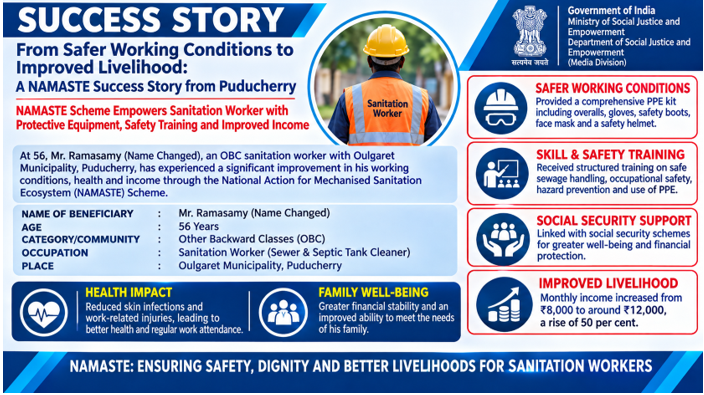
The intervention enabled Ramasamy to adopt safer working practices and develop greater awareness of occupational hazards. Access to appropriate protective equipment contributed to a reduction in recurring skin infections and work-related injuries, improving his health and enabling more regular attendance at work.
The improvement in his working conditions also contributed to greater financial stability. His monthly income increased from approximately ₹8,000 to around ₹12,000, registering a 50 per cent rise. Improved work attendance and fewer health-related disruptions enabled him to contribute more consistently towards household expenses and the needs of his family.
With improved occupational safety, greater financial security and increased awareness of safe sanitation practices, Ramasamy has experienced a positive transformation in his professional and personal life. The support received under NAMASTE has helped him continue his work with greater confidence while strengthening his ability to provide for his family.
****
SS-182-TAR/KV/GA/RK
Date: 13.11.2026