Posted On:
16 NOV 2026 11:34AM by PIB Delhi
|
Nobody in Gujarat had rehearsed for this, yet leadership rose to the moment. Local officers decided on the spot, even as networks failed. The Centre released Rs. 500 crore that same day. Within two weeks, a new authority, chaired by the Chief Minister, took charge of recovery. Villagers shaped decisions, and families led the rebuilding of their own homes. District Judges, serving as ombudsmen, gave complaints a fair hearing. In October 2001, the Chief Minister raised the momentum further. Eleven senior Secretaries spent weekends in the worst-hit talukas, reporting to him every Monday. Their goal: visible progress by the first anniversary. By 2004, about 1.87 lakh homes stood rebuilt. Kutch proved that humility, urgency and trust can rebuild a region.
|
A Morning That Changed Gujarat
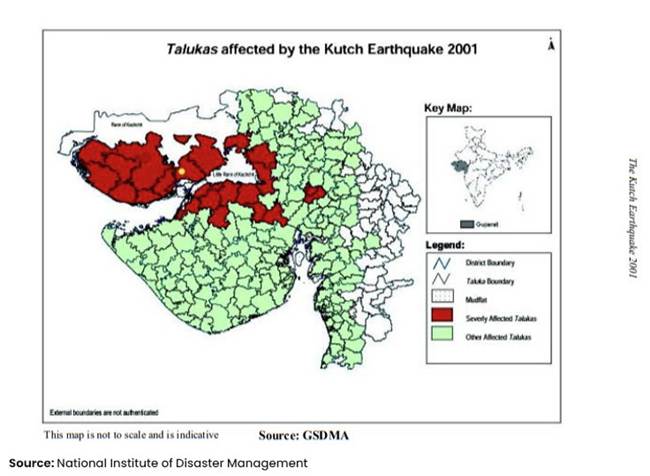
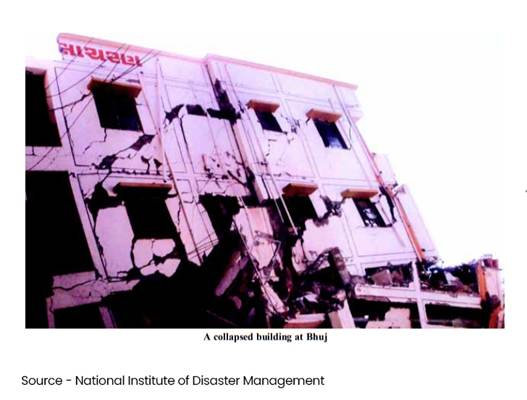
On the morning of 26 January 2001 at 8:46 a.m., an earthquake of magnitude 6.9 struck Gujarat, with its epicentre in Kutch. This earthquake presented an unprecedented test of leadership, governance and institutional resilience. It affected about 7,633 villages in 181 talukas, which are administrative sub-divisions of a district. Nearly one crore people were affected across these places, and 13,805 lives were lost, including 12,221 in Kutch. About 1.67 lakh people were injured, and the scale of human suffering was immense across the region.
More than two lakh houses were destroyed and about nine lakhs were damaged, leaving countless families without shelter. Livelihoods were hit just as hard, as over 10,000 small and medium industrial units suspended production. About 50,000 artisans also lost their livelihoods, adding an economic crisis to the human tragedy of the day. Gujarat had emergency plans for cyclones and floods, but it did not have a plan specific to earthquakes.
Yet, the tragedy also demanded decisive leadership, with swift decisions, coordinated action and a vision that went beyond immediate relief to rebuilding a safer and more resilient Gujarat.
The First Hours: Acting Before Certainty
On 26 January, the Director of Relief reached the State Control Room at Gandhinagar and began coordinating the response. Communication soon became a major challenge, as landline and mobile networks in the capital region failed within an hour. Satellite phones and the police wireless remained the principal means of communication in the hours that followed.
In Bhuj, the Superintendent of Police took charge of search and rescue, and the Collector led relief and supply. A medical camp was set up on open ground within about two hours, bringing care to the injured. After a request to the Brigadier, an Army platoon was deployed, and police families started a community kitchen. The Government of India acted the same day, as the National Crisis Management Committee met under the Prime Minister.
Rs. 500 crore was sanctioned for immediate relief, which allowed urgent work to begin without delay. Armed forces and paramilitary forces joined the rescue effort, and relief supplies were airlifted to the region.
An Institution for the Mission: The Making of State Disaster Management Authority
As the first phase of relief progressed, attention turned to the larger task of rehabilitation and reconstruction. On 8 February 2001, the Government of Gujarat constituted the Gujarat State Disaster Management Authority, known as GSDMA.
It was set up through a Government Resolution with a mandate to oversee re-building. The model was not entirely new, as it drew on the Orissa State Disaster Management Authority. That body was created by the State Government after the 1999 super cyclone to lead recovery. The Government of India had suggested that Gujarat set up a similar body of its own.
At first, GSDMA was a society registered under the Societies Registration Act, and it became an authority established by law. This change came through the Gujarat State Disaster Management Act, 2003, which gave the Authority a firm legal basis.
The Governing Body set policy and guidelines, and it comprised the Chief Minister as Chairman, senior Ministers and senior officers. On 10 February 2001, the Governing Body adopted an initial framework that involved public participation i.e., villagers in key decisions.
Village Committees and Gram Sabhas were to take part in decisions on relocation of severely damaged villages. At the national level, the Government of India constituted a National Committee on Disaster Management on 13 February 2001. This step followed an all-party meeting convened by the Prime Minister in the days after the earthquake.
Counting the Cost: Funding the Recovery
Rebuilding a region on this scale needed large funds, and the first step was to estimate the cost. Joint assessments by the World Bank and the Asian Development Bank placed the damage at Rs. 9,909 crore.
They estimated the cost of reconstruction at about Rs. 10,575 crore, and both are international lending institutions. The State Government later placed its own estimate at about Rs. 8,496 crore, which was lower than the joint estimate. The two institutions had first sanctioned loans of US$ 1 billion (Rs. 100 Crore) and US$ 500 million (Rs. 50 Crore). After review, these loan sanctions were revised to US$ 703 million (Rs. 70.3 crore) and US$ 350 million (Rs. 35 crore) respectively.
The State Government met about 30 per cent of the cost, approximately Rs. 2,603 crore, from its own resources.
The Owner-Driven Approach: Families at the Centre
With funds in view, the Government turned to housing and announced four housing assistance packages on 23 February 2001. The assistance varied by the severity of damage, the seismic risk and the type of settlement.
A fifth package followed on 24 April 2001 for the four worst-affected towns of Kutch: Bhuj, Bhachau, Anjar and Rapar. The reconstruction policy provided for an owner-driven approach, under which families rebuilt their own houses instead of using contractors.
The Government gave families financial assistance, technical guidance and safe designs to help them rebuild. Non-governmental organisations and private partners also played a part, building houses in adopted villages under a public-private partnership programme.
Under this programme, each side contributed funds, and money was released in stages as construction progressed. Official documents described the entire programme as reconstruction plus, also known as building back better.
Making It Work on the Ground: Leadership in Implementation
Damage assessment
The first step was to assess the damage, which was graded on a scale from G1 to G5. In this scale, G1 meant minor damage and G5 meant complete destruction or damage beyond repair. Surveys were undertaken by 2,051 teams comprising a total of 4,592 persons, including 1,794 revenue officers. Each survey team had three members, and the community was involved in the survey process. Families could request a re-survey, and the period for applications was extended to allow this.
Grievance redressal
Complaints were handled by village committees, district committees and the District Judge, who was designated Ombudsman in each district. An Ombudsman is an official who looks into complaints from the public against the administration. The Ombudsman could receive complaints directly from the public and direct the administration to act on them. By October 2003, the Ombudsmen had received 47,156 petitions, and about 99 per cent of these had been dealt with.
Administrative structure
A four-tier structure operated at the State, district, taluka and village levels, with Additional Collectors posted in the worst-affected talukas. In each village, a committee called the Gram Navrachna Samiti supervised the reconstruction work in that village. Its members included the Sarpanch, the elected village head, a woman member, and members of backward castes and minority communities. The primary school headmaster and a representative of a non-governmental organisation were also part of the committee.
Government departments carried out works, while the Authority, led by Chief Executive Officer Dr P.K. Mishra, coordinated and monitored them. District Collectors served as Joint Chief Executive Officers, and an operational manual was prepared to speed up approval of works.
Assistance and quality arrangements
Assistance was paid to beneficiaries in instalments, with an engineer certifying the progress of construction at each stage.
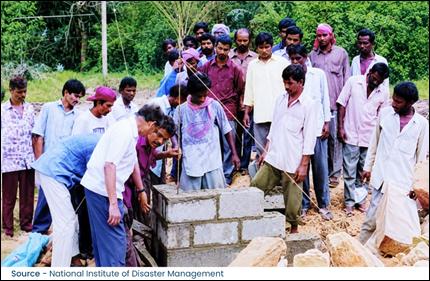
A total of 1,082 material banks supplied cement and other materials, while nearly 30,000 masons and 6,200 engineers were trained.
About 2.6 lakh houses were inspected independently, and reconstructed houses were registered jointly in the names of husband and wife. New construction incorporated earthquake-resistant and cyclone-resistant features.
Reviewing Progress, Renewing Momentum
By October 2001, a review of progress showed both achievements and problems that still needed attention. A number of families continued to live in tents, and some offices and schools still functioned from temporary buildings.
Urban reconstruction proceeded more slowly than rural reconstruction, as it required plot surveys, road widening and reallocation of land. Water shortages or site-related difficulties were reported in some of the new villages built after the earthquake.
Action was also taken in connection with debris clearance, with disciplinary action against 276 government employees. Cases were also initiated against 738 persons linked to local bodies in the same matter.
Shri Narendra Modi assumed office as Chief Minister in October 2001, and a fresh review of progress followed. After the review, eleven senior Secretaries were assigned to the worst-affected talukas for focused attention. Each Secretary visited the assigned area for three days every weekend until the end of January 2002.
A review meeting chaired by the Chief Minister was held every Monday during this period. The stated objective was to demonstrate progress by the first anniversary of the earthquake on 26 January 2002. Based on field visits and the Secretaries’ suggestions, a number of policy and operational issues were resolved.
As a result of these steps, the pace of reconstruction and rehabilitation increased in the following months.
Homes, Towns and Livelihoods: Progress by 2004
Repair work was largely completed in the first year, while reconstruction progressed steadily in the years that followed. By January 2002, about 7.7 lakh houses had been repaired and nearly 60,000 had been reconstructed.
Reconstructed houses rose to about 1.43 lakh by January 2003 and about 1.87 lakh by January 2004. The target was about 2.15 lakh houses, so the January 2004 figure was 87 per cent of the target.
By January 2004, all 42,678 primary schoolrooms that had been identified for repair were repaired. Of the 8,212 destroyed schoolrooms, 7,469 had been reconstructed by then, which is 91 per cent of the total.
The District Civil Hospital at Bhuj was reconstructed with assistance from the Prime Minister's National Relief Fund. It cost about Rs. 114 crore and used a technology called base isolation, which helps buildings face earthquakes. The hospital was inaugurated on 14 January 2004, completing a key part of the health recovery. Six community health centres, 24 primary health centres, 184 sub-centres and 183 anganwadi centres were also constructed.
Area Development Authorities were constituted for Bhuj, Anjar, Bhachau and Rapar for town planning and new infrastructure. These Authorities engaged consulting firms to prepare plans, issued building permissions and developed relocation sites.
Town plans were prepared for three of the four towns, which required surveying thousands of plots and settling disputes. Urban infrastructure works included about 403 km of roads, 546 km of water pipelines and 504 km of sewerage.
These works could begin only after development plans; town planning and the selection of contractors were completed. The works also covered 134 municipal buildings, and about 40 per cent had been completed by January 2004.
The Government of India and the Government of Gujarat announced tax incentives for new industrial units in Kutch. These incentives included exemptions from excise duty, sales tax and octroi, all of which are taxes on goods. By March 2004, 151 new industrial projects, with proposed investment of about Rs. 4,785 crore, had been located in Kutch.
A Lasting Legacy: Institutions for Disaster Management
The recovery also led to lasting reforms, and Gujarat adopted the State Disaster Management Policy in September 2002. In 2003, the Gujarat State Disaster Management Act was enacted, which put disaster work on firm legal ground.
The Gujarat Institute of Disaster Management was established, and officials and community members were trained. Village-level preparedness teams, called the Afat Sajjat Senas, were formed in 484 villages across the State.
In 2002, the State Government took steps to activate the Gram Sabhas, making disaster preparedness a permanent agenda item. The Sasakawa Award of the United Nations for disaster reduction was conferred in 2003, recognising this work.
In 2004, the Gold Award of the Commonwealth Association for Public Administration and Management was conferred for innovation in governance.
Together, these developments preceded the Disaster Management Act, 2005, which applied to the whole country.
Decoding Leadership: Six Lessons from Kutch
Act first, organise as you go. Relief began within hours, even though landline and mobile networks had failed within the first hour. Clear roles in Bhuj and a same-day meeting of the National Crisis Management Committee kept the response moving.
Build an institution for the mission. GSDMA was formed within two weeks, with the Chief Minister chairing its Governing Body and a clear mandate. The model was borrowed from Orissa and later given a firm legal basis through the 2003 Act.
Keep people at the centre. Families rebuilt their own homes, supported by financial assistance, technical guidance and safe designs from the Government. Village Committees and Gram Sabhas also had a voice in the decision to relocate severely damaged villages.
Build fairness into the system. Open surveys, re-survey requests and an Ombudsman in every district gave families a way to be heard. Staged payments and the independent inspection of about 2.6 lakh houses helped protect the quality of construction.
Review honestly and correct course. The October 2001 review openly listed problems, from families still in tents to slow urban reconstruction. Senior Secretaries, weekly reviews and a clear deadline then helped the pace of work to increase.
Leave behind capability, not just buildings. Gujarat gained a policy, a law, a training institute and preparedness teams in 484 villages. These institutions were recognised with the Sasakawa Award in 2003 and a Gold Award in 2004.
Kutch Earthquake 2001
******
PIB Research