Posted On:
17 NOV 2026 5:10PM by PIB Kolkata
Kolkata, November 17, 2026
In a significant scientific contribution to environmental sustainability and river rejuvenation, researchers at the Indian Institute of Technology Kharagpur (IIT Kharagpur) have reported an encouraging decline in metal contamination in the sediments of the Ganga–Hooghly estuary, offering valuable insights into the long-term effectiveness of environmental management and pollution-control initiatives.
The findings, published in GeoHealth, a peer-reviewed international journal of the American Geophysical Union (AGU), form part of a comprehensive comparative investigation of metal pollution in major estuarine ecosystems across India, China and the United States.
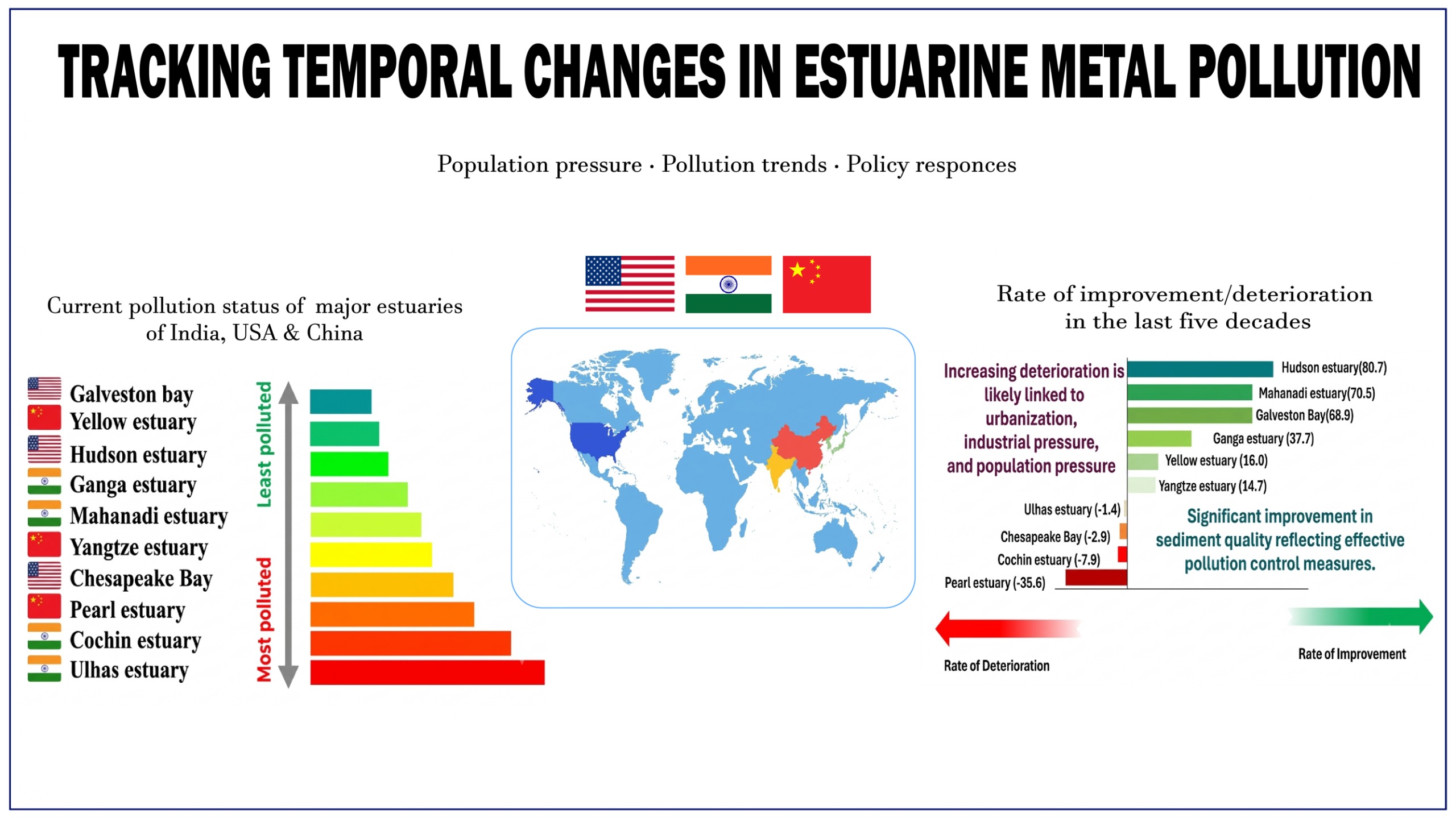
The study, titled “Tracking Temporal Changes in Metal Pollution in Estuarine Sediments: Population Pressure, Pollution Trends, and Policy Responses in India, China, and the USA,” identifies a substantial improvement in the sediment pollution indicators of the Ganga–Hooghly estuary. Its long-term comparative assessment reports a 37.76% reduction in the Pollution Load Index (PLI), indicating a decline in the overall metal contamination burden of the estuarine sediments.
The research was undertaken by Prof. Parthasarathi Chakraborty, Soham Chatterjee, Anindya Das, Gunjan Roy, Smrutirekha Mohanta and Sucharita Chakraborty. The study was led by Prof. Parthasarathi Chakraborty of the Marine Trace Metal Biogeochemistry Laboratory, Centre for Ocean, River, Atmosphere and Land Sciences (CORAL), IIT Kharagpur, with contributions from researchers at CORAL.
The researchers examined 10 major estuarine systems, comprising four in India, three in China and three in the United States. The assessment drew upon approximately 150 scientific publications containing relevant quantitative data, identified through a broader review of 1,323 research publications.
Importantly, the researchers observed declining contamination levels during the period following the introduction of the Government of India's flagship Namami Gange Programme in 2014, underscoring the encouraging relationship between sustained river conservation initiatives and improvements in environmental quality.
The researchers emphasised that the observed trends should be interpreted in the context of long-term environmental changes and that continued monitoring, effective wastewater treatment and consistent implementation of pollution-control measures remain essential. The Ganga–Hooghly estuary, which connects one of India's most important river systems with the Bay of Bengal, is exposed to multiple environmental pressures arising from urbanisation, industrial activity, municipal wastewater, agricultural runoff and port-related operations. Despite such pressures, the IIT Kharagpur study identifies a promising trajectory of improvement.
Analysis of the historical and recent scientific observations revealed that sediment metal contamination in the Hooghly estuary had remained elevated during earlier periods, particularly around the beginning of the 2000s. However, a gradual reduction became evident in subsequent assessments, with lower contamination values reported in the years following 2014.
The Pollution Load Index is an indicator used to assess the combined contamination burden of multiple metals in sediments. A reduction in this index generally indicates an improvement in sediment quality with respect to the metals assessed.
The findings therefore provide encouraging evidence of declining metal pollution in the Ganga–Hooghly estuarine system, while reinforcing the need for continued scientific assessment of its environmental condition.
The research places particular emphasis on understanding how environmental policies and pollution-control programmes correspond with long-term changes in sediment contamination.
Among the initiatives examined is the Namami Gange Programme, launched by the Government of India in 2014 to support the conservation and rejuvenation of the River Ganga through pollution abatement, wastewater management and ecosystem restoration.
The decline observed in the Ganga–Hooghly estuary during the subsequent period represents an encouraging environmental trend consistent with the objectives of this national initiative. The study also acknowledges earlier conservation efforts, including the Ganga Action Plan, while recognising that improvements in river systems emerge from multiple interacting factors, including regulatory interventions, industrial practices, wastewater management and natural sediment processes.
The findings highlight the importance of combining national environmental programmes with rigorous scientific monitoring to assess long-term progress and identify areas requiring further intervention. Beyond the Ganga–Hooghly system, the IIT Kharagpur research offers an international perspective on the challenges of managing metal pollution in densely populated and industrially developed coastal regions.
The comparative findings revealed substantial differences in pollution trajectories. India's Mahanadi estuary recorded a 70.46% long-term reduction in PLI, while the Hudson River estuary in the United States recorded an 80.68% reduction. Conversely, certain estuaries continued to experience elevated or fluctuating contamination, demonstrating that economic development, population growth and environmental management can influence sediment quality in different ways.
The research further introduces the Population Normalised Pollution Load (PNPL) as a complementary assessment tool that considers sediment contamination in relation to population pressure.
By integrating the conventional Pollution Load Index with this additional indicator, the researchers have developed an analytical approach that can help scientists and policymakers better understand whether pollution conditions are improving relative to the human pressures experienced by estuarine environments.
This framework has potential applications in long-term environmental monitoring, sustainable coastal management and the evaluation of pollution-control strategies.
The multidisciplinary investigation reflects IIT Kharagpur's continued commitment to advancing environmental research that addresses critical challenges at the intersection of water resources, ecosystem sustainability, scientific assessment and public policy.
The findings reinforce the importance of evidence-based environmental governance, particularly as India continues to pursue sustainable development, improved estuarine/coastal management and the restoration of its major river systems.
For a country where rivers are central to livelihoods, agriculture, biodiversity, cultural heritage and economic activity, scientifically documented improvements in environmental quality carry considerable significance.
As India advances its commitment to environmental sustainability and the vision of Viksit Bharat, IIT Kharagpur remains committed to generating scientific knowledge that can contribute to cleaner waterways, healthier ecosystems and a more sustainable future.
************
SSS/Kol/17.11.26……..