JODHPUR, November 18, 2026: Can meditation bring about measurable biological changes in the human body, similar to those associated with certain medicines? Researchers at the Indian Institute of Technology Jodhpur (IIT Jodhpur) have explored this question through an interdisciplinary study that connects meditation, molecular biology and brain science. The research has identified molecular signatures associated with meditation that overlap with those of 438 pharmaceutical compounds, offering new insights into the biological pathways through which meditation may influence brain functioning.
The research, titled “Meditation as a Bioactive Intervention: Evidence of Translational Potential via Connectivity Mapping and TMS Neurophysiology,” has been published in the international peer-reviewed journal Frontiers in Human Neuroscience on November 9, 2026.
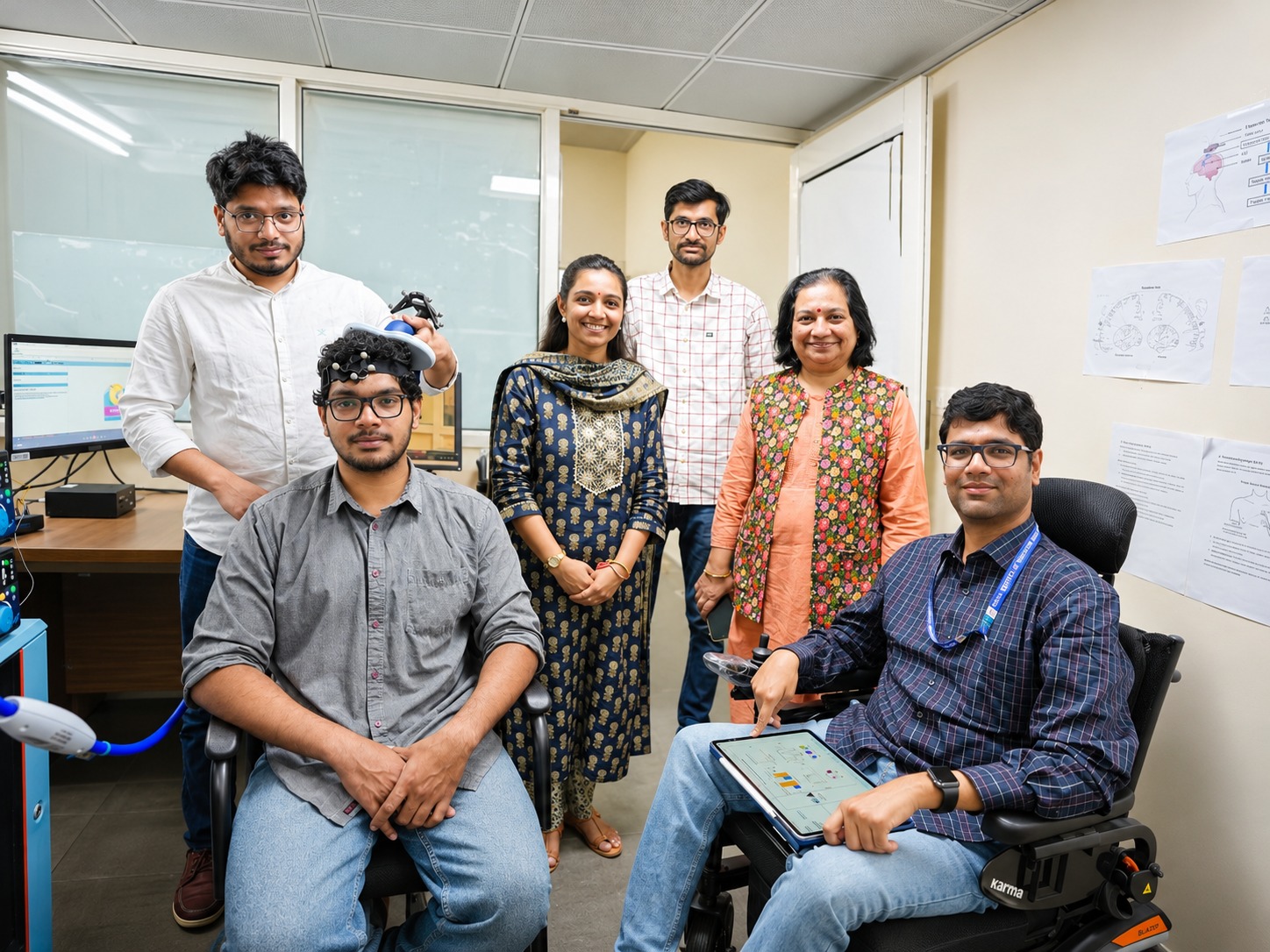
The study was conducted by Prof. Mitali Mukerji who works in the area of Ayurgenomics with her PhD student Ms Aditi Joshi in collaboration with Dr. Vignesh Muralidharan, an AI and cognitive neuroscience faculty from Department of Bioscience and Bioengineering, IIT Jodhpur and Mr Deep Patel, a former BTech student from the Department of Computer Science and Engineering, IIT Jodhpur presently in Yale University.
Going beyond the conventional understanding of meditation as a practice for mental relaxation and wellbeing, the researchers investigated whether meditation is also associated with identifiable changes in biological pathways involved in regulating brain activity. Their findings provide an important starting point for scientifically examining meditation as a potentially bioactive, non-pharmacological intervention.
Tracing the biological effects of meditation
The research team analysed a publicly available gene expression dataset from 106 individuals participating in an Inner Engineering meditation retreat. The study examined 389 biological profiles collected at four stages: before the programme, after an eight-week preparatory phase, eight days after the meditation retreat, and three months later.
Using an advanced computational approach called Connectivity Map (CMap), the researchers compared meditation-associated changes in gene activity with biological signatures produced by thousands of pharmaceutical compounds. This analysis revealed connections with 438 unique compounds, particularly those acting on pathways associated with GABA (GABA – Gamma-Aminobutyric Acid), glutamate, dopamine, serotonin and other chemical messengers that help nerve cells communicate.
One of the most significant findings was the involvement of the neuroactive ligand–receptor interaction pathway, which plays an important role in communication between nerve cells and the regulation of brain functions.
Understanding how meditation may influence brain activity
A major focus of the research was the brain's excitation–inhibition balance, which refers to the balance between signals that activate brain cells and those that regulate or inhibit their activity. This balance is essential for functions such as attention, emotional regulation, learning and movement.
The researchers examined this relationship by integrating their molecular findings with published scientific studies on the effects of medicines on brain activity, measured using a non-invasive technique called Transcranial Magnetic Stimulation (TMS).
The analysis involved meta-analysis using studies on 75 drugs, 55 drug classes and 21 measures of brain activity. It revealed interesting connections between meditation-associated molecular changes and drug-related effects involving GABA, glutamate and other neurotransmitter systems.
The study also found that these associations differed across the stages of meditation. The preparatory phase showed connections involving GABA and dopamine-related pathways; the intensive meditation phase showed associations involving GABA and calcium-channel-related mechanisms, along with glutamate, dopamine and serotonin; while the follow-up phase showed a different combination of GABA, dopamine and serotonin-related signatures.
The researchers also observed differences in biological responses among individuals, indicating that meditation may not affect everyone in exactly the same way.
A new direction for scientific research on meditation
An interesting aspect of the study was the identification of molecular connections involving specific drug classes, including zolpidem, which acts on GABA-related receptors and is used for insomnia, as well as drugs influencing glutamate and acetylcholine signalling.
These findings do not mean that meditation works like these medicines or can replace medical treatment. Rather, they suggest that meditation-associated biological changes may involve some of the same broad molecular pathways influenced by these drugs.
The team has proposed a framework for future research combining molecular analysis with TMS, Electromyography (EMG) and Electroencephalography (EEG) to directly measure changes in brain activity before and after meditation. Such studies could help establish whether molecular changes are accompanied by measurable changes in brain inhibition, excitation and neural plasticity.
Commenting on the significance of the research, Prof. Mitali Mukerji, Professor, Department of Bioscience and Bioengineering, IIT Jodhpur, said:
"Meditation has traditionally been understood as a practice for mental wellbeing. Through this research, we wanted to explore whether its effects could also be understood through measurable biological changes. Our findings reveal interesting connections between meditation-associated gene expression patterns and pathways targeted by several neuroactive drugs. This opens up an exciting possibility of studying meditation through the combined lens of molecular biology and brain physiology. It is an important step towards understanding how meditation may influence the brain and how these effects can be scientifically investigated."
The research also highlights the importance of recognising individual differences in meditation responses. The authors emphasise that the nature, duration and intensity of practice, along with an individual's physiological and psychological background, need to be considered. Appropriate guidance and supervision are particularly important when meditation is used alongside clinical treatment.
The researchers caution that the study is exploratory. It is based on an existing dataset, does not include a non-meditating control group, and did not directly measure participants' brain activity using TMS. Moreover, the gene expression data came from blood samples and may not directly represent changes within the brain. Further experimental studies are therefore required to validate these findings.
Overall, the research provides a new scientific framework for understanding meditation beyond its established psychological and contemplative dimensions, bringing molecular biology and neuroscience together to investigate its potential effects on human health.

00000