Posted On:
18 NOV 2026 6:00PM by PIB Delhi
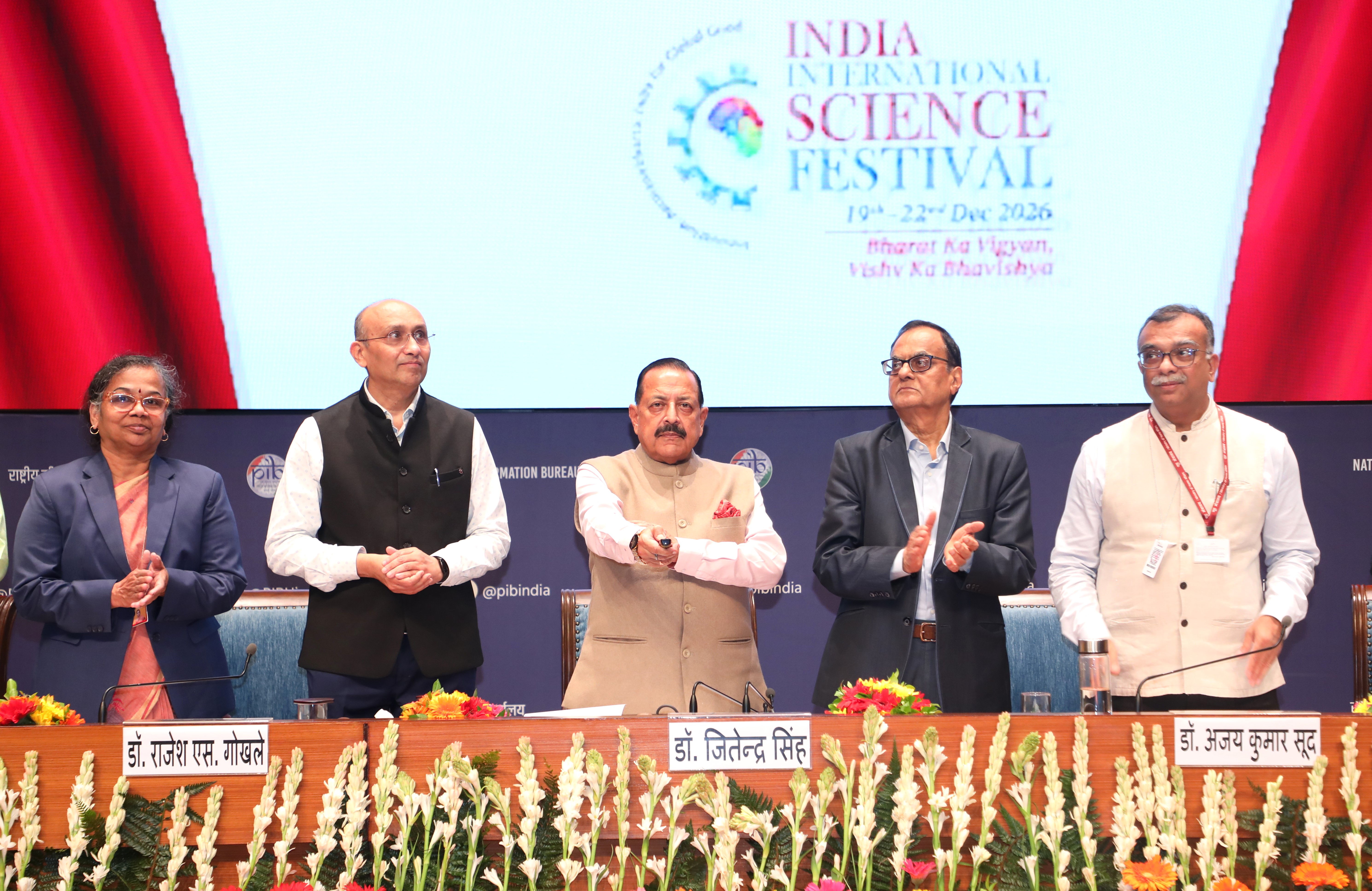
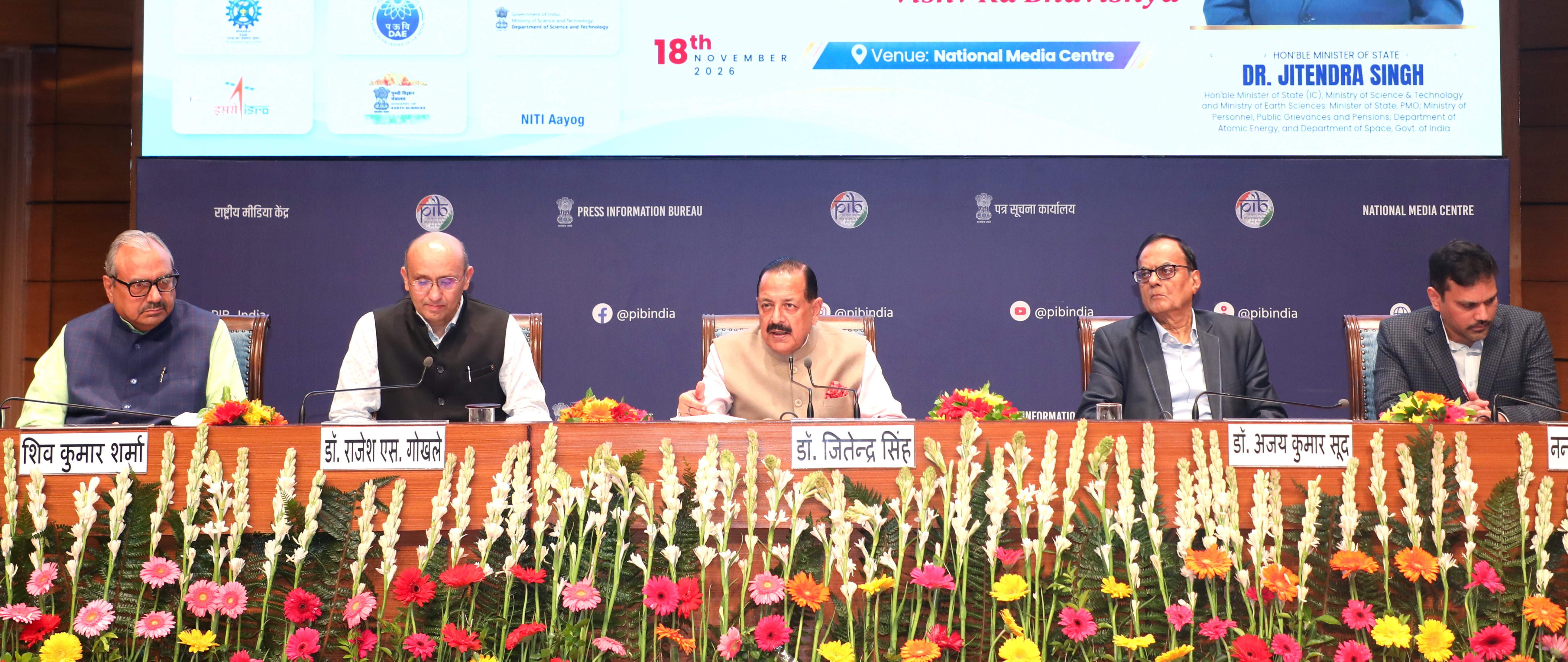
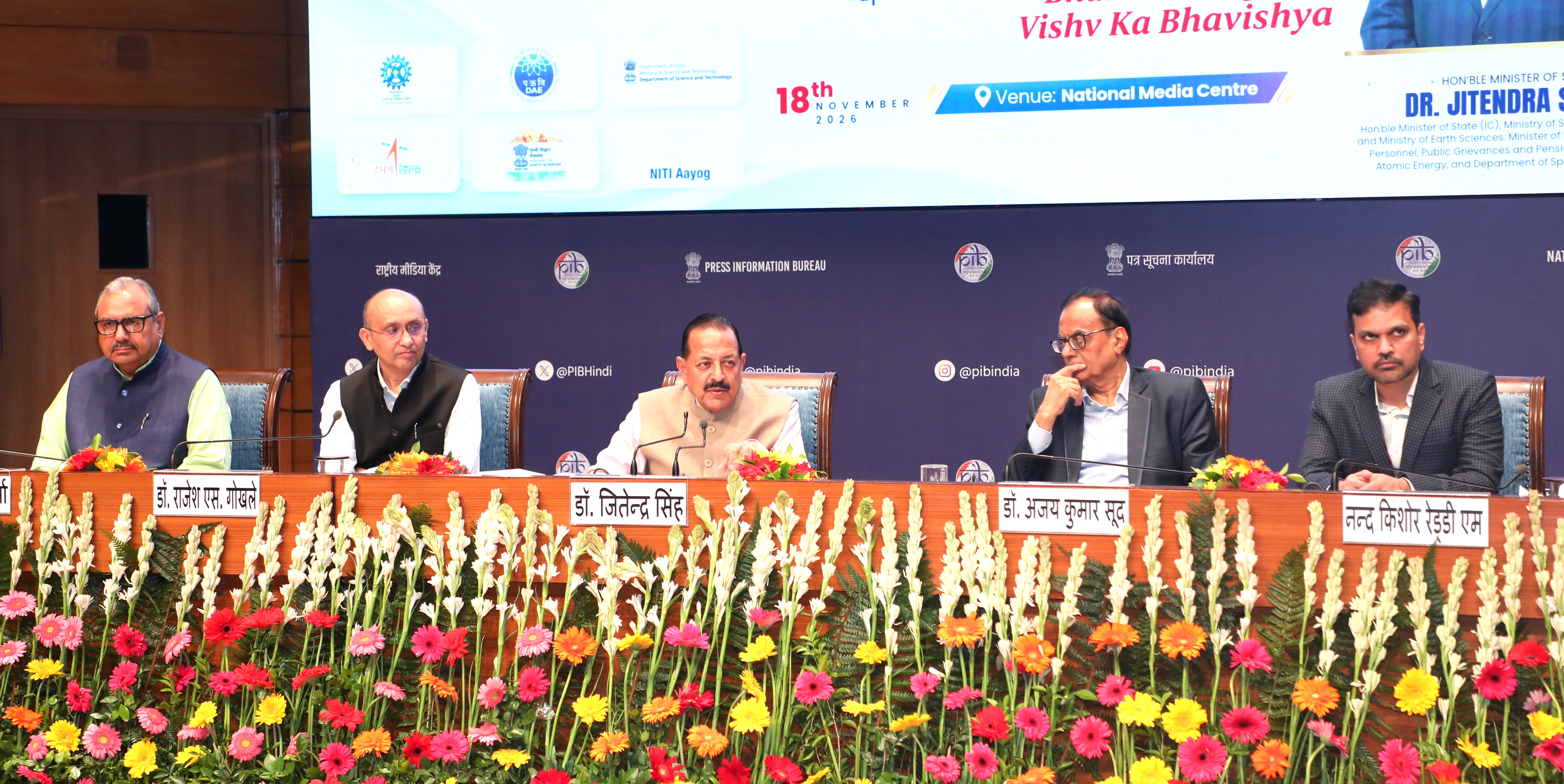
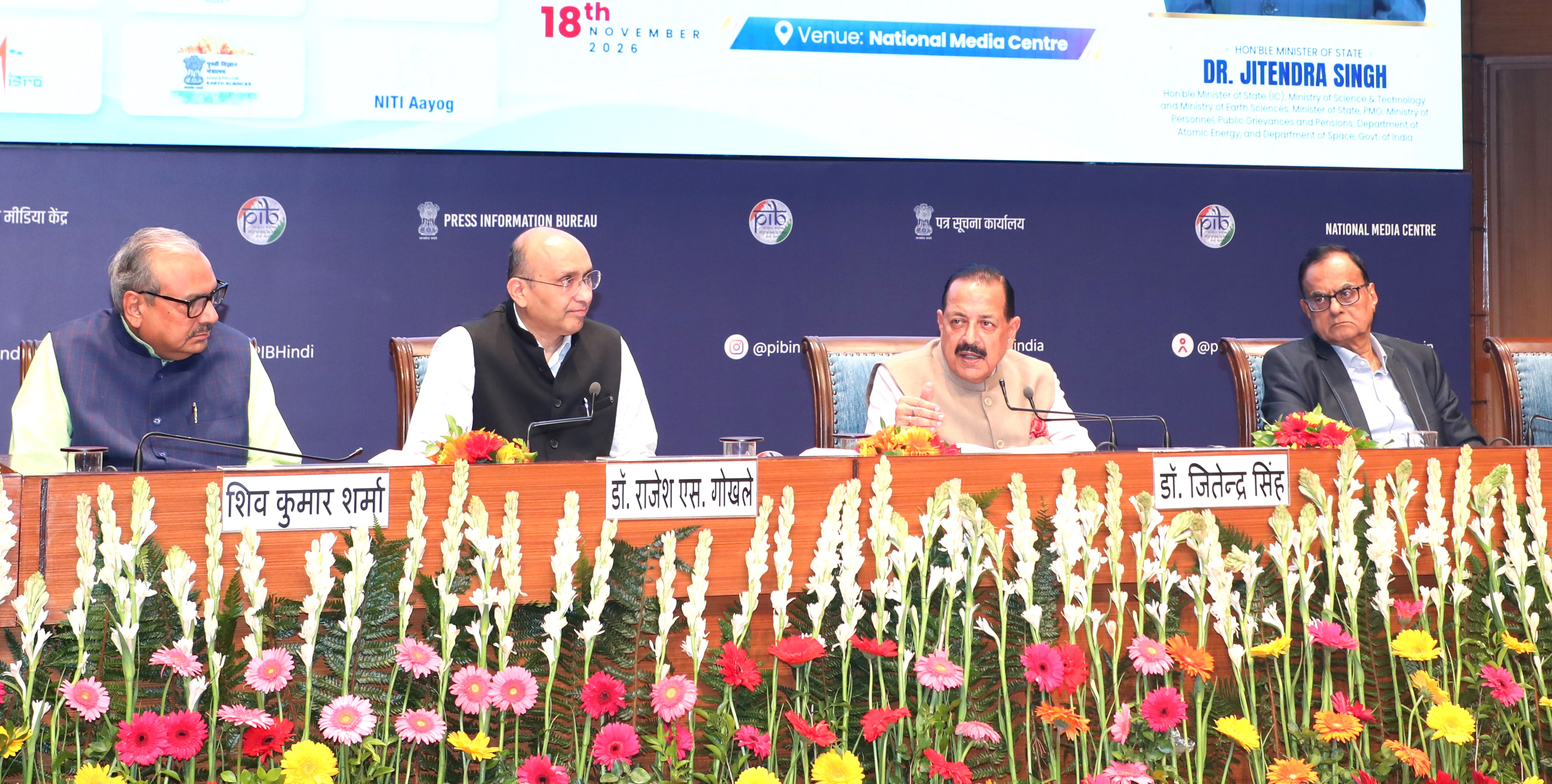
Union Minister of State (Independent Charge) for Science & Technology and Earth Sciences, and MoS PMO, Personnel, Public Grievances & Pensions, Atomic Energy and Space, Dr. Jitendra Singh today formally launched the Curtain Raiser for the 12th edition of the India International Science Festival (IISF) 2026, alongside unveiling the official festival website and brochure, at the National Media Centre in New Delhi.
Addressing the gathering, Dr. Jitendra Singh stated that IISF 2026, scheduled to be held in Pune from December 19 to 22 under the theme "India’s Science, World’s Future" (Bharat ka Vigyan, Vishwa ka Bhavishya), embodies Prime Minister Shri Narendra Modi’s vision of Vishwa Bandhu Bharat, where Indian scientific breakthroughs serve the welfare of the entire humankind. Explaining that the theme is already being translated into action rather than remaining a slogan, the Minister cited indigenous research kits developed by the Department of Biotechnology (DBT) and carried to the International Space Station (ISS) by Indian astronaut Shubhanshu Shukla, whose experimental outcomes will benefit the whole world. As India moves toward a frontline global position on the path to Viksit Bharat 2047, Dr. Jitendra Singh added, Indian science will increasingly shape the global scientific ecosystem.
The curtain raiser ceremony, organised by the Department of Biotechnology (DBT), Ministry of Science & Technology, in collaboration with Vijnana Bharati (VIBHA), was graced on the dais by Principal Scientific Adviser to the Government of India, Prof. Ajay Kumar Sood; Secretary, Department of Biotechnology, Dr. Rajesh S. Gokhale; and National Organising Secretary, Vijnana Bharati (VIBHA), Dr. Shiv Kumar Sharma.
Secretary, Department of Scientific and Industrial Research (DSIR) and Director General, CSIR, Dr. N. Kalaiselvi; Secretary, Department of Science and Technology (DST), Prof. Umesh V. Waghmare; Secretary, and Director, BRIC–National Centre for Cell Science (NCCS), Pune, Dr. Thomas Pucadyil, along with senior scientists, institutional directors, and officials from participating departments, also attended the event.
Speaking on the strategic transformation of India’s scientific engagements over the past few years, Dr. Jitendra Singh stated that the government took a conscious decision to replace scattered, repetitive gatherings, including the erstwhile Indian Science Congress, with two flagship national events carrying distinct identities. While the Emerging Science, Technology and Innovation Conclave (ESTIC), inaugurated annually by the Prime Minister in New Delhi with the participation of over 13 ministries and Nobel Laureates, serves as an academic-driven conclave exploring frontier themes, IISF brings a festive, public-facing character with international resonance. By rotating the venue to different regions, after Chandigarh, Hyderabad, Goa, and Delhi, bringing IISF for the first time to Pune leverages the western hub’s vibrant academic, research, and industrial ecosystem.
Dr. Jitendra Singh stated that IISF 2026 is designed to communicate complex, futuristic domains, ranging from gene editing, antibodies, and insulin production to next-generation energy sources and an immersive, larger-than-life walk-through 3D cell, in an engaging format tailored for diverse stakeholders. Beyond academic talks, including a special lecture by 2001 Nobel Laureate Sir Tim Hunt, the festival creates dedicated pathways for children, youth, women, existing and aspiring startups, entrepreneurs, and industry through B2B meetings, hackathons, and science safaris so young minds can discover their aptitudes and turn ideas into enterprises.
Commending Vijnana Bharati (VIBHA) and Dr. Shiv Kumar Sharma for championing a "whole-of-government, whole-of-science, whole-of-nation, and whole-of-society" approach, Dr. Jitendra Singh lauded VIBHA’s pivotal role in spearheading curtain raiser events across 13 cities, including Chennai, Kolkata, Dehradun, Thiruvananthapuram, Pune, Hyderabad, Bengaluru, Mumbai, Imphal, Indore, Mohali, and Ahmedabad, leading up to the Pune festival. He also urged media representatives to actively participate in and travel to Pune to carry India’s science story to every corner of the country.
Principal Scientific Adviser Prof. Ajay Kumar Sood described IISF 2026 as a unique celebration of science as a collective national endeavour aimed at bringing young people into the scientific fold and embedding scientific temper into public consciousness beyond research laboratories. Connecting the tagline Bharat ka Vigyan, Vishwa ka Bhavishya with India’s timeless philosophy of VasudhaivaKutumbakam, Prof. Sood stated that India has repeatedly demonstrated its willingness to share homegrown innovations at scale, from Vaccine Maitri to Digital Public Infrastructure (DPI), and expressed confidence that the energy of IISF 2026 will inspire youth to drive cutting-edge, people-centric innovations for Viksit Bharat.
In his welcome remarks, DBT Secretary Dr. Rajesh S. Gokhale stated that since its inception in 2015, IISF has belonged to the people, uniting curious students, inspiring teachers, small-town innovators, and farmers practising everyday soil engineering. Describing IISF at its core as a platform connecting Samaj, Sarkar, aur Bazaar (Society, Government, and Market) through science, where societal needs guide research, government empowers innovation, and markets convert discoveries into public goods, Dr. Gokhale informed that the 2026 edition brings together major science departments alongside the Department of Atomic Energy and NITI Aayog’s Atal Innovation Mission (AIM).
During the programme, BRIC–NCCS Director Dr. Thomas Pucadyil presented the detailed blueprint of IISF 2026, which will be held under the banner "One Nation, One Science Festival" across five closely located campuses in Pune: BRIC–National Centre for Cell Science (NCCS), CSIR–National Chemical Laboratory (NCL), Indian Institute of Science Education and Research (IISER) Pune, Indian Institute of Tropical Meteorology (IITM), and COEP Technological University.
Spanning 26 programmes across 17 working laboratory venues with the participation of seven Union Ministries and Departments and 16 national institutions, the four-day festival will feature a Global Summit on Biomanufacturing aligned with the BioE3 Policy, a Clinicians–Academia Conclave, "The New Nalanda" Science and Technology Village for 1,800 students and 200 teachers, a Student–Scientist Interaction Programme for 1,200 students, "The Gurukula" teachers' workshop, an eight-zone Science Safari, and a public Science–Technology–Defence–Space Expo showcasing Chandrayaan-3, Gaganyaan, INS Vikrant, Mission Shakti, and national missions in quantum, semiconductors, and deep ocean exploration.
Concluding with a strong policy and global outreach agenda, IISF 2026 will also host Vision Sansad for 150 institutional heads, a Science Diplomacy Conclave, a Global S&T Alliance spanning three continents, the National Social Organisations and Institutions Meet (NSOIM) with 150 NGOs, Nari Shakti, Vigyanika, and SHIV-DURG celebrating the engineering heritage of Maratha forts. The festival is expected to yield concrete national deliverables, including the Vision Sansad Declaration 2026, the NSOIM Declaration, an IISF 2026 Statement on Science Diplomacy with a bio-diplomacy roadmap, and a National Roadmap for Biomanufacturing, while identifying promising student innovations for mentoring and incubation.
***
NKR/AK