Posted On:
19 NOV 2026 3:38PM by PIB Delhi
The Department of Drinking Water & Sanitation (DDWS), Ministry of Jal Shakti, organised the 14th edition of the District Collectors’ Peyjal Samvad today through video conferencing, bringing together senior officials, District Collectors/ District Magistrates, and Mission Directors of State/UTs to deliberate on accelerating the implementation of Jal Jeevan Mission (JJM) 2.0 and sharing of best practices.
The Samvad was chaired Shri Kamal Kishore Soan, Additional Secretary & Mission Director, National Jal Jeevan Mission (NJJM). Senior Officers from DDWS and National Project Monitoring Units were also present.
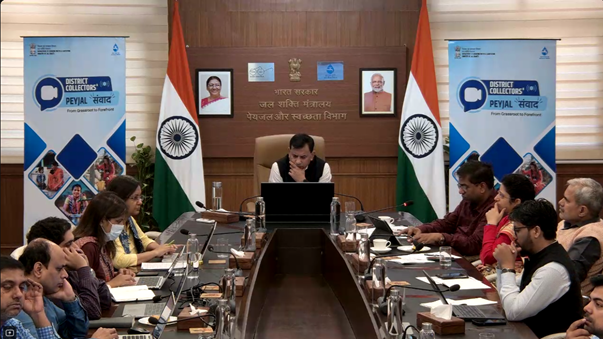
In his opening remarks, Shri Kamal Kishore Soan, AS&MD, NJJM, highlighted that the District Collectors' Peyjal Samvad has evolved into an important platform for sharing grassroots innovations and district-level experiences from across the country. He emphasised that the good practices presented during the Samvad are compiled and shared with key institutions, including the Prime Minister's Office, Cabinet Secretariat, NITI Aayog and other stakeholder ministries to facilitate wider replication and policy learning.
He urged District Collectors to ensure regular monthly meetings of District Water and Sanitation Committees (DWSCs), active use of the Decision Support System (DSS) for evidence-based planning, and review of gaps identified during the Jal Seva Aankalan through district-level improvement plans (DIP). He also called upon States and districts to leverage opportunities under the 16th Finance Commission, strengthen community participation and promote skill development through government institutions and setups like ITIs, RSETIs, SRLMs for sustaining rural water supply infrastructure created under Jal Jeevan Mission.
Ms. Pooja Bhatt, Director, NJJM, made a presentation on Skilling under Jal Jeevan Mission 2.0. Highlighting the employment potential emerging from the rural drinking water sector, she shared that studies have indicated significant opportunities for creation of skilled local workforces for operation and maintenance of water supply systems. She elaborated on the proposed framework involving Jal Jeevan Mitras, multi-skill technicians, diploma operators and supervisory personnel, supported by district-level technical units. She also highlighted the Sujalam Shakti initiative, which seeks to empower women to play a greater role in water quality surveillance, community mobilisation and protection of water assets.
The presentation also stressed the importance of strengthening local capacities through structured training programmes, convergence with government training institutions and refresher training for field-level personnel to ensure long-term sustainability of drinking water infrastructure.
Innovative Best Practices Shared by Districts Through Presentations
During the Peyjal Samvad, a total of four districts presented their progress and best field practices which will further help other State’s districts to develop better under JJM 2.0. Each presentation was delivered by the respective District Collector/ District Magistrate.
- Kangra Nagar, Himachal Pradesh – Sh. Hemraj Bairwa, Deputy Commissioner presented the district's efforts towards ensuring sustainable drinking water services in a geographically challenging Himalayan region. He informed that the district has achieved 100% coverage and also has made considerable progress in Har Ghar Jal certification, with certification processes continuing for the remaining villages. The presentation highlighted challenges arising from difficult terrain, scattered habitations, power constraints, ageing distribution systems, monsoon-related disruptions and operation and maintenance requirements. To address these challenges, Kangra has prioritised revival and augmentation of older schemes, strengthening of pumping systems, creation of additional storage infrastructure and implementation of source sustainability measures. The district also showcased its extensive water quality surveillance network and community engagement through VWSCs, training of women members, awareness campaigns. Preventive maintenance practices, grievance redressal systems and continuous capacity building of field-level stakeholders were highlighted as key pillars of the district's strategy.
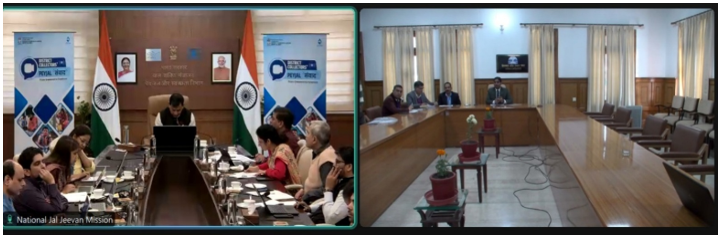
AS&MD, NJJM emphasised the need for strengthening user charge collection mechanisms and ensuring long-term source sustainability. He suggested that Himachal Pradesh may study successful inter-departmental convergence models adopted in Uttarakhand for addressing source sustainability challenges in hilly regions. He also encouraged greater use of the Decision Support System for planning and monitoring interventions.
- Valsad, Gujarat - Sh. Nitin V. Sangwan, District Collector’s presentation focused on innovative approaches for strengthening operation and maintenance, tariff collection and skilling. He mentioned that the district has completed 100% Sujalam Bharat Ids and Sujal Gaon ID creation. The district highlighted its performance-based incentive mechanisms for Gram Panchayats, Self-Help Groups and operators, which have significantly improved user charge collection and strengthened financial sustainability of rural water supply systems. Valsad also shared experiences in promoting surface water-based drinking water systems, thereby reducing dependence on groundwater sources. The district demonstrated how targeted training programmes delivered through ITIs and vocational institutions have strengthened the technical capacities of water supply operators, Panchayats and community institutions. Community awareness programmes, regular water quality monitoring and innovative infrastructure mapping initiatives were also highlighted.
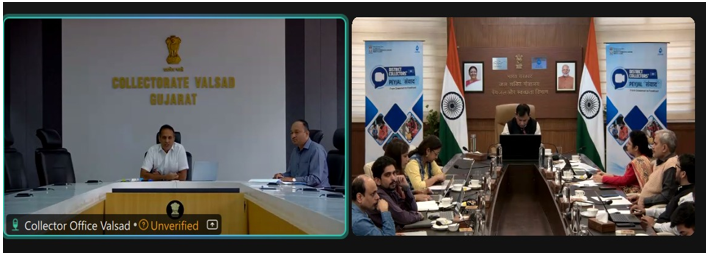
AS&MD, NJJM appreciated Gujarat's innovative approach towards tariff collection, skilling and operation and maintenance. He emphasised the importance of continuous training and refresher programmes for village-level workers and encouraged the State to facilitate exposure visits for other States interested in learning from Gujarat's approaches to skilling and community-based management.
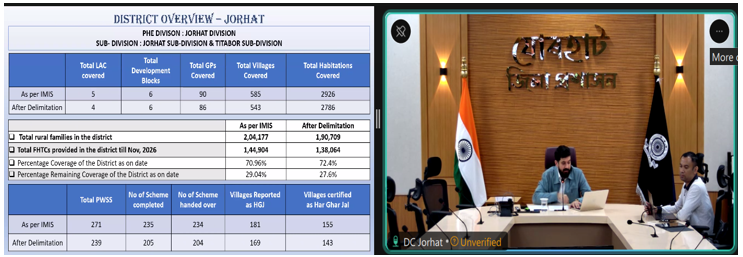
- Jorhat, Assam – Sh. Jay Shivani, Deputy Commissioner highlighted the district's efforts to achieve full functionality of water supply schemes, strengthen community ownership and pioneer 24x7 rural water supply systems in Assam. The district described its robust monitoring framework, decentralised O&M mechanisms and innovative practices for improving tariff collection. Jorhat reported significant progress in ensuring regular monitoring of schemes, timely repairs and strengthening the capacity of Panchayats and local institutions and also showcased innovative tariff collection models and strong community participation through Water User Committees, Jal Mitras and Jal Doots. These efforts have contributed to improving both functionality and financial sustainability of rural water supply systems. The district shared its experience of preparing communities, strengthening local institutions and adopting a phased approach before transitioning to continuous water supply. The district’s initiative has generated valuable learnings for scaling up 24x7 rural water supply across Assam.
AS&MD, NJJM congratulated Jorhat for pioneering 24x7 rural water supply in Assam and called upon other districts to learn from and replicate the district's best practices relating to functionality, operation and maintenance, tariff collection and community ownership. He also encouraged the district to progressively move towards saturation, beginning from villages and Gram Panchayats.
- Unakoti, Tripura – Ms. Megha Jain, District Magistrate and Commissioner presented the district's initiatives focused on Jan Bhagidari, source sustainability and strengthening drinking water service delivery in tribal and difficult terrain areas and highlighted the active involvement of Gram Panchayats, Self-Help Groups, School Water Clubs and local communities in promoting water conservation, water quality monitoring and community ownership of assets. The district also showcased convergence-based approaches for groundwater recharge, pond rejuvenation, greywater management and rainwater harvesting. Through close coordination among line departments, source sustainability measures are being integrated with drinking water service delivery interventions to ensure long-term water security. A notable example presented during the Samvad was the development of an innovative surface water-based drinking water scheme for habitations inhabited by the Reang community, a Particularly Vulnerable Tribal Group (PVTG). Through scientific source identification, community participation and local planning processes, the district has successfully addressed drinking water challenges in an area where groundwater-based solutions were technically unviable.
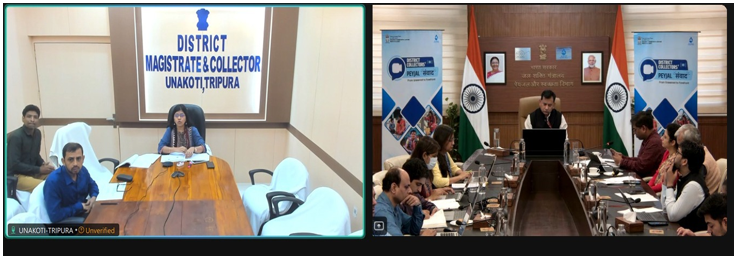
AS&MD, NJJM appreciated the district's emphasis on source sustainability, community ownership and convergence. He stressed the importance of post-monsoon water quality testing and directed all States and districts to ensure regular water quality surveillance to safeguard public health.
The deliberations during the 14th District Collectors' Peyjal Samvad demonstrated how districts across the country are adopting innovative and locally suited approaches to strengthen drinking water service delivery. The sharing of these experiences is expected to support wider replication of successful practices and further accelerate progress towards the vision of Har Ghar Jal and sustainable rural water supply across India.
***
TM/AK