Posted On:
21 NOV 2026 8:44PM by PIB Delhi
The second day of the First Shanghai Cooperation Organisation (SCO) Civilizational Dialogue Forum, being hosted by India in New Delhi from November 20 to 22, featured a series of sessions focusing on the cultural expressions of civilisations, shared heritage in art and architecture, and historical trade relations. The sessions brought together ministers, senior representatives, academicians, historians, and experts in art and culture from SCO member states and dialogue partner countries. The day-long deliberations explored various dimensions of cultural exchange, shared artistic traditions, and historical connections among different civilisations.
It may be recalled that Hon’ble Prime Minister Shri Narendra Modi inaugurated the Forum on November 20. The objective of the event is to strengthen cultural ties among SCO member states, promote mutual understanding and cooperation through shared civilizational heritage, and create new opportunities for cultural dialogue. The Indira Gandhi National Centre for the Arts (IGNCA) is the Knowledge Partner for the event.
Union Minister of Culture and Tourism Shri Gajendra Singh Shekhawat, while chairing the first and second joint sessions on the theme ‘Civilizational and Cultural Expressions’ on the second day, said that historical connections have played a significant role in bringing countries closer to one another. They have also effectively highlighted the immense potential of cultural cooperation in fostering mutual understanding, trust, and friendship.
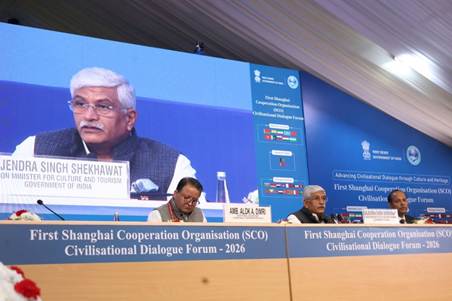
He said that today's deliberations are deeply rooted in the spirit of the eternal Vedic prayer referred to by the Hon’ble Prime Minister Shri Narendra Modi yesterday (November 20): “Om Sangachchhadhwam Samvadadhwam Sam Vo Manamsi Janatam.” This means, “Let us move together, deliberate together, and let our minds be in harmony with one another.”
He further observed that our civilisations are not merely legacies of the past but living traditions whose knowledge continues to illuminate our present and inspire future generations.
He emphasized that the shared civilizational knowledge and heritage should be harnessed to advance collective efforts through dialogue, institutional partnerships, cultural exchanges, and meaningful cooperation. He expressed confidence that the Forum would emerge as a lasting platform for fostering civilizational understanding, strengthening cultural ties, and deepening connections among the member states of the SCO.
Secretary, Ministry of Culture, Shri Vivek Agrawal, in his welcome address and introduction to the themes of the Forum, said that the SCO Civilizational Dialogue Forum provides member states with an important opportunity to understand their rich cultural heritage, historical connections, and shared civilizational values, while facilitating the exchange of ideas.
Pakistan’s Federal Minister for Climate Change and Environmental Coordination, Dr. Musaddiq Masood Malik, referring to archaeological remains from different periods discovered during excavations at Purana Qila, said that the fort in which the delegates were seated was, in itself, a story. Its foundation was laid by Humayun, who belonged to the Timurid dynasty and had arrived from Central Asia. Its construction was further carried forward by Sher Shah Suri, who came from Afghanistan. Thus, within a single wall, one could find the art of two different rulers, two cultural layers, and traces of two traditions. This, he said, was the very diversity that the delegates had been invited to celebrate. He appreciated the description of the event as ‘Tehzeeb Ki Guftagu’, or ‘Dialogue of Civilisations’.
He further stated that dialogue takes place amid diversity. Referring to his conversation with Shri Shekhawat the previous day, he said that the layers of history and culture had been an integral part of the region's way of life for thousands of years. It was therefore important to recognise that distinct identities have their own significance, while dialogue among diverse identities is equally essential. He said that the participants had gathered precisely for this purpose—to bring together multiple voices and identities and facilitate the free flow of ideas among them. He emphasised that wisdom and courage lie in acknowledging, respecting, embracing, and moving forward together with these diverse identities.
Shri Alok Dimri, Additional Secretary, Ministry of External Affairs, and National Coordinator for the Shanghai Cooperation Organisation (SCO), presented a summary of the discussions during the first session. Expressing his views from the perspective of the SCO, he said that it had clearly emerged that the organisation now needed to move beyond its security-centric approach. He observed that several common themes had emerged during the discussions, including cultural networks, climate, youth, digitalisation, and joint projects.
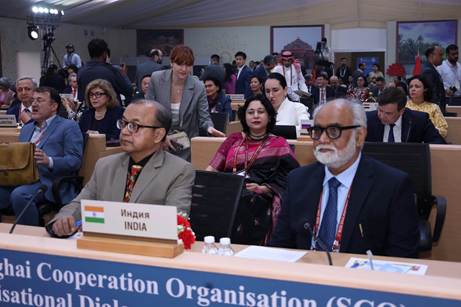
He further noted that the discussions had highlighted the need to take culture beyond the confines of the state and government institutions and bring it closer to the people. Undoubtedly, he said, the Forum was a powerful medium for connecting hearts and minds.
During the joint session, several dignitaries and representatives shared their perspectives, including Azerbaijan’s Minister of Culture, Mr. Adil Karimli; Nepal’s Minister for Culture, Tourism and Civil Aviation, Mr. Khadga Raj Poudel (Ganesh); Pakistan’s Federal Minister for Climate Change and Environmental Coordination, Dr. Musaddiq Masood Malik; and Tajikistan’s Minister of Culture, Ms. Matlubakhon Amonzoda Sattoriyon. Representatives from Belarus, Iran, Kazakhstan, Cambodia, Kyrgyzstan, Laos, Russia, Saudi Arabia, Uzbekistan, and other countries also participated.
In the subsequent session, scholars and experts from India and other countries shared their perspectives on the historical and cultural connections among civilisations. The speakers included Prof. Chandrashekhar from the Department of Persian, University of Delhi; Prof. Srikanth Kondapalli from Jawaharlal Nehru University; Indologist Shri Megh Kalyanasundaram; Dr. Sanjeev Kumar, Senior Research Fellow at the Indian Council of World Affairs (ICWA); and Prof. Puneet Gaur from Jawaharlal Nehru University.
The third session, held in the afternoon, focused on ‘Art and Architecture Across Civilisations: Shared Aesthetics’. Titled ‘A Shared Cultural Canvas: Artistic and Architectural Exchanges Among SCO Nations’, the session explored the interconnections between the artistic traditions, architectural styles, and cultural influences of different countries.
The session was chaired by Shri Yadubir Singh Rawat, Director General, Archaeological Survey of India (ASI), and moderated by Dr. Sanjay Kumar Manjul, Additional Director General, ASI. Her Excellency Ms. Sadat Yusifova, Deputy Minister of Culture of Azerbaijan, attended as the Special Speaker.
The fourth session of the day also focused on ‘Art and Architecture Across Civilisations: Shared Aesthetics’. Its special sub-theme was ‘Trade: Merchants, Monks and Monarchs – Diverging Networks to Converging Cultures’. The session was chaired by Shri Yadubir Singh Rawat, Director General, ASI, and moderated by Shri Jhanvi Sharma, Additional Director General, ASI.
The session deliberated on historical connections that developed between different regions through trade routes, travellers, Buddhist monks, and rulers, as well as their cultural impact. Representatives from various countries also shared their perspectives.
Thereafter, participants visited the exhibition ‘The Light and the Lotus: Relics of the Awakened One’ at the Rai Pithora Cultural Complex in New Delhi. The day's programme concluded with a cultural performance, followed by an official dinner hosted by the Secretary, Ministry of Culture, Government of India.
The second day of the First SCO Civilizational Dialogue Forum proved significant in exploring the shared cultural heritage, art, architecture, historical connections, and common civilizational values of different countries, while identifying new avenues for cooperation.
*****
M. Annadurai