Posted On:
25 NOV 2026 3:53PM by PIB Delhi
A novel antivenom specifically effective against the venom of two particular pit vipers common in the North Eastern states can help improve treatment for snake bites common in these areas. and Meghalaya states in order to close this gap in snakebite treatment.
Northeast India is home to a wide variety of venomous snakes, making snakebite a major public health concern. However, India's "Big Four" snakes—Russell's viper, spectacled cobra, common krait, and saw-scaled viper—are the main targets of commercially marketed antivenom. The effectiveness of this polyvalent antivenom against a number of medically significant venomous snakes in Northeast India has been shown to be limited.
Snake bites from pit vipers—the Pope's pit viper (Trimeresurus popeiorum) and the red-tailed bamboo pit viper (Trimeresurus erythrurus) found in the North Eastern states are a common medical emergency in these areas. Snakebite is regarded as a neglected tropical disease and a medical emergency by the World Health Organization (WHO). The absence of antivenoms that can effective against venoms of these specific snakes leads to the the antivenom crisis in Northeast India, according to a recent study.
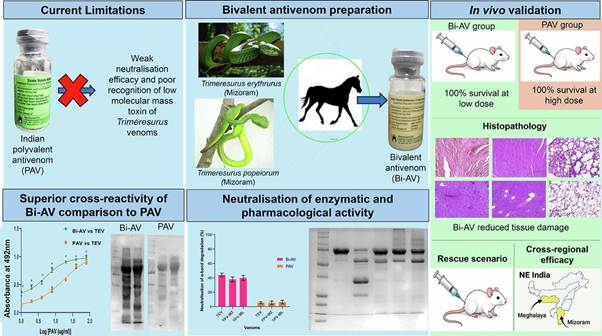
Fig: A schematic diagram depicting the superior neutralizing activity of Bi-AV compared to Indian PAV against pit vipers from North-east India.
A research team led by Prof. Ashis K. Mukherjee, Director of the Institute of Advanced Study in Science and Technology (IASST), Guwahati, an Autonomous Institute of the Department of Science and Technology (DST) has created a novel equine F(ab)2 bivalent antivenom that is specifically effective against the venom of T. erythrurus and T. popeiorum that were collected from Mizoram and Meghalaya states in order to close this gap in snakebite treatment.
Researchers from IASST, Guwahati, Premium Serums and Vaccines Pvt. Ltd., Pune, Amrita Research Center Delhi-NCR, Mizoram University, and Aaranyak, Guwahati, collaborated on the project to demonstrate academic-industry cooperation.
In laboratory and preclinical investigations, the novel bivalent antivenom showed noticeably superior protection against pit viper envenomation of the NE region as compared to Indian polyvalent antivenom (Figure 1). Pit viper envenomation is characterized by disruptions in blood coagulation and injury to local and organ tissue, both of which are significantly reduced by the novel antivenom.
Prof. Mukherjee, who led the research stated that additional clinical and regulatory testing will be necessary before this novel antivenom is routinely used on patients and he is hopeful about it. The study published in the International Journal of Biological Macromolecules emphasizes the significance of creating region-specific antivenoms based on the snakes that cause severe envenomation in various regions of India, especially in Northeast India, where a number of medically significant species do not fit into the conventional "Big Four" paradigm.
Publication Link: 10.1016/j.ijbiomac.2026.154578
****
NKR/FT/AA