Posted On:
25 NOV 2026 4:30PM by PIB Delhi
Mr Raja’s (name changed) journey highlights the importance of identifying and formally profiling sanitation workers and facilitating opportunities that promote dignified employment.
Through the NAMASTE Scheme, efforts are being made to move sanitation work towards mechanisation, safety, formalisation and improved livelihood opportunities for workers.
For many workers engaged in sewer and septic tank cleaning, informal employment arrangements often mean uncertain income, hazardous working conditions and limited access to occupational safety or formal recognition.
For Raja, a 27-year-old graduate from Manipur, securing dignified and stable employment marked an important step towards greater financial security and professional recognition.
Despite completing his graduation, Raja had been working in informal sewer and septic tank cleaning under contractor-based arrangements. His work was characterised by irregular earnings, limited occupational safety measures and the absence of formal employment benefits. With his household dependent on uncertain income, the lack of employment stability posed continuing challenges.
The National Action for Mechanised Sanitation Ecosystem (NAMASTE) Scheme seeks to formalise and improve the working conditions of Sewer and Septic Tank Workers (SSWs) by facilitating their identification, profiling and access to support and opportunities.
Through formal profiling under the NAMASTE Scheme, Raja was recognised as a Sewer and Septic Tank Worker, helping facilitate an opportunity for institutional employment.
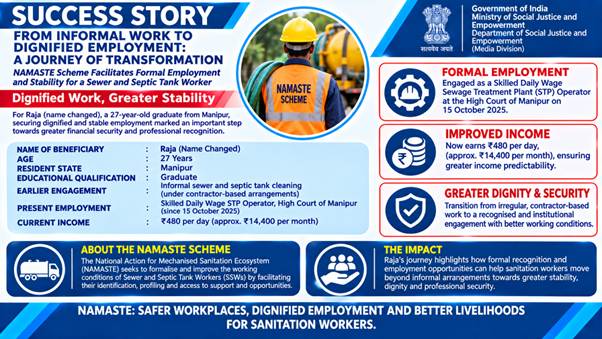
On October 15, 2025, Raja was engaged as a Skilled Daily Wage Sewage Treatment Plant (STP) Operator at the High Court of Manipur. The employment opportunity provided him with a more predictable source of income and improved recognition of his work and skills.
He now earns ₹480 per day, amounting to approximately ₹14,400 per month. The transition from irregular contractor-based work to a formal institutional engagement has brought greater income predictability and improved employment conditions, helping him work towards long-term financial stability.
His experience reflects how formal recognition and employment opportunities can help sanitation workers move beyond informal arrangements towards greater stability, dignity and professional security.
*****
SS-196-TAR/KV/GA/RK