Ministry of Personnel, Public Grievances & Pensions
Posted On:
27 NOV 2026 5:29PM by PIB Delhi
Union Minister of State (Independent Charge) for Science & Technology and Earth Sciences, and MoS PMO, Personnel, Public Grievances and Pensions, Atomic Energy and Space, Dr. Jitendra Singh, today called upon States and Union Territories to strengthen administrative reforms, promote inter-state collaboration and build a responsive, "role-based", technology-driven and citizen-centric governance ecosystem.
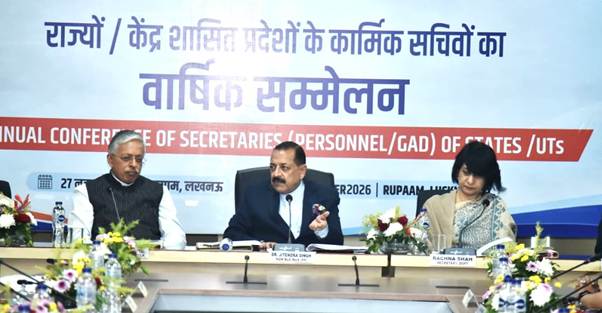
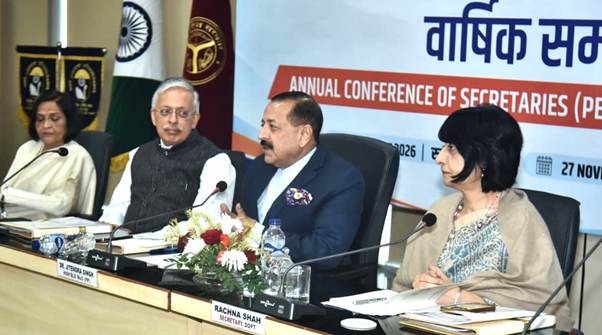
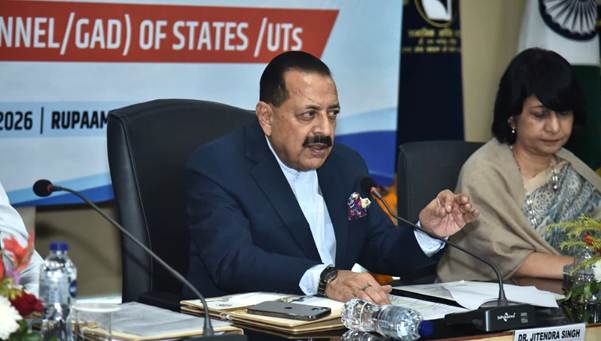
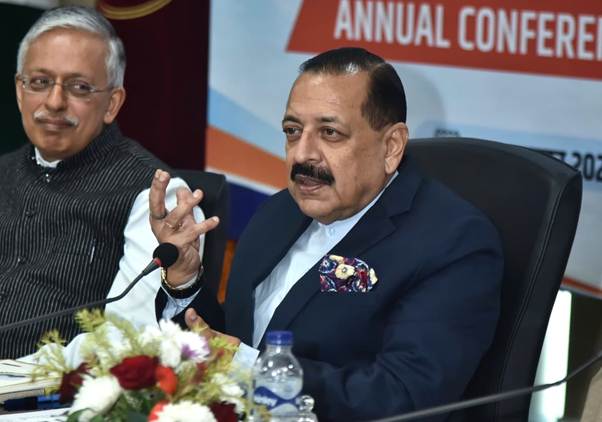
Addressing the Annual Conference of Secretaries (Personnel/GAD) of States and Union Territories at Lucknow, he said that the evolving governance landscape requires administrators to move beyond conventional rule-based functioning towards a role-oriented approach, with greater emphasis on institutional capacity, professional competence, ethical conduct and responsiveness to citizens.
The conference, organised by the Department of Personnel and Training (DoPT), brought together Secretaries (Personnel/GAD) and senior administrative officers from various States and Union Territories to deliberate on administrative reforms, personnel management, capacity building and the exchange of successful governance practices. Chief Secretary of Uttar Pradesh Shashi Prakash Goyal; Secretary, DoPT, Rachna Shah; Secretary, Department of Administrative Reforms and Public Grievances (DARPG), Nivedita Shukla Verma, and other senior officers and representatives from States and UTs participated in the conference.
Dr. Jitendra Singh also conveyed his appreciation to Uttar Pradesh Chief Minister Yogi Adityanath and the State administration for their continued cooperation in hosting national-level administrative and capacity-building programmes in the State.
During the Conference Dr. Jitendra Singh said that the Government has consistently encouraged the practice of taking national-level conferences and governance-related deliberations beyond Delhi to different regions of the country. Recalling initiatives undertaken across the States, he said that the objective was to ensure wider administrative outreach, strengthen a sense of participation among officers and provide opportunities for direct interaction between Central and State administrations.
He cited the example of organising a North-Eastern regional conference in Itanagar instead of limiting it to Guwahati, as well as taking governance conferences to locations such as Leh and Katra. Such initiatives, he said, have helped senior Central Government officers establish direct engagement with State administrations and understand regional governance challenges more closely.
The Minister said that the approach has also strengthened the exchange of best practices between the Centre and States. Referring to the District Governance Index developed through DARPG, he appreciated Uttar Pradesh for being among the early States to adopt the initiative. He said that successful models developed at the national level should be adapted by States, while effective State-level practices should also find wider application across the country.
Referring to the governance approach adopted since 2014 under Prime Minister Narendra Modi, Dr. Jitendra Singh said the focus has been on removing outdated rules and procedures rather than merely introducing new regulations. He cited the introduction of self-attestation in place of the requirement for gazetted officers to attest documents, describing it as an important expression of the Government's trust in the youth of the country.
He also referred to the discontinuation of interviews for recruitment to several lower-level government posts and various legislative and administrative changes in the pension system. Explaining the broader approach towards pensioners' welfare, he said that reforms have extended beyond pension disbursement to address the changing needs and circumstances of beneficiaries.
The Minister cited amendments enabling separated daughters to receive family pension and allowing women employees to nominate their children, rather than being restricted to their spouse, as nominees for family pension. These changes, he said, reflect the Government's effort to make administrative provisions more sensitive to contemporary social realities.
Dr. Jitendra Singh said that the challenge before administration is not merely to frame rules and regulations but also to build strong institutions, nurture talent and create an ecosystem that is friendly and responsive to citizens.
The Minister said that today's administrators must be continuous learners, professionally competent, technology-savvy, ethically grounded and responsive to public expectations. Citizens increasingly assess the functioning of government through their everyday experiences, including the growing role of social media, making accountability and public responsiveness essential attributes of administration.
He placed particular emphasis on communication skills, describing them as especially important for administrators. He said civil servants must be equipped to communicate effectively with three important stakeholders: the general public, the media and elected representatives, including Ministers, Members of Parliament and Members of Legislative Assemblies.
Dr. Jitendra Singh said administrators must be able to engage constructively with citizens, including those raising grievances or participating in protests, while also maintaining effective communication with the media and responding appropriately to public representatives. He added that administrative training curricula must evolve accordingly, incorporating science, technology, communication and exposure to contemporary governance practices alongside traditional academic disciplines.
The Minister also invited State representatives to deliberate on personnel-related challenges, particularly central deputation and timely cadre reviews. He explained that central deputation provides officers with wider administrative exposure and professional opportunities, while also helping them remain prepared for changing responsibilities across different levels of government.
He said that delays in cadre reviews, sometimes extending over several years, can create administrative complications and affect career progression. States should therefore address such issues in a timely manner and develop constructive mechanisms to manage the administrative and institutional considerations involved.
The Minister also proposed reviving the concept of pairing States facing similar governance challenges to facilitate the exchange of solutions and successful practices.
Referring to technology-led administrative reforms, Dr. Jitendra Singh cited the Centralised Public Grievance Redress and Monitoring System (CPGRAMS) and Digital Life Certificate initiatives as successful practices that have attracted international interest. He also referred to the Public Examinations (Prevention of Unfair Means) Act and technology-driven examination procedures adopted by the Staff Selection Commission, where the elimination of unnecessary human interface has helped strengthen transparency and minimise the scope for malpractice.
The Minister further shared examples of employee-friendly workplace initiatives in Central Government offices, including gym facilities and crèches, and encouraged States to adopt suitable practices from the private sector to improve workplace efficiency and employee welfare.
Concluding his address, Dr. Jitendra Singh encouraged the participating officers to share their experiences, suggestions and State-specific challenges so that successful initiatives could be replicated and administrative bottlenecks addressed through collective deliberation. He said that sustained cooperation between the Centre and States, supported by innovation, institutional strengthening and citizen-centric governance, would be essential to building a more responsive and efficient public administration.
*****
SG/AK